

Like all great art, Samuel Beckett's works find a way to speak to you as an individual, stretching from page to stage and on, on, on into our psyches. This happens not through sentimental manipulation or cheap sensationalism, but through the accrual of impressions, the gathering of memories, the painstaking construction of meaning. Rarely far from view on the London stage, Beckett has two seminal one acts on view briefly in London before touring to Bath.
Upon hearing the shoes of May (Charlotte Emmerson) in his 1976 Footfalls pace out the nine steps back and forth as we learn of the relationship between a daughter and her mother for whom she cares, I was sent back to my great aunt's home almost 50 years ago. What loomed largest in my child's mind then (and what I had not thought about since) was the sound of the many clocks in the small terraced house: pendulums that swung back and forth, ticking and tocking loud in the darkened quiet spaces, the punctuation of a cuckoo plaintively marking the passage of another hour. I didn’t know I could recall such detail - until, prompted by this play, I did.
 This kind of experience seldom happens in theatre - it’s more likely to come when contemplating a painting in a gallery, with a certain smell or taste in a Proustian rush or with music, a song or simply a melody that transports. But it’s arguable that Beckett isn't "theatre" at all - more performance art or recital that takes place in a theatre under the constraints of theatrical convention.
But, just as time seems to slide back and forth dissolving its usual power, we get a gathering sense of place. The director, Richard Beecham, understands this, trapping May in a narrow oblong marked on the floor and us, underground in Jermyn Street, cramped for room with nothing else to look at, guiltily sipping a glass of wine. Were we in a gallery, we would not be trapped, the soundscape would roll over and round us, the decision on whether to continue our participation entirely our own. In the theatre, and this theatre more than most, you’re in it for the duration.
There’s no real story provided by the playwright in Footfalls, more a set of uneasy hints that infect your thoughts. In that sense, the job of the storyteller is displaced to us, aware as we are (and as, with a smart watch we are told) that we have only so many paces in our lives and we must decide how to use them. This is true whether trapped by our neuroses, as is May, or not.
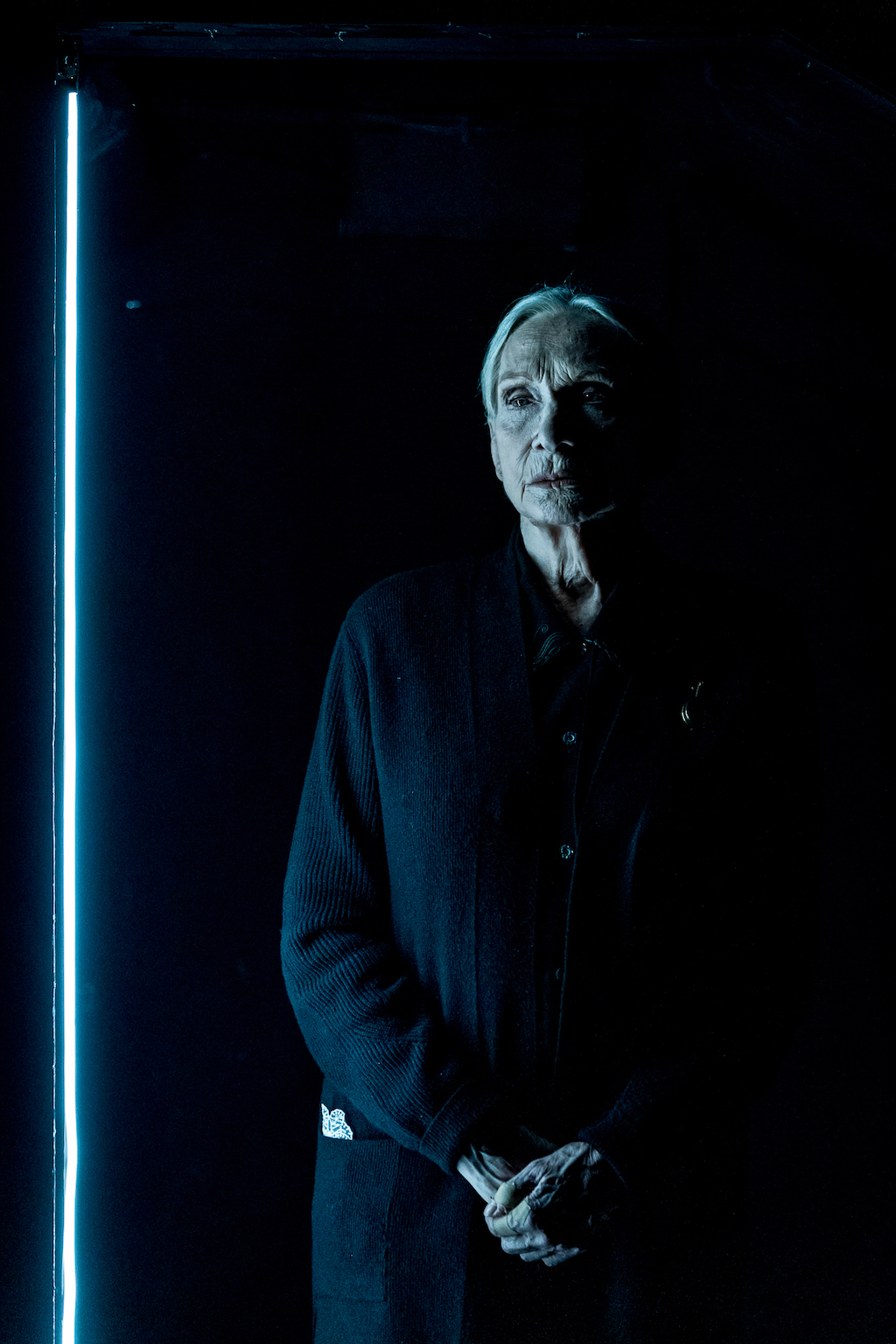
We had already heard Siân Phillips (pictured above), who surely possesses one of the great voices of stage and screen, but her face is an even more powerful instrument. It appears first halved by the lighting and pauses, a half-face in the half-light, a thing of wondrous beauty, weathered by years of accumulated wisdom. It is an electrifying moment.
Rockaby, premiered in 1981 by the great Billie Whitelaw, finds the speaker seated in a rocking chair describing her loneliness, her awareness of her imminent fate, her ever-hastening slide out of this world into the void beyond. We hear resistance too, but it’s too thin a thing, the rocking losing its cadence, the eyes closing.
Samuel Beckett isn’t for everyone, these two works typically driven by poetry rather than the conventions of character and plot. But it’s powerful, affecting stuff, particularly when directed with such an ascetic aesthetic and with such arresting sounds and visuals as we are blessed with in this brief, deep, distressing confinement.
- Footfalls and Rockaby are at the Jermyn Street Theatre until 20 November and at the Theatre Royal Bath from 24 November to 4 December
- More theatre reviews on theartsdesk











