

In 2020, during a gentle easing of lockdown restrictions, I was asked to play for the Culture Clinic sessions at Kings Place, a creative initiative where small groups of up to six people could book a ticket for a private, personally tailored performance. After speaking together briefly, I would then prescribe and perform music I felt they needed to hear.
One concert-goer described my role as "Physician of the soul", a job title I like the sound of, and a way to use music that feels meaningful. I’ve been thinking about this format since and how different it was from performing to a large audience. The earliest and fundamental use of music was to heal and deeply connect us. Is it possible that, as musicians, we’ve moved too far from music’s original purpose?
When we meditate with an intention of creating a bond, our brains' wave patterns sync up, even if in separate roomsThe "Performer Archetype" is not an extrovert as we might presume, but a person who strives to create magical moments. Music by its nature can be a pathway to better listening and attention – engaging our entire body, our emotions, empathy and leading to heightened awareness. Our modern-day malaise is that of internal suffering – loneliness, addiction, anxiety and depression. Music, sound and silence have the power to take us out of ourselves.
I founded the classical concert experience Lie down and Listen to create a relaxed and deep listening environment, where we can connect with each other and to a higher consciousness through meditation and classical music. It’s proven that when we meditate with an intention of creating a bond, our brains' wave patterns sync up, even if in separate rooms. While meditation, yoga and chanting might not resonate with everyone, music is a part of everyone’s lives and I see us moving into a new era – a hybrid of music and wellness – a new industry creating space for deep and transformational listening.
As author and journalist Kate Murphy points out, “We have two ears and one mouth for a reason.” Rituals and spiritual practises have a lot in common with concerts. "Concert" means to work together "in concert" and "yoga" translates as "union". The classical concert ritual evolved through the 18th and 19th century and we more or less have maintained it. Music therapy emerged as a treatment after the Second World War to help veterans cope with trauma, but strangely kept very separate from the concert tradition. Although, in my family, the story goes that whenever my great grandfather was ill, he didn’t go to the doctors, but instead to the opera. 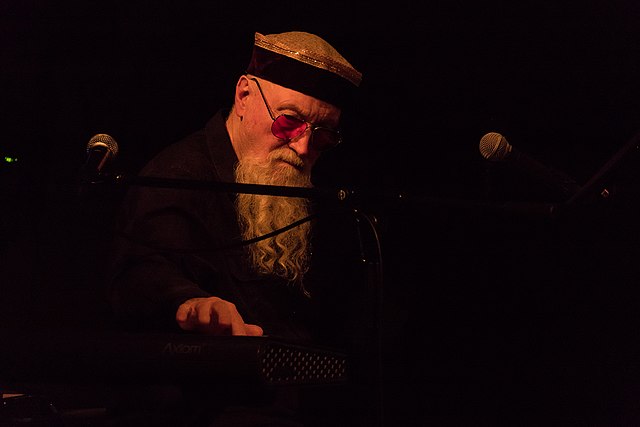 Much contemporary music can provide insight for transformational listening. The work of minimalist composers such as Terry Riley (pictured above), La Monte Young and Steve Reich can take us into trance-like states. For this reason they were known as the "New York Hypnotic School". The "chant or mantra-like" rhythmic and repetitive patterns are similar to the earliest form of yoga, Nāda yoga. Terry Riley uses mantra-like motifs as the basis for his "Keyboard Study No. 2" to create a type of musical mantra meditation, where the performer decides which mantra to use and how many times to repeat it. John Cage was a practising Buddhist who questioned silence and the perception of time; his piano piece "In a Landscape" guides us into a spiritual milieu of delicate gongs and Tibetan bells, shifting our perspective of the pianos sound.
Composer and mystic Dane Rudyar believed that “within a single tone you can find the secret of being”, and Giacinto Scelsi similarly found that repeating a single note opened up an awareness of the entire universe. In Erik Satie’s deceptively simple "furniture music", he asks performers to “seek within yourself” or to play “as if in the tip of one’s tongue”. These, amongst other unusual performance directions, are both a mark of Satie’s eccentric character, and of someone who is challenging us to pay attention. Similarly, Arvo Pärt’s seemingly simple "Für Alina" is "about" the resonances between the notes. As in life, when we become more perceptive, inspiration can reveal itself.











