

It feels like a decade, but only two and a bit years have passed since Steven Isserlis stepped out in front of a small but very much live audience at what was then the Fidelio Orchestra Cafe in July 2020. Three hundred or so Fidelio events later, he’s back, and much as he clearly loves the place, he loves the French repertoire he’s been playing with violinist Irène Duval and pianist Alasdair Beatson even more.
I’m with Isserlis on Ravel’s Sonata for Violin and Cello being the greatest masterpiece ever composed for that combination – I’d go even further and say for any meeting of two stringed instruments. And I doubt if anyone was going to deny his massive claims for Fauré’s late Piano Trio after the equally rapturous performance.
First, though, in the first of his always entertaining introductions, three hates had to be cited – liver, bad reviews and learning new pieces. One he’d just mastered with Beatson was Lalo’s early (1856) Cello Sonata, and there were positives here not only for the work itself – he prefers it to the concertos, not sure I’d go that far – but also for the extraordinary online library of works out of copyright, IMSLP Petrucci (it’s free to use, but I recommend a donation to keep it going). Cellist and pianist had found the metronome marking for the central movement absurdly slow, but found an edition on Petrucci giving an indication which made it two or three times faster, so we could set to our meals after the concert much sooner. 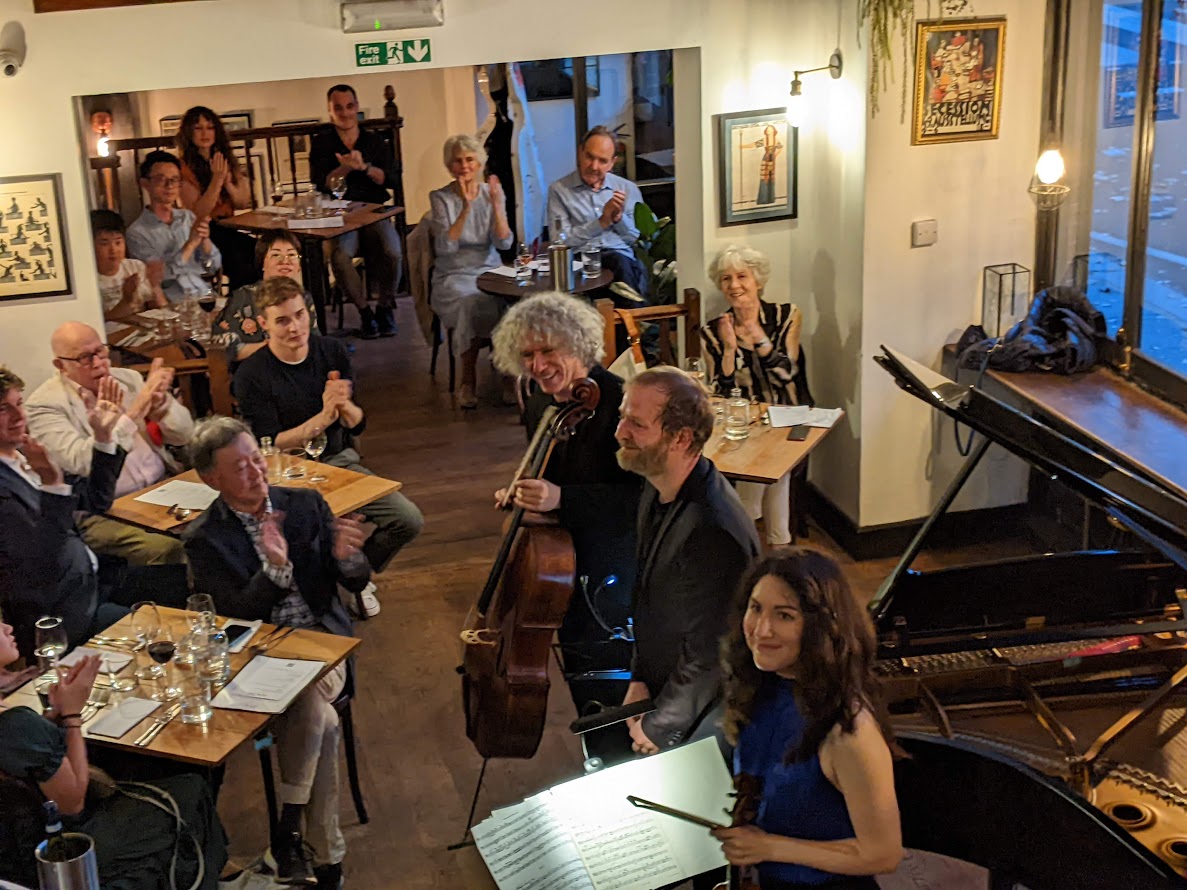 Many of the themes, however gilded here, sounded generic for their time, but Lalo can’t resist a rather French quirk of letting the piano lighten the finale’s rodomantade with an intermezzo-like charmer; Beatson handled it deliciously. And the finesse of the finishes in the first two movements was very much an Isserlis hallmark.
How much more of an impact they have in the first and third movements of Ravel’s genius duo sonata. From the start, with the cello meshing on the high wire with the violin, this was a riveting performance. I first encountered Duval earlier this year in a concert for Ukraine conducted by the Estonian Andres Kaljuste. She made very charming work of Mozart’s A major Violin Concerto, while Isserlis – who would have been in Odesa on the night of the fundraiser – brought extraordinary inwardness to Haydn’s C major Cello Concerto. This was the first time I’ve heard them play together, and it’s the highest compliment that Duval could sometimes draw focus from the most charismatic of cellists. The “vif” (lively) movements were on the right, fantastical kind of edge, while the “Lent” scoured the soul before retreating to its original memorial tone.
Fauré’s slow movement in his D minor Piano Trio, an astonishing, in-love-with-the-world feat from the outwardly frail end of his life, goes even further. As the violin and cello unisons grew ever more ecstatic, Isserlis seemed to be in another world, and then we were there too, without knowing how it had happened. The elusive harmonic journeys which make the composer unique among the late-romantics were effortlessly charted by Beatson; the uplift at the end was total. And then we had the perfect “good night” of an encore from, as Isserlis put it, the only German composer who could follow these French masters – Schumann’s “Duett” from his Op, 88 Fantasiestücke. All this, and the unbelievable good fortune of being a couple of metres away from these remarkable artists,, along with others in a star-studded audience: that’s the magic of the Fidelio Cafe











