

It’s particularly poignant to watch this story in the knowledge that a little over a year after US-led troops withdrew from Afghanistan, women and girls are enduring a renewed repression of their rights under the Taliban. The real-life story of The Boy with Two Hearts took place in 2000 – the year before the western invasion began; to see it today is a depressing reminder of how little was achieved through that ill-thought-out venture.
Though the focus of the story is on Hussein – the older brother of narrator Hamed – the dramatic backdrop is the entire family’s forced flight from Afghanistan after the mother delivers a public speech calling for women’s liberation. When the Taliban makes it clear that her life is in danger as a result, the family are forced to sell all their possessions to raise money so they can pay traffickers to spirit them across Europe.
How do you translate this into a piece of theatre that’s as compelling as the story on which it’s based? Hamed Amiri, the middle sibling of the family, wrote a book that was published to huge acclaim from those who were bowled over by a narrative that was as touchingly humorous as it was eloquently direct about the traumas he’d endured.
This theatrical version – adapted by Phil Porter from a version of the book by Hamed and his younger brother Hessam – premiered to favourable reviews at the Wales Millennium Centre in Cardiff. In Amit Sharma’s vivid production we’re welcomed into the gently chaotic Amiri family home, where the dad, Mohammed, is known for his, well, dad-jokes, the mother, Fariba (pictured below, right) is a political firebrand, and the boys are obsessed by American movies and football.
There are great virtues to the simplicity of the narrative. Yet the longer the story goes on the more details you find yourself wanting to know. Hamed was 10 years old when his family was suddenly forced into exile, and the predominant sense here is of a story told primarily so that people of his age group can understand it. There’s a gentle pleasure to watching the teasing chemistry between the brothers, yet for extraordinary dramatic events – such as their father’s arrest and torture by the Taliban – there’s little sense of what’s at stake.
The central theme to the story – of Hussein’s heart problems – is tackled with sensitivity. Just as there’s little sense that his family sees themselves as victims because of the escape they are forced to undertake, we never primarily see Hussein (Ahmad Sakhi) as a patient. In the book, Hamed makes it clear that this is how he himself dealt with his medical condition; admirably he wanted to get on with a normal life and refused to be treated with pity.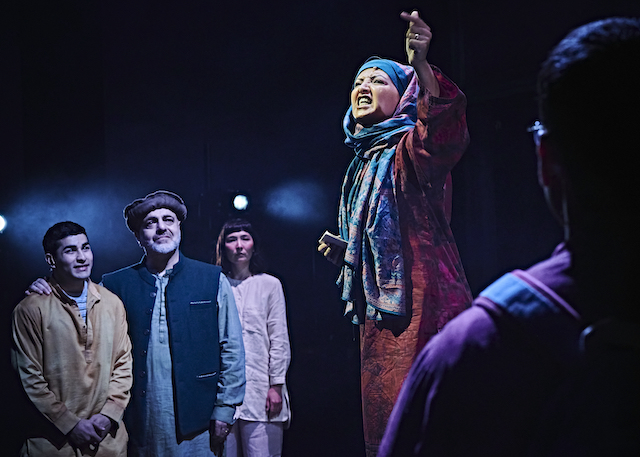 Hayley Grindle’s set neatly conveys the shifting environments that the family encounter, whether it’s their Herat home, the car boot in which they’re first smuggled out of Afghanistan, or the dreaded Sangatte refugee camp in France. It initially appears as a simple bungalow structure with one main room; as the action progresses hidden compartments and simple projections (in which objects are often playfully depicted by words) give us a sense of how their world is changing.
There’s a nice chemistry between the cast; the relationship between Fariba (Houda Echouafni) and Mohammed (Dana Haqjoo) is credible and heartwarming, while Hessam (Shamail Ali), Hamed (Farshid Rokey) and Hussein (Ahmad Sakhi) make for a congenial trio. But I wanted to know so much more; about the fraught logistics needed to make their epic journey possible, and indeed about how Hussein himself felt about his frightening medical condition.
You leave the theatre feeling nothing but respect for those forced to live this story. Yet this theatrical retelling feels frustratingly underpowered and sadly overshadowed by the new stories emerging daily from a country that once more has proved that, for better or worse, it will always be a law unto itself.











