

A man in modern garb reads a tabloid newspaper and makes smarmy wisecracks about the malaise of contemporary Britain – strikes, NHS waiting lists and the rest of it. But hang on a minute: isn’t this meant to be a period drama?
Lulu Raczka’s new play at the Almeida, directed by Rupert Goold, declares its fundamental, gleeful tricksiness from the start. The aforementioned chap is the devil, no less, breaking the fourth wall with spoilers, and bemoaning the fact that, whereas once upon a time he was the accepted cause of the world’s ills, today “it’s structural, systemic, never evil... You don’t need me anymore.” And then he takes us back to a time when he was far more in vogue.
So, Raczka does indeed locate her drama in the past, 1640, and the eve of the English Civil War, though her richly conceived, daring, larking, fascinating oddity of a play resonates strongly with a Britain which continues to be stymied by tradition, elitism and a monarchy that just won’t go away; while witchcraft and domestic power struggles dominate the action, the subtext is a dialectic between the impulses for revolution and the status quo that the country has never resolved.
For Lady Elizabeth (Lydia Leonard), the issue is property, namely her family’s country estate, which will be lost unless her brother Edward (Leo Bill) quickly marries into money and secures himself an heir. The trouble is, the snobbish and dim Edward isn’t interested in Elizabeth’s candidate, wealthy merchant’s daughter Katherine (Ioanna Kimbook), preferring to sate his sexual needs with the staff and wait for a status match. 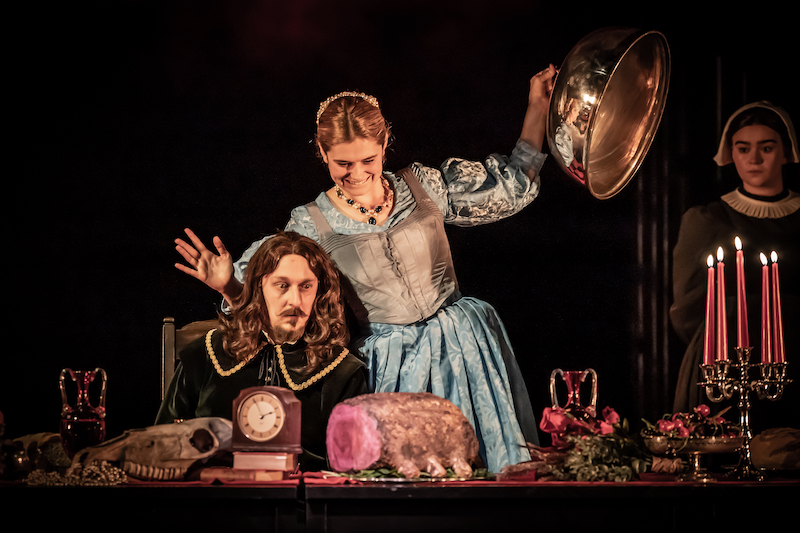 Elizabeth’s leftfield solution is to blackmail a stable girl who is accused of being a witch, responsible for the recent death of the area’s entire livestock: be handed over for trial and a guaranteed hanging, or conjure Edward’s consent to wed. Agnes (Alison Oliver, pictured above, with Bill) professes her innocence – she may have the abilities, yet insists that all she wants is “to be good”. Eventually she relents. In the first instance, her prize is speedy elevation to the position of Katherine’s lady’s maid; though, of course, it is never going to end there.
With her obvious nod to Middleton’s Jacobean tragedy Women, Beware Women (not to mention Webster's The White Devil) Raczka presents a world driven by cynicism and self-interest, in which the women are the principal players in a roundabout of deceit and betrayal, and innocents – Katherine, who just wants to be loved by her oblivious husband, and Agnes, who is driven towards the devil by others’ insistence that she’s evil – don’t remain innocent for long. When women call each other “sister” here, it’s with the irony ladled on thick.
Rather than keenly felt drama, Raczka and Goold for the most part focus on humour and social critique, as their anti-heroine, Agnes, deliciously turns the tables on the house – lord, ladies, servants and all – while the civil war threatens the very legacy that Elizabeth, in particular, is fighting for. 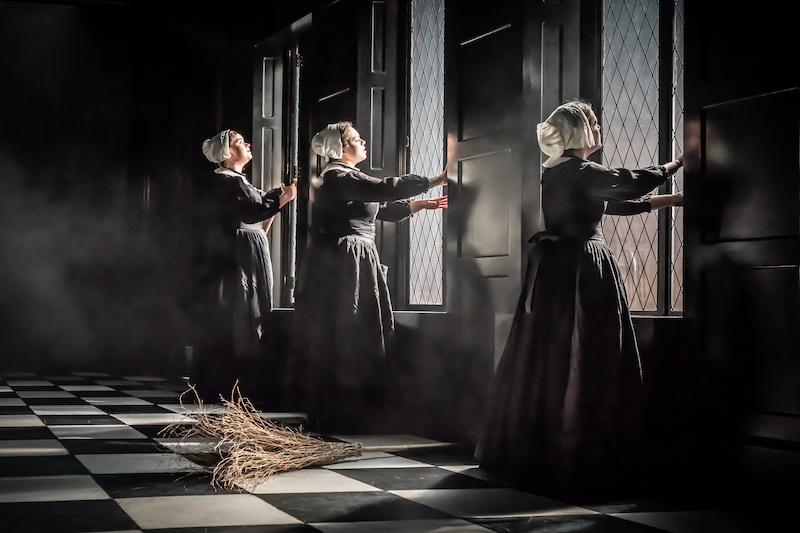 The result is thematically ambitious, certainly funny, always highly entertaining, but also a little erratic. What it lacks is a grounding in atmosphere. Despite all the talk of witchcraft and superstition, the play isn't as diabolical as it might have been: Nathan Armarkwei-Laryea’s devil is too flippant, the magic, such as it is, delivered off stage. A single, genuinely spine-tingling scene, reminding us that mental breakdown can be just as frightening as evil, is too isolated a moment of disturbance. In Miller’s The Crucible or, on film, Ben Wheatley’s A Field in England (also set during the Civil War) and Robert Eggers The Witch, fear and horror actively fuel the themes.
Nevertheless, Oliver skilfully conveys Agnes as an improviser, a woman at first desperate, merely, to survive, who then covets and ascends, before acknowledging the hollowness of the world she’s fought her way into – willing on revolution. Leonard is bullishly convincing as a woman stranded by her failure to marry, resorting even to incest to establish her security; and Bill is a hoot as the buffoonish, loutish lord, pathetically in thrall to the king and obsessed with the lack of beef on his table. “I’m a man. I need meat,” he roars, which is everything we need to know about the patriarchy under Raczka’s microscope.
Miriam Buether’s set is elegant and functional, a bare, panelled room in which appealingly laden dining tables are wheeled in from the wings and the much-maligned marital bed rises from the floor. Lighting and costume create some evocative moments, some with gorgeous intimations of Vermeer. Goold maintains a heady pace and a hearty wink throughout.











