

It’s apt that this new play, with characters moving in and out of Paris either side of World War I, is staged at this intimate theatre, one that always has the ambience of a below-ground oubliette. These bohemians are not penniless and cold as were Puccini’s, but they still wrestle with the bittersweet complexities of a love that burns too brightly, one that fuels a ménage à trois that does not end well.
Timberlake Wertenbaker’s play takes us back to Henri-Pierre Roché’s 1953 novel, best known as the source for François Truffaut’s celebrated 1962 movie, a staple of Best Film lists for half a century. Jules (German-Jewish) and Jim (French-Catholic) hit it off in the Rive Gauche cafes, become the firmest of friends who discuss art, literature and women and are both infected by that heady flush that is most aptly described as love without the sex. Things go well, each feeding off the other’s enthusiasms, as conversation soars in an environment that continually assails their senses with more and more stuff to delight and intrigue.
 When Kath, a German with something of a Latin temperament and a superego as cowed as her id is rampant, visits the French capital, Jules falls in love with her, as does Jim. Somewhat inexplicably given the rules by which she lives, she marries the boorish Berliner but never subdues her desire for the flighty Frenchman. Each, of course, offers exactly what half her personality needs, something both men recognise, and she’s soon being indulged by Jules and, well, something-elsed by Jim. With two daughters by her husband, she longs for more children with her lover, but they don’t come and no amount of patience from Jules or worship from Jim can keep Kath’s head above water as her rule-breaking eventually catches up with her.
Told in a breakneck 90 minutes, this is a rare play that could bear the addition of an interval and another half hour. With the focus so tight on Kath’s alluring but destructive psychology, opportunities to expand the characters of the two men are missed. Both have mothers that play a huge role in their lives, but those relationships and how they play out in their different approaches to loving Kath are barely fleshed out. Nor is their wartime experience (on opposite sides of course), with Jules appearing shellshocked at first, but largely unaffected later beyond a professed commitment to Buddhism. The rise of the Nazis, and the impact that would have on transnational cosmopolitans like these, is also presented as little more than mood music, Jules too deep into Eastern mysticism to hear the jackboots marching towards him.
That said, what we do get is perceptive, funny and leavened with gradual foreboding, despite the obvious privilege on show. Jules is like an addict who cannot put down the needle, marrying Kath a second time, inevitably unsuccessfully. Jim can’t break with her either, clinging and clinging on to the hope that the child that never comes would bind them forever. Kath is a ball of frustrated FOMO, and if the playwright’s aim is to poke out some empathy for all three, flawed though they are, she succeeds - I know I found plenty of myself in each of them.
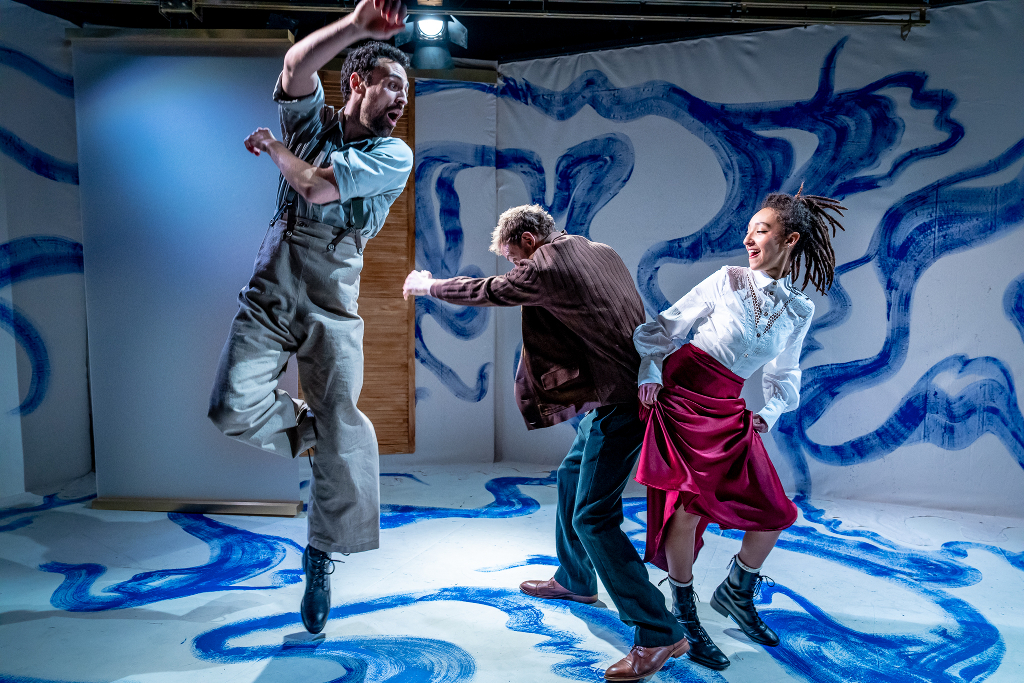
Patricia Allison (pictured above with Alex Mugnaioni and Samuel Collings) invests her femme fatale with an enticing unpredictability, a hair-trigger temper and an emptiness where the compensations of love’s compromises should reside. She doesn’t quite smoulder, but that may be a little too Hollywood for this most European of milieux. Samuel Collings retreats from the action in the post-war scenes, shoulders shrugging too frequently as Jim and Kath go at it again (in both senses of that phrase) - he just doesn’t have enough to do after a fine introduction. Alex Mugnaioni catches Jim’s infatuation with Kath, but he can’t quite pivot to portray the dangers that so perceptive a man must have sensed even through the fog of love.
I suspect each actor will find greater nuance as they relax into the roles, with director, Stella Powell-Jones (artistic director at this venue) keeping the three prowling around each other on a tiny stage supplemented by a superb and essential trompe l'oeil addition to Isabella Van Braeckel’s Matisse-influenced set.
As is so often the case at Jermyn Street, this production represents a confident commitment to challenging theatre, one that makes demands on its audience (an hour and a half in those seats is no déjeuner sur l'herbe, believe me) but rewards them with intellectual nourishment. If one can find holes in the plotting and performances, such shortcomings detract little from the delight one derives from a play that never retreats from its ambition to show that life can be difficult, even for those blessed with good looks, intelligence and money. That’s a flattering, if uncomfortable, message to take home with you on the Tube.











