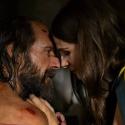
People have been making films about the unreliability of memory since, oh, I can’t remember. Often it’s a cue for a genre escapade, but here French filmmaker Alice Winocour gives us a social drama, telling the fictional story of a survivor of the terrorist attacks in Paris in November 2015, which killed 130.
To recover, the lead character has to sort out an understanding of events from the Escher staircases of her upside-down recollections. It’s an absorbing movie that becomes slightly less so in the final third.
Mia (Virginie Efira, pictured below) is a good-natured translator who one evening stops off at a bistro to escape a downpour. Small, studied glances at other patrons and staff, ominously slowing time, alert us to what will follow – the batter of gunfire, a grenade blast, the shots to the head of those still moving, witnessed from Mia’s floor-level point of view as she tries to make the ground swallow her up, all over in two long minutes on the screen.
Mia is only moderately hurt, and some months later she’s drawn back to find the bistro unnervingly good as new and the site of a self-help group of fellow survivors. What we glimpsed in the attack, though, doesn’t seem the whole story. Mia is assailed by a woman who accuses her of selfishly locking herself in the loo – and thereby locking out other victims – during the attack, which sends her into a guilt trip that takes up most of the rest of the film.
 Bits of memory – or “memory” – start coming back to Mia, sometimes in the form of regular flashbacks, sometimes in the form of baleful bistro revenants who appear in hallways or Métro carriages, like moments from The Shining, as she struggles to fill in her less-than-total recall and exculpate herself from the woman’s accusation. Winocour has spoken of how such (real-life) flashbacks can be more vivid than anything for survivors (and the director’s own brother came out alive from the massacre at the Bataclan theatre that night).
But Winocour is also an urbane, realist filmmaker who isn’t going to fracture and time-warp consciousness the way David Lynch or even Christopher Nolan might: her sleights of perception stay limited. And the relatively affable, understated performance from Efira doesn’t take us into James Stewart-like mania from Hitchcock. Instead, Mia starts to be rescued by nuggets of therapy-wisdom, such as “once you begin to remember, you’re on the road to recovery” and the notion that trauma always yields “diamonds”.
She also hangs out with bistro survivor Thomas, a rumpled financier played by Benoît Magimel who gives her someone characterful to bounce off. It’s Thomas’s wife who makes the grimmest observation in the film – that trauma victims get sealed away from their nearest and dearest, perhaps forever.
Winocour needs to be alive to audience sensitivities, however, so Mia embarks on some breezier, TV-style detective work to find the Senegalese cook who could prove that a vision planted in her brain, to borrow from Simon and Garfunkel, still remains true. We also get plenty of hugs, smiles and an obligatory love-making scene by the close.
Winocour provides a notable new take on PTSD in the movies (something she’s explored before), painting existential grief across a shadowy Paris, the city’s typical magic occluded. Despair, though, is withheld. Uncomfortable truths come with get-out clauses.