After a few years of cinema, the wow factor of seeing actual things moving about on a screen wore off a bit and showmen saw that jump cuts and stop-motion – the dawn of animation – could lift audiences some more. The liberation from gravity, in fact, is a singular pleasure of animation: being half-sellotaped to the floor is one of life’s great bores, it seems to delight in pointing out.
If Disney led the tradition of smooth-as-you-like animated artwork, Europeans often fancied the jerkier joys of stop-motion mannequins leaping around. The Polish-language The Peasants adopts a new form somewhere in the middle of all of this – combining live action with a jumpy kind of animated painting. It doesn’t succeed, alas, in unsticking you from the floor.
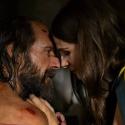
This adults-only saga of female persecution in rural 19th-century Poland has shot actors against sets and then added a paint effect in post-production. (A number of the frames were re-painted by hand with others hazarded by computer.) So there’s a constant look of flecking colours and textures on bodies and backgrounds. It brings to mind post-impressionism, which is where the filmmakers, DK Welchman and Hugh Welchman, earned their, as it were, stripes – the 2017 Loving Vincent, an airy and revelatory voyage into the life and mind of Vincent van Gogh, which used similar techniques.
But where that film wasn’t so tied down to the workflow entering an on-set camera, this one is. Now and then a wholly animated element – scudding clouds, creeping mists, animals moving across a frozen lake – gives you that lifting sense. And the palette of the movie, which is big on crimsons and nettle greens, frequently pops. For the rest, it’s a set of mudbound actors in a story that doesn’t really live up to all the re-rendering effort that’s been put in.
Based on a novel by Wladyslaw Reymont, it depicts the travails of Jagna (Kamila Urzedowska), a Margot Robbie in a country backwater that can’t cope with her blond plaited hair and dazzling smile. She’s forced to marry an ageing wealthy grouch (Miroslav Baka) as part of a land deal, while carrying on with the landowner’s strapping, moody son (Robert Gulaczyk). “Are you coming to the cabbage party tomorrow?” is a typical social invitation in these parts. (It turns out to be cabbage-peeling set to music.) If Jagna is an undisputed 10 in the looks department, it’s not as though the others are especially gnarled: they all look like well-fed Warsaw thesps, something that more thorough-going animation might have fixed.
Jagna is always being caught in more or less innocent conversations in the woods and fields with a succession of blokes, and so is labelled a hussy and destined for ostracism of a particularly harsh kind. Her character is alternately defiant and a bit inert, and she never quite moves us in the way a Thomas Hardy heroine might. But the ethnographic elements, beyond the cabbage party, are fun – they should try doing the hurling Polish “volta” dance on Strictly – while Lukasz Rostkowski’s score of plangent strings and song add well to the spiral of woe.
The Peasants is Poland’s entry for the foreign-language Oscar in 2024, so maybe two animated films will win Academy Awards this time around. But in a modern world where visual effects can ginger up the most realist of live-action movies without us realising it, this is an odd example of a film where you’re conscious of unusual effects but somehow it all looks too natural and neat.