

Is this the same Roman Rabinovich who drew harp-like delicacy from one of Chopin’s Pleyel pianos, and seeming authenticity from a 1790s grand which may have belonged to Haydn, both in the Cobbe Collection at Hatchlands, Surrey? He clearly cares about the possibilities of any instrument on which he plays, so the natural consequence is maximum sonority on a modern Steinway. Too cultured to deafen, as Beatrice Rana did in this small space, he still compels you to listen to every note.
You feel that Haydn would have loved the startling fullness with which the Sonata in F, HXV1/29 began. Rabinovich knows and has recorded all the Haydn sonatas, so this was innovation born of love. Those far-flung single notes could be Stravinsky; but there’s no violation to the wit and energy of the original. It made me wonder what this work might sound like if arranged for wind.
Nothing less than full orchestra was conjured in Rabinovich’s Beethoven A flat Sonata, Op. 110. The visionary gleam gave way to bass-line shocks, then sudden jolts in the second movement. The Adagio which punctuates the two fugues didn’t work for me: surely it needs the ease of long-established wisdom (Leonskaja, a recent interpreter presenting the last three sonatas in a single concert, comes to mind). And while lines remained clear in the counterpoint, the full-toned effect could weary. 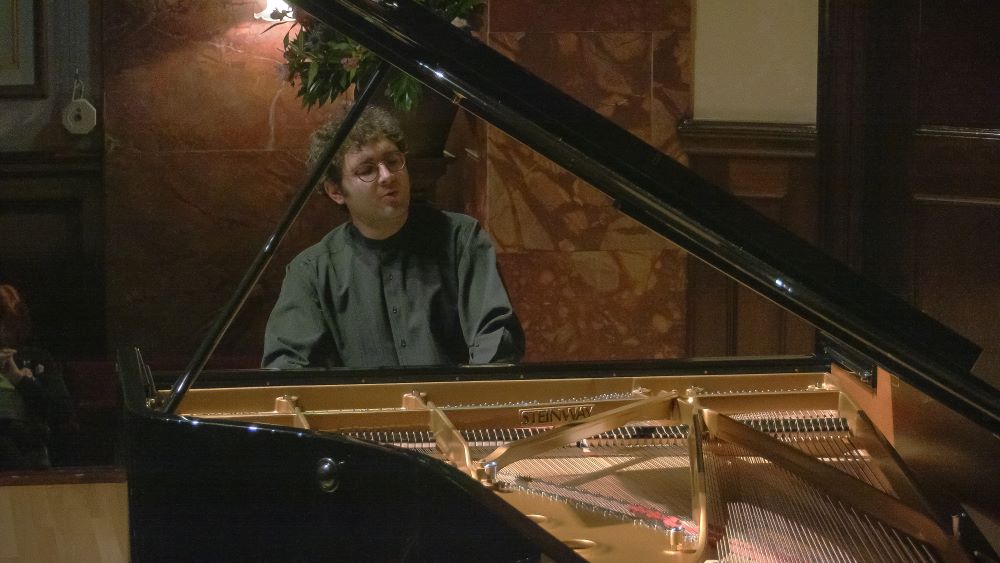 Thoughtful programming still felt odd, to have this titan at the end of a first half and not in the second. The middle work of part one was, as expected from Rabinovich’s recording of French music, revelatory: an equivalent to Boulez’s determination to “burn the mists off Debussy”. There was delicacy in the three Estampes at times, but impetus to the habaneras of “La soirée dans Granade”, and fireworks rather than rain in “Jardins sous la pluie”.
Schumann’s Études Symphoniques followed the interval, the ones Brahms exhumed after his friend’s death strategically placed, mostly as much-needed breathers from all that coruscating rhythmic energy, the eleventh original Étude, Andante espressivo, very much the poetic heart before the rambunctious finale. Exhausting, again, for the listener as well as (presumably) for the pianist, but faultless on its own terms. And Rabinovich had energy to spare for two Rachmaninov encores – strutting Prelude Op. 23 No. 5 and cascading No. 4 of the Op. 16 Moments Musicaux. If only he’d chosen something quiet to finish.











