Hermia is a headbutting punk with a tartan fetish, Oberon looks like Adam Ant and Lysander appears to have stumbled out of a Madness video. Yet Eleanor Rhode’s exuberant A Midsummer Night’s Dream – which has transferred from a triumphant run at Stratford-Upon-Avon – is no straightforward Eighties tribute, but a psychedelic mashup that’s as ravishing as it’s gritty.
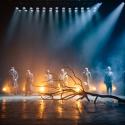
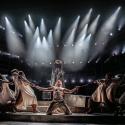
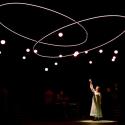
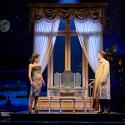
Lucy Osborne’s versatile design whisks us from the sinister grandeur of the opening – in which a sun resembling a military flag hangs over the stage to remind us that Theseus has wooed Hippolyta by force – to the hallucinogenic beauty of the forest. Here a galaxy of suspended paper lanterns shift colour according to the production’s mood, whether they’re sparking like electric impulses passing through a synapse or glowing white and shocking pink for one of Titania’s seduction scenes.
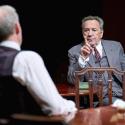
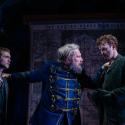
Horrible Histories’ Mathew Baynton (pictured below) receives top billing as Bottom here, and it’s part of his appeal that even as his character tries to steal scenes he uses his star power to create a collaborative comedy. Angular as a hairpin in his pinstripe suit and vibrant orange shirt and socks, he conveys a man who’s simultaneously full of himself and out of his depth. When he’s rehearsing for Pyramus and Thisbe, he hilariously echoes Laurence Olivier’s Richard III but struggles to remember the names of fellow cast members. Transformed into a donkey, his ears move with phallic suggestiveness, yet his love is clearly as much for himself as for Sirine Saba’s flamboyantly seductive Titania.
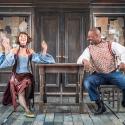
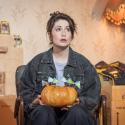
 As well as having a set designer, this production features John Bulleid as illusion director and designer, and there are plenty of sleights of hand in which characters seem to appear from nowhere. There’s an unearthly sci-fi aspect to the magic here – sometimes evocative of Christopher Nolan’s similarly dream-driven Inception – that raises questions about the degree to which Oberon and Puck truly understand the control they exert. Andrew Richardson’s Oberon – in contrast to his oily Theseus – is both New Romantic and eccentric professor, wild-eyed and malignly mischievous as he experiments on the people around him. Katherine Pearce’s blue, green and purple haired Puck (pictured below) – with baggy dungarees and a tartan shirt – is as anarchic a Puck as I’ve seen, actively seeking out chaos and any violence that might accompany it.
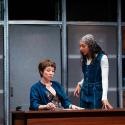
That undercurrent of violence is something that underpins the lovers’ scenes, in which the punkish Hermia and Lysander are the clear rebels while Demetrius and Helena are more country farmer and Pierrette. The distinctive characterisation makes for an amusing opening scene, in which it’s utterly clear why Dawn Sievewright’s spiky Hermia would never have contemplated Nicholas Armfield’s stuffed-shirt Demetrius. Yet in the forest, the physicality of the violence that erupts makes you genuinely concerned at moments at the injury the lovers might do to each other. Ultimately they all seem able to stand up for themselves – as Helena, Boadicea Ricketts delivers her speeches with the assertiveness of the female warrior after whom she’s named – yet it’s another moment at which the play’s sinister undertones are delivered with a shovelful of grit.
 The music is also a star here – overseen by Katherine Gillam, a live band rocks the action with styles ranging from ska to psychedelia. In one innovation, when Theseus asks Philostrate to tell the huntsmen to wake the lovers with their horns, he does so instead with a riff on an electronic air guitar. Shortly before Puck has reunited each individual with their “correct” partner as if presiding over a grotesque cabaret, animating them so they move like they’re possessed. Here the music heightens the sense of a world out of kilter, in which even apparently benign gestures come with possibly malevolent consequences.
This then – unlike Nicholas Hytner’s 2019 production of A Midsummer Night’s Dream at the Bridge Theatre, which acknowledged the sinister aspects of the play before erupting into unadulterated hedonism – never lets you forget the dangers lurking in the forest’s alternate reality. It’s not my favourite version of the play – Ninagawa’s 1996 version still wins the crown for that in my book – yet its visual abundance and engaging spikiness make it well worth a visit for something a little different this festive season.