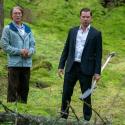
Jesse Eisenberg's first film as writer/director was 2022’s When You Finish Saving the World, which met with modest acclaim. But he’s taken a giant leap forward with the follow-up, A Real Pain, which has been hoovering up critical plaudits from festival showings and its American release.
This isn’t the easiest moment in history to be launching a film exploring its author’s Jewish heritage, thanks to the violent repercussions of events in the Middle East, but the historical baggage that comes with that heritage is all part of Eisenberg’s theme. Set to an eloquent and frequently melancholy soundtrack of Chopin’s piano music, A Real Pain is a bittersweet story about two Jewish cousins, Benji and David Kaplan (Kieran Culkin and Eisenberg), who take a trip to Poland in memory of their beloved grandmother, a recently-deceased Holocaust survivor. Beneath the wisecracks and one-liners there’s a subtle and penetrating analysis of family bonds and the burden of shared history.
 The film’s gentle ripple of underlying sadness stems from the fact that the cousins were previously very close, but have drifted apart. They’re about as dissimilar as it’s possible to be, but glimpses of their odd-couple bond gradually resurface as the narrative develops. Eisenberg’s David is quiet and introverted, but is successful as both family man and in his Manhattan-based career in computing. On the other hand, we gradually learn that Benji is drifting rootlessly through his life out in the suburbs. He’s searching desperately for something meaningful, and is struggling to keep himself on the rails. He has been hit hard by his grandmother’s death, confessing that “she was just my favourite person in the world.”
In any event, the role gives Culkin carte blanche to charge recklessly through the gears, in a bravura performance which gives the film its centrifugal force. Some of the time he’s a babbling extrovert who effortlessly dominates any social gathering, for instance persuading everybody in their touring party to pose for selfies on a statue commemorating the Warsaw Uprising, but the flipside is that he can’t tell where the boundaries are (and has little interest in finding them). David is aghast when they’re heading for the boarding gate for their flight to Poland, and Benji cheerfully announces that he’s carrying a stash of dope (“I got some good shit for when we land”).
One moment everybody loves Benji, then suddenly he becomes an insufferable asshole. He’s prone to wildly inappropriate outbursts, like the moment when the tour party are travelling in a first class railway carriage and Benji goes into an emotionally incontinent display of guilt about the contrast with his Jewish antecedents being transported to death camps in cattle trucks. Fortunately their travelling companions (who include Dirty Dancing veteran Jennifer Grey, pictured top, and Kurt Egyiawan as a survivor of the Rwandan genocide) show superhuman patience, not least their English tour guide James (Will Sharpe), who graciously accepts Benji’s tactless critique of his guiding technique (Sharpe and Eisenberg pictured above). The fact that James is a scholar of East European Studies from Oxford University, not Jewish himself but “fascinated by the Jewish experience”, is a crafty little comic narrative all of its own.
It’s a difficult film to categorise, being part comedy, part road movie, part psychotherapy session and part personal memoir. Perhaps Woody Allen might have called it a “situation tragedy”. It’s a clever, complex piece, but Eisenberg has made it look breezily simple.