

“Don’t put your co-artistic director on the stage, Mrs Harvey,” as Noel Coward once (almost) sang.
Tamara Harvey took no heed and Edward II sees her RSC compadre, Daniel Evans (pictured below, kneeling centre), back on stage after 14 years and in the title role to boot. In Daniel Raggett’s stripped back, helter-skelter, 100 minutes version of Christopher Marlowe’s sex, power and violence fest, Evans has certainly jumped in at the deep end (literally so at one point, which you won’t miss!). 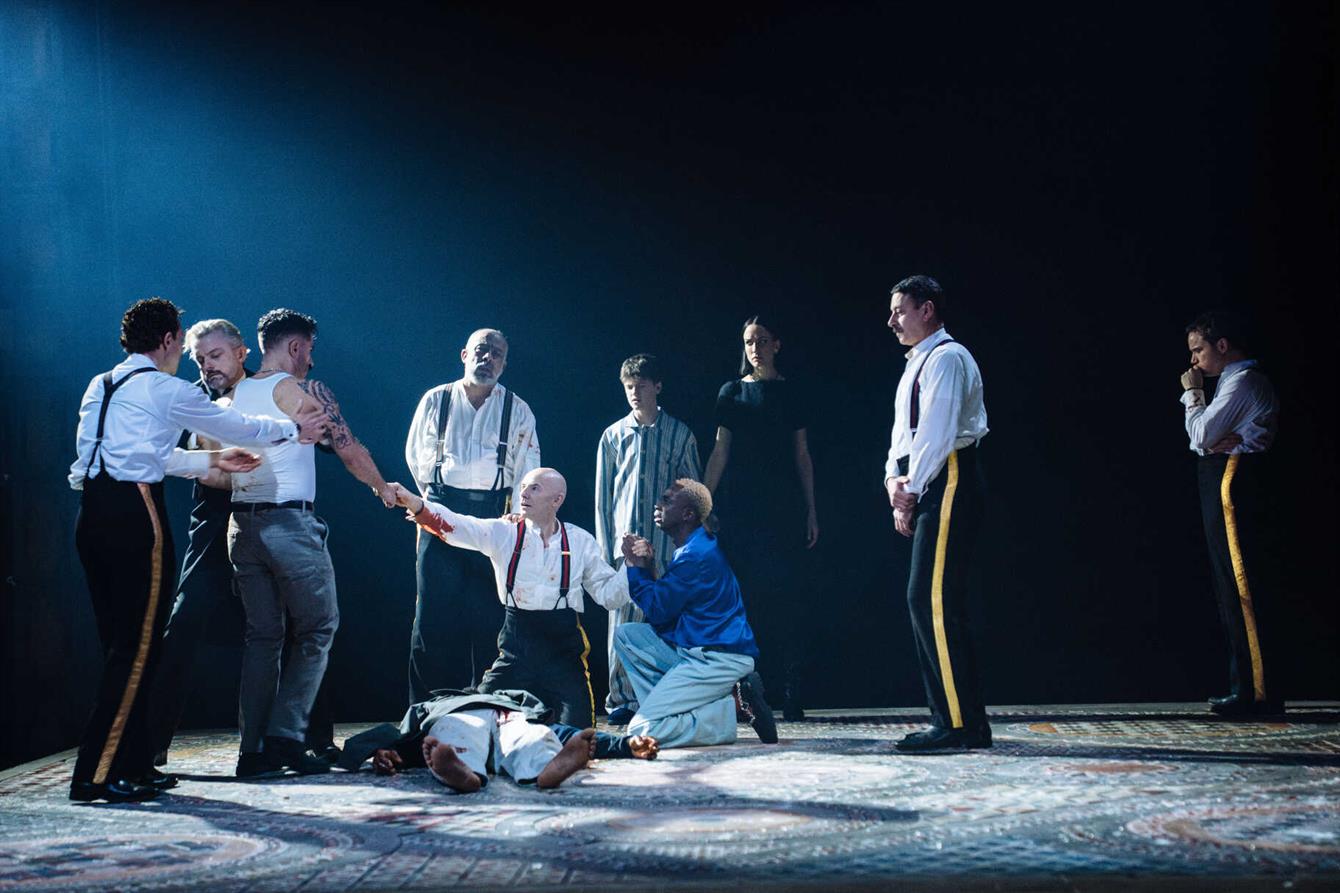 The noblemen of England disapprove of the king’s flamboyant "friend", Gaveston (Eloka Ivo, blessed with the physique and strut of a cruiserweight champion). The favourite returns from exile and receives kisses and titles from his besotted monarch and basks in his cocksure challenge to the status quo. The earls don’t care for his low-born status nor his gay entourage, but fear his unabashed distracting of his king from the monarch’s two main duties – governing the country in alignment with their advice and producing heirs to secure its future. Sure they’re ambitious, ruthless and homophobic, but their overarching aim is to stabilise their carefully constructed world has been thrown out of kilter by this upstart. It doesn’t end well.
Everyone is aggressive in this hyper-masculine court with two exceptions. Ruta Gedmintas gives Queen Isabella a regal melancholy, floating about in bias cut dresses, lost on a sea of patriarchal politicking. For a second time in her life, she picks the wrong man (not that royal women had much choice in such matters) when, ejected from the king’s bed once Gaveston is peacocking about court, she conducts an open affair with the ruthless and increasingly psychotic Mortimer, a fine turn from Enzo Cilenti.
Edward himself does not conform to kingly norms. He vacillates when he should be decisive, chooses love over power and makes enemies when he should be making friends (he really does not want to upset the bishops in a fit of pique). If democracy’s filtering of would-be political leaders produces some of the specimens we’ve seen in recent years, it’s hardly any wonder primogeniture can spit out men wholly unsuited to the job description. That’s poor Edward.
Leslie Travers’ set and costumes work together well to glitch us between the 14th century court and more contemporary times, underlining the truism that with men and power, not much changes. Inviting us hoi polloi to walk around the deceased king’s coffin prior to the play’s opening, forces us to recall the scenes from the Queen’s lying-in-state in 2022, but Marlowe’s astringent language roots the play in its Elizabethan (the other one) origins. We're simultaneously in both the here and now and the then and there.
That duality works particularly well in the infamous murder scene, given full value by Jacob James Beswick’s terrifying assassin, Lightborn, and magnificently realised staging. I thought of Nicolae Ceaușescu, of Saddam Hussein and, specifically, of Muammar Gaddafi – when the end comes for autocrats, it’s usually death that brings it and often violently so.
What would Marlowe have done had he lived into his 30s? Not lived into his 40s, is probably the most likely answer, so why not ask what he would be doing today? With his rizz and talent, he’d be a star, showrunning for Game of Thrones perhaps or scandalising Hollywood in red carpet interviews and beyond. He knew how to entertain on stage and off and then, as now, such mavericks can fascinate their fans, but often pay a heavy price for their hubris.
This production, to its credit, starts with the dial at 11 and stays there (true to its writer’s reputation) but this is no Titus Andronicus-style bloodbath shocker, no 1590s version of a 1990s slasher for all the blood spilt. It asks searching questions about the price even the most powerful must pay in order to stay true to themselves, analyses the friction generated when the personal butts up against the political and underlines the foundational fragility of what lies behind the great pantomimes of a state’s pomp and circumstance.
At a time when democratic nations feel more vulnerable than ever they have in my lifetime, that’s both a comfort (change can come quickly) and a torment (who knows what carnage will erupt when it does). In the warm Spring sunshine by the Avon, January 6 2029 suddenly looked more scary than ever.











