In 2012, an eight-hour long version of F Scott Fitzgerald’s The Great Gatsby arrived in London at the Noel Coward Theatre. Rather than risk offending the novel’s devotees by missing any detail out, the Elevator Repair Service theatre company had decided that they would stick their necks out and offer a theatrical marathon, narrating the book in its entirety.
The gamble paid off: when Gatz played on Broadway, the New York Times declared it to be “the most remarkable achievement in theatre not only of this year but of this decade.” In London, the Guardian praised it for preserving “the haunting rhythms of Fitzgerald’s prose and sustain[ing] his narrative dynamic”.
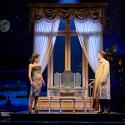
This new musical – which also transfers from Broadway – goes for the more traditional approach of taking an elegant two and a half hour sprint through the 1925 classic. While it certainly captures the Bacchanalian fizz of jazz-soaked New York, it’s less successful at conveying the novel’s tortured soul. It may look the part, with a magnificent art-deco framed design that whirls us from one location to another through lavish projections. Yet the “haunting rhythms” and eloquent melancholy that so brilliantly revealed the different shades of the human condition have been eclipsed by a colourful assertiveness that doesn’t entirely work.
The Great Gatsby, as the writer and academic Sarah Churchwell has observed, was a novel about "the American Dream" before it became an established concept. F Scott Fitzgerald perceived the Faustian pact that many around him had struck with capitalism, and was able to show the thrill of its demonic energy at the same time as illuminating its destructiveness.
Yet as Marc Bruni’s production opens, the emphasis is on soft pastel romance as we see Gatsby from behind, gazing out onto the bay that separates his mansion from the home of the woman he loves. Then, in a neat coup de theatre, a large French-window-style frame glides across the stage between us and him, making him disappear and revealing Corbin Bleu’s narrator (pictured below), Nick Carraway. Wisely Kait Kerrigan, writer of the book for the show, has kept Carraway – widely perceived as a version of Fitzgerald – as the anchor to what happens. “I left my home in Minnesota to escape a kind of restlessness I couldn’t shake after the war,” he tells us, before dancers erupt around him chorusing “The Great War has been won/The Bacchanalia has begun”. Jason Howland’s lively score – which he also conducts – is at its best when it’s pastiching Jazz Age dance numbers. It's problematic, however, when Gatsby first sings of his love for Carraway’s cousin, Daisy, in For Her. As Gatsby, Jamie Muscato initially conveys both the melancholy and the dignity that defines the character in the book, but this is difficult to sustain when he’s blasting out his love at top volume to harmonies more evocative of Lloyd Webber than a Jazz Age great. Scott Fitzgerald’s works have inspired some wonderful music – not least Richard Rodney Bennett’s compositions for the BBC’s Tender Is The Night. Yet at these most emotionally intense moments, the music fails to capture the mystery and wistfulness underpinning Gatsby and Daisy’s story.
The production gets stronger in the second half as the shadows of tragedy begin to loom. Rachel Tucker is full of fire and fury as Myrtle, the lover of Daisy’s husband Tom. Amber Davies delivers wit and pizazz throughout as Jordan Baker, the female golf player who both dazzles and dismays Nick. Frances Mayli McCann deals gamely with the rather anodyne material she has been given as Daisy. But it’s not till one of the most arresting songs – Beautiful Little Fool, in which she sings witheringly about what’s expected of women – that we see what she’s really made of.
Critics are rarely great indicators of how a musical will do. It seems far from impossible that the dynamic pace of Bruni’s direction, Paul Tait depot III’s sumptuous design and Dominique Kelly’s choreography will keep many people extremely entertained. But if you’re devoted to the spirit of F Scott Fitzgerald’s original, this will leave you with mixed feelings. Probably best to get out the novel and spend eight hours re-reading that instead.