The reporting of Anna Politkovskaya, the journalist who was shot dead in her Moscow apartment building in 2006 – on Vladimir Putin’s birthday, a deranged gift from his loyal security services – is perhaps the nearest thing we have to a full diagnosis of the horrifying corruption and brutality of Russia under his governance.
Some of the events depicted in Words of War happened over a quarter of century ago when, as Yeltsin’s Prime Minister, Putin started a war in Chechnya on the same false pretext of anti-terrrorism that now masks his real intentions in Ukraine. However, as Politkovskaya, who is played by Maxine Peake in the film, tells a state television talk show after the Dubrovka Theatre siege of 2002: “The only terrorist that the Russian people need to fear is their own President.”
It’s a timely message. Politkovskaya worked for Novaya Gazeta, one of the last independent newspapers in Putin's Russia until it was forced to close in 2022, a month after the full-scale invasion of Ukraine. And the best thing about James Strong’s English-language movie, apart from its largely English (or Irish) cast, is the implicit parallel it draws between Russia’s brutal hammering of Chechnya, a tiny republic of a few hundred square miles, with a population of only a million, and another quarrel in a faraway country, the ongoing carnage in Ukraine.
“Do you still think that the world is vast,” asks Politkovskaya, in a voiceover at the beginning of the film, “and that if there is a war in one place it has no bearing on another, and that you can sit it out in peace, ignoring all that you see?” Is she speaking to us posthumously? Or after surviving a previous assassination attempt, an inflight poisoning that is typical of Putin’s methodology, and which we see in a flash-forward before the titles.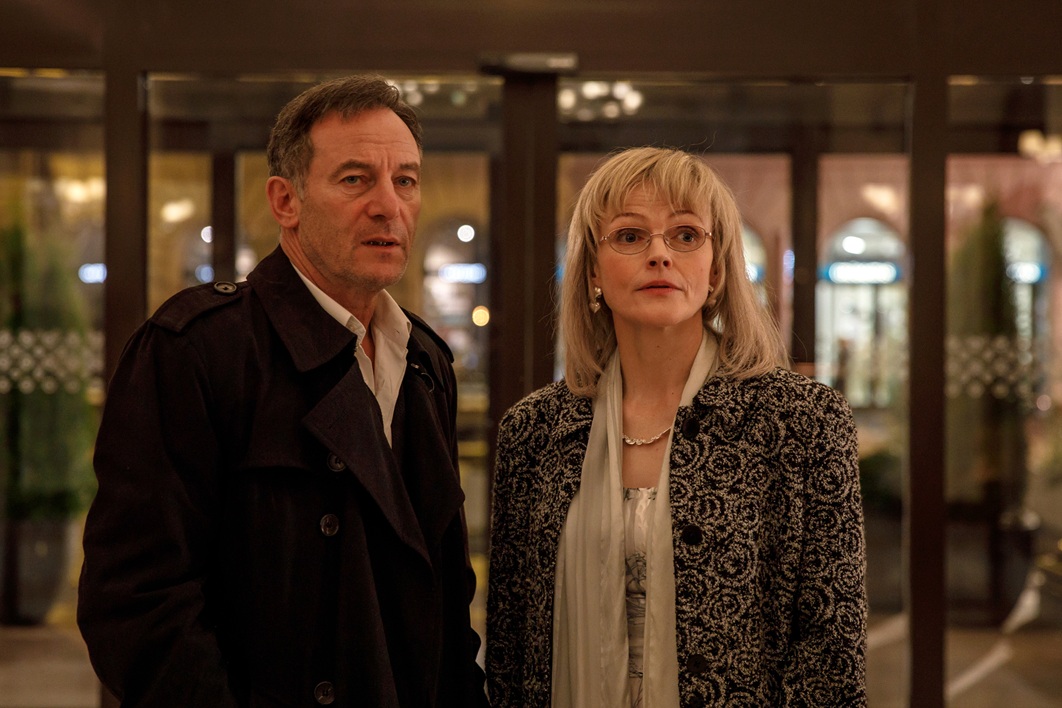 The structure of the movie, written by Eric Poppen, is vaguely reminiscent of Joel Schumacher’s Veronica Guerin (2003). As Cate Blanchett did in that earlier film about Ireland’s drug wars, Peake here marvellously conveys an empathy and listening style that enabled Polikovskaya as a reporter to win the trust of Chechen civilians.
“They shouldn’t have sent her to a war zone,” Politkovskaya’s husband Sasha (Jason Isaacs, pictured above, with Maxine Peake) tells their grown-up children over supper. “She is a people correspondent. She loves people – it’s who she is.” But that love of humanity is exactly what made Politkovskaya such a gifted war reporter because it’s people, of course, who are the main victims of any military conflict.
Other family scenes involving Politkovskaya’s son Ilya (Harry Lawtey), who protests at the risks she takes on assignment, and daughter Vera (Naomi Battrick), who announces that she is pregnant towards the end of the movie, are less successful, too sentimental and evocative of soap opera, as are the dodgy accents and Russian weather clichés. For instance, a snowstorm greets Politkovskaya as she steps onto the tarmac at Moscow’s Vnukovo Airport en route to Beslan where Chechen rebels have taken hundreds of schoolchildren hostage, even though it was the end of summer, in fact – and almost 30°C – on the day in question.
Nevertheless, the film boasts several fine performances, not just by Peake in the lead role but also by Ciarán Hinds as Dmitry Muratov, the Nobel Peace Prize-winning editor of Novaya Gazeta, and by Ian Hart as an inscrutable but fictional Russian security service officer.