William Byrd, Arnold Schoenberg and their respective acolytes go cheek by jowl, crash into one another, soothe, infuriate and shine in their very different ways This is all in a typical programme of pianist, conductor, composer and all-round pioneer Karim Said, and last night in the studio of Leighton House, it nearly all worked (when it didn’t, that was the nature of the beast, not the pianist).
Lord Leighton may not have been a great artist – he was a state figure who had a grand funeral in St Paul’s Cathedral in the same year as the much more original William Morris was buried under simple circumstances – but he had genius in his collecting habit, especially in the oriental sphere. The domed room in the house, its greatest treasure, embraces an assemblage of priceless tiles, including a panel from Damascus completed by William De Morgan, who created one of the parrots to make the fantasy whole (pictured below, courtesy of Leighton House). This was one of the many things we learned on an excellent pre-concert guided tour by Daniel Robbins, Senior Curator of Leighton House and Sambourne House.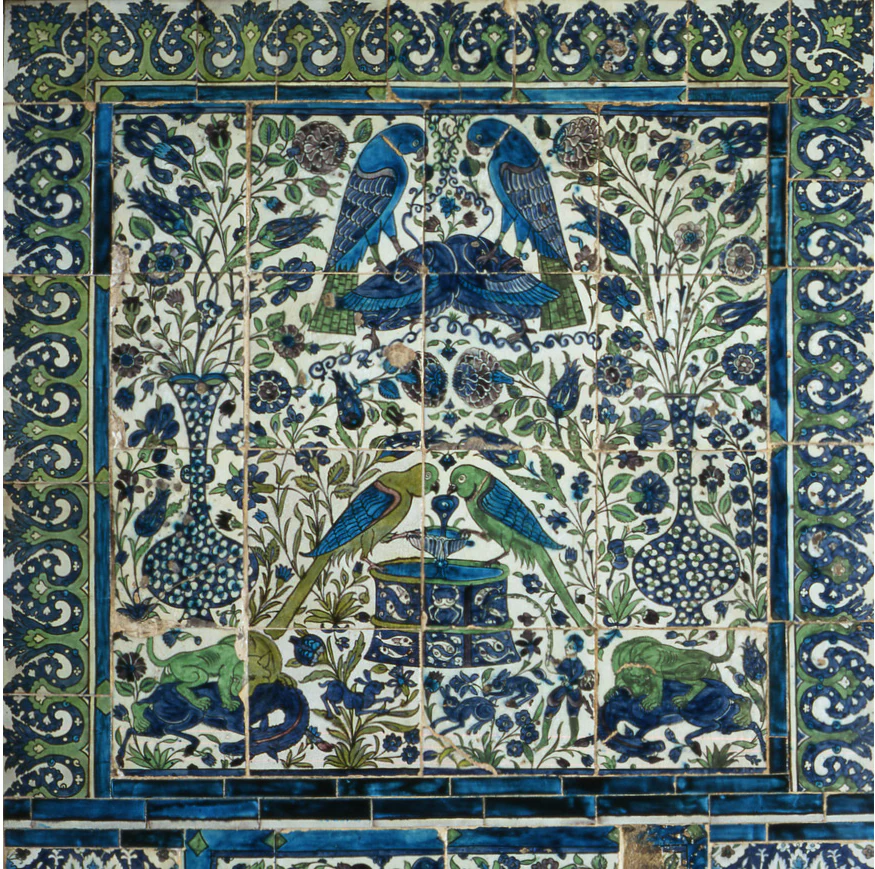 The link means that the house embraces work by Middle Eastern artists of all kinds – the beautiful new helical staircase has a mural by Iranian artist Shahrzad Ghaffari – and although Said appeared under the auspices of a piano series, he fits the bill, though he’s also a true citizen of the world. He told us in his modest spoken introduction that he has just completed a series of Beethoven piano concertos as Artist in Residence at the Lebanese National Philharmonic Orchestra. In his native Amman, where he is Director of Music at the new Institute of Performing Arts, he has set up both the Etihad String Orchestra and now the Amman Chamber Orchestra. All this might suggest why I haven't seen him in action here since he launched his first idiosyncratically-programmed CD, Echoes from an Empire, though he is also Associate of London's Royal Academy of Music.
Said paved the way in his talk by saying that if anyone had come for...(dashed off the opening of a Chopin waltz), they would be disappointed, but he hoped they would either hate or love what he was offering. Dissonance could be ugly – cue Herrmann's stabbings for the shower scene in Hitchcock's Psycho – but also beautiful, which it was, uniquely, in this programme, in the distant gleams of Schoenberg's Six Little Pieces, Op. 19. We could even catch it, passingly, in the Byrd Fantasia in A minor which he confessed was his personal favourite and which he placed at the official end of the evening: high, lucid and bright.
Karim Said plays Byrd's Fantasia MB27
There were careful symmetries in Said's five-part sequence. Berg's tumultuous one-movement Sonata was at the heart, its disquieting ending brightened instantly by Morley's Nancy. Everything was unpredictable: Tomkins and Bull could tumble in the conclusions of what sounded like free fantasias, Schoenberg could charm, however briefly. It was a revelation to hear his unique and rhythmically brilliant serving up of twelve-tone neoclassicism, the fiendishly difficult Op. 25 Suite, where even in the Musette framed by a Gavotte, you started as if watching a charming kid in a playground, only to have the child lob rocks at you. The most startling segue was from Tomkins' The Hunting Galliard to the coruscating Gigue of the Suite.
Only at the end of this sequence did dodecaphony become arid. I've never understood the value of variations in that style, when any note can seemingly be related to any other, and Webern's set, though short, quickly felt sterilised. Not Said's fault, of course, and Byrd decisively clinched the argument for freshness in tonality at both ends. All that, and a real zinger of an encore, Balbastre's La Suzanne, rounded off with drinks in the Leighton House Garden – a rare evening.