

The water proves newly inviting in The Deep Blue Sea, Terence Rattigan's mournful 1952 play that some while ago established its status as an English classic. Lindsay Posner's production, first seen in Bath with one major change of cast since then, takes its time, and leading lady Tamsin Greig often speaks in a stage whisper requiring you to lean into the words. (This is that rare production that, praise be, is unamplified.)
But what develops is a study in coping that is required once people arrive at a place beyond hope, not to mention a scalding portrait of the lacerating effect of lovelessness that has a resonance extending well beyond the period confines of Peter McKintosh's aptly frayed set: the wallpaper peels on cue with the carefully cultivated reserves erected by the characters as a defence against life's abrasions.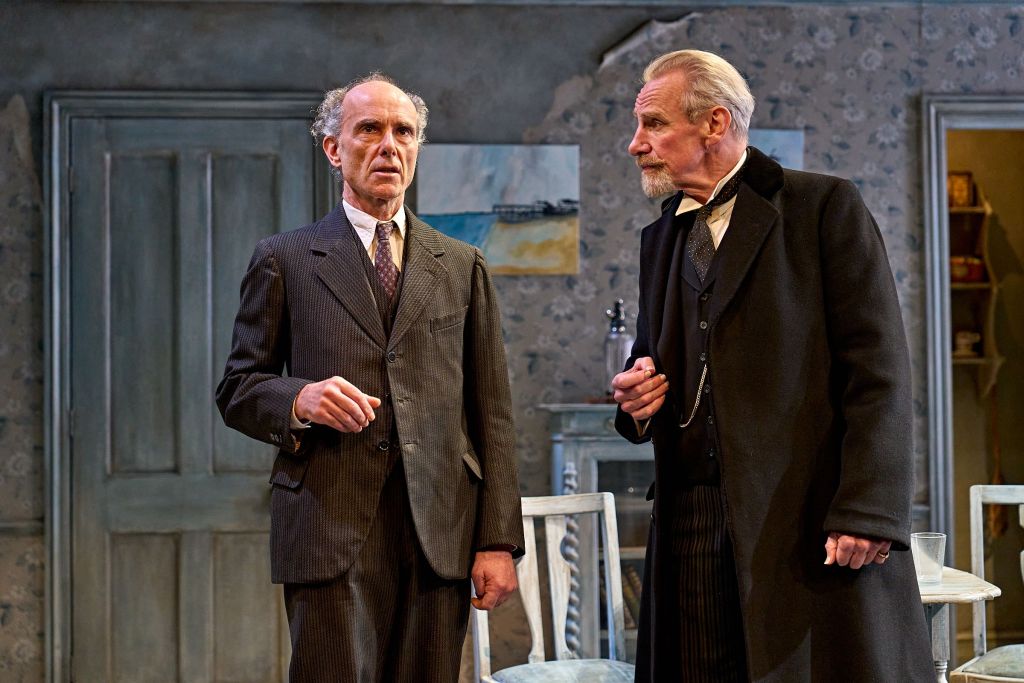 The star attraction amidst a notably name-heavy cast is the wonderful Greig, marking her second London play this year (following Backstroke at the Donmar). On paper, she's at the upper age range of suitability for a heroine, the suicidal Hester Collyer, whom I last saw acted onstage by the formidable, much-missed Helen McCrory in a National Theatre staging rather more daring than this one. But Greig, as ever, is second-to-none in her ability to communicate a soul in torment. As she rolls the phrase "angry Cupid" around in her mouth, shifting along the way from laughter to tears, there is little doubt that you're in the hands of a supreme talent, even if the price paid is an occasional matronliness that deprives the play of some of its heat.
What strongly emerges is the sense of a community that has made a fetish of the furtive. You might think that Hester has chosen a place of retreat where she can quietly pursue her romance with the younger, heavy-drinking ex-RAF pilot Freddie Page (a commandingly hearty Hadley Fraser in the role taken in Bath by Oliver Chris), even as her actual husband, a titled high court judge played with kindly insistence by Nicholas Farrell (pictured above right, with Finbar Lynch), shows up now and again in a black Rolls to plead his case.
No such luck. Not only is Freddie more in love with the bottle (and golf) than with Hester, but their accommodation is rife with visitors who aren't shy about coming to call. Thank heavens, too, or this clergyman's daughter would have died by the gas fire where we find her lying inert at the start, Freddie having forgotten her birthday and thereby plunged his lover (the household thinks they are married) into the abyss indicated by the title.
Others at the property aren't shy about proffering points of view. Selina Cadell bustles in and out of view as a landlady who remarks on the difference between "nice" and "good", rather like a song lyric out of Into the Woods. A fretful middle-class couple, Philip and Ann Welch (played by Preston Nyman and Lisa Ambalavanar, pictured below), advocate for perspective, and Greig's Hester – as alive and alert to language as she is to feeling, or its absence – takes what she is offered like a patient questioning medication. Some of Greig's finest moments come from her consideration of words like "contemplate" and "objectively speaking", which Hester knows make general sense – but perhaps not specifically for her. 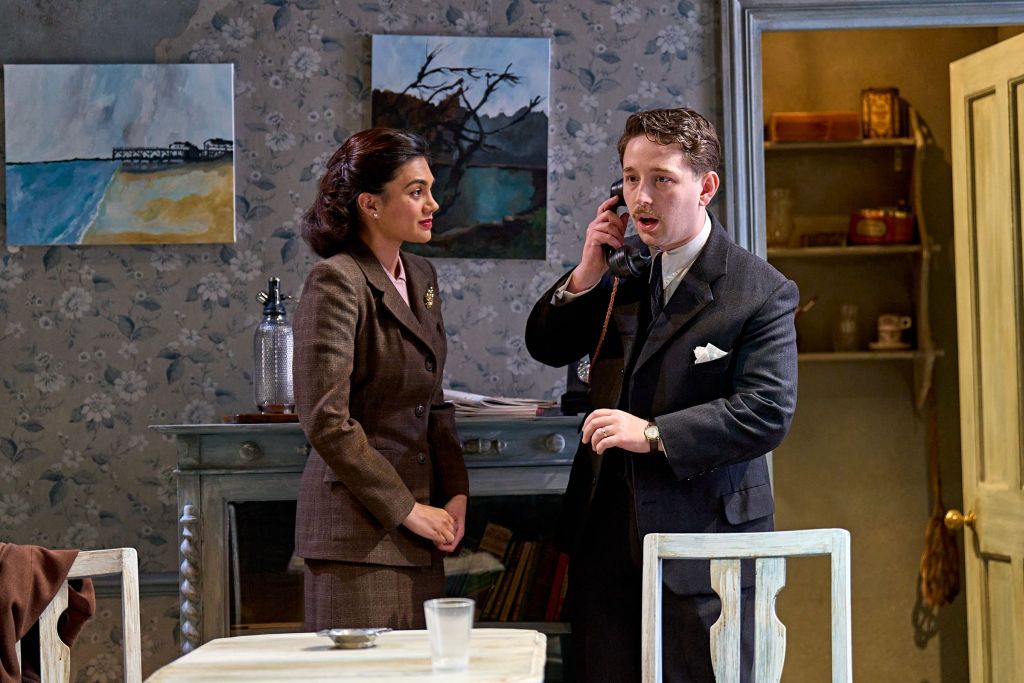 A league apart is Finbar Lynch, playing a far from respectable tenant who lends an Ibsenesque import to proceedings as a doctor (or is he?) with access to pills and also, one feels, to a full-on embrace of humankind at its most heartless. The world, Lynch's essentially mysterious Miller says in passing, is "a dark enough place", though Rattigan never tells us precisely why or how this man with a chequered past has reached this assessment. He and Hester come face-to-face in an electrifying, raised-voice climax that ramps up the stakes of the play as the dulled Hester gets detonated back to life. In this context, that may or may not be a good thing.
"Stormy Weather" is heard more than once to cue us to a milieu where, as the song says, "it keeps raining all the time", and one after a while comes to view Hester's smile as a sort of facial umbrella. A brief reference to a cloakroom at Charing Cross feels like a scripted nod of sorts to Oscar Wilde, but the play itself endures as a matchless portrait in soldiering on in sadness, until such time, presumably, as you simply can't.











