

The Gathered Leaves is set on the tectonic plates of a middle-class family menu reunion, in which three generations grapple with the shifting values of an indifferent world. Adrian Noble’s sensitively observed production investigates what happens when a tyrannical patriarch starts to succumb to dementia, making disorientating demands on a family that till this point has been more concerned with protecting a son suffering from autism.
Ten years ago, The Gathered Leaves played at this same venue with a cast that included Jane Asher and her real life daughter Katie Scarfe and Alexander Hanson and his real life son Tom. There are no genuine blood ties in this cast, yet – led by Jonathan Hyde as William Pennington, a bullying dinosaur who’s merciless about others’ faults – they skilfully evoke the claustrophobia of family members trying to fake togetherness as they fall apart.
Dick Bird’s fastidiously observed design in beiges and pale greens sets the scene for emotional daggers in the drawing room. Andrew Keatley’s script begins with a flashback to the childhood of William’s sons, Giles and Samuel, as they act out an episode of Dr Who with Samuel becoming increasingly agitated as Giles fails to remember his lines properly.
Keatley sets up a delicate tension between Samuel’s detailed and obsessive memory and William’s increasingly fallible powers of recollection. William is cruelly scathing about Samuel’s autism, at one point exploding that he’s “a parrot with the brain of a computer”. Yet it’s Samuel (movingly evoked by Richard Stirling) who innocently highlights how William’s oppressive superiority is fading in a game of Trivial Pursuit when William can’t remember the first line of a literary passage that Samuel can recite in its entirety.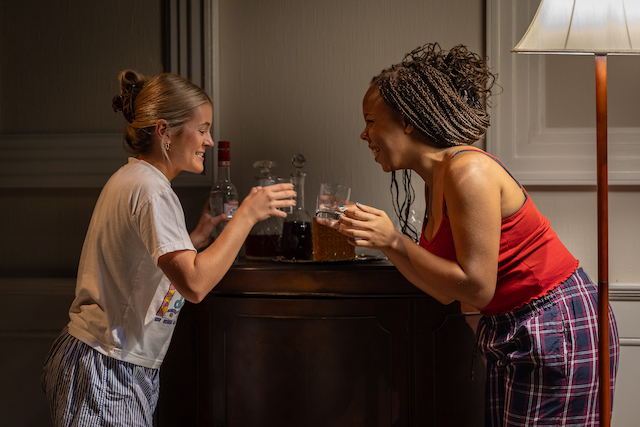 Understanding of autism has advanced immensely over the last decade, but Keatley still skilfully manages to convey how the condition can feel like a minefield both for the person who is autistic and for those around them. Samuel’s autism means that he can brilliantly model a cake that looks like the Pennington family home, yet he also needs to be watched so he doesn’t burn himself in the kitchen. Equally worryingly for his family, his fascination for detail leaves him oblivious to the bigger picture which can lead to alarming misunderstandings – not least when he becomes transfixed by a ladybird on the window of the guest bathroom when it’s occupied.
It’s Giles, Samuel’s long-suffering brother, who’s most impacted as he takes it upon himself to protect Samuel both from the sarcasm of his father and the misunderstandings of the outside world. Chris Larkin nicely conveys the tortured affability of a decent man who has become an emotional punchbag for everyone, including his wife, Zoë Waites’ prim-as-a-hairpin Sophie. Olivia Vinall shakes things up as Alice, the sister once banished by William in a racist rage after she's had a baby with a black man at university. As Aurelia, the now grown-up baby, Taneetrah Porter proves to be, unsurprisingly, a wise head on young shoulders, taming William by refusing to rise to the bait as he shamelessly stirs his family into acrimony.
The whiff of dated values around this script is as distinct as this season’s smell of autumn leaves. William’s combined entitlement and prejudice is offset by the endless patience of his wife, Joanne Peace’s empathetic, self-effacing Olivia, who has clearly sacrificed any sense of self in order to address the tensions in her family. As the adult grandson who most openly challenges William, George Lorimer is a warmly mature presence, while Ella Dale is entertainingly spiky as his younger sister Emily.
You emerge from this play simultaneously feeling as if you’ve taken a gentle walk back in time and thankful that the world has moved on. Keatley’s script holds up well enough, but it’s Noble’s subtle direction – in which the cast doesn’t strike one false emotional note – that gives the evening its pull.











