If a classic story is going to be told for the umpteenth time, there is a good bet it will come with a novel spin on it. So it proves with a new Dracula by Morgan Lloyd Malcolm, directed by Emma Baggott.
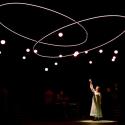
Here, the Count makes just one heavily disguised appearance, and the focal character is Mina (Umi Myers). After a predictable scary start – a sudden thunderclap and total darkness – Mina appears with a lantern. She is our narrator, sole survivor of the terrible events that she and her team of five helpers are going to re-enact. Fear, she tells us, will be her focus, the anxieties that build themselves into our common stories.
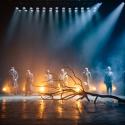
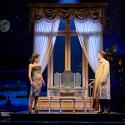
At first, things look promising. This is the kind of production where all hands onstage recreate scenes with props and quick costume changes. Jonathan Harkness’s business trip to the Carpathians to visit a reclusive count is deftly told by cast members crisscrossing the stage holding place names on boards and toting little trees (pictured below). The carriage that takes Jonathan to the castle is, wittily, a posh hotel luggage trolley; the gothic brick walls that surround the set are perfect stand-ins for Castle Dracula.
 The script then gives us all the familiar features immortalised in the novel: the sinister castle without mirrors, lights or servants, where the Count is seen only at night and won’t let his visitor leave; the coffin full of earth in his bedroom. The verbal descriptions of the castle are chilling, however well known, especially the portrait of the Count himself, with his pointy ears and hairy palms. The sound design (Adam Cork) gives sterling support, from the Count’s imperious voice with its eerie echo to the wolves howling in the distance and the doors that open, of course, with a creak.
I settled in for inventive storytelling by a lively crew of actors. Especially as Mina seemed to be increasingly disturbed by the proceedings, as if they were summoning up forces she didn’t want to face. The play now seemed to be becoming a seance, where the company’s playacting might open a portal to a realm of evil. Already the actor playing Jonathan (Jack Myers) was claiming he felt spooked and had to be coaxed by Mina into continuing.
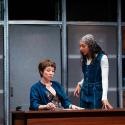
The tracing of the ship’s journey to Whitby is evocatively done, as the crew disappear one by one, until the captain is left alone to lash himself to the wheel. But then there’s a pivot. There are two narratives onstage, not just the story of Dracula but also, a plot line Bram Stoker’s novel didn’t include, the story of his impact on Mina and her relationship with her best friend Lucy (Mei Mac, pictured below with Umi Myers), one of the Count’s victims after his ship arrives in England. The focus now shifts 180 degrees into a story of forbidden love, where what makes people anxious, Mina insists, is not people’s fear of vampires but of the idea of sexual impulses, especially between two women who intensely love each other, while not being free to do so.
The script now devolves into a scramble to take the action back to Castle Dracula, with Mina racing through the dialogue as if she were narrating a Keystone Cops film. The possibly fruitful split performance/seance approach of the first half disappears, and instead we are subjected to an increasingly hectoring lecture, where men are the target that Mina and her ilk will be pursuing. They will now keep up the good work of saving other abused women with their love-bites, presumably.
 I went home feeling confused, until I read the helpful programme essay by somebody researching contemporary gothic drama that outlines previous feminist reworkings of Stoker’s story, including a play by Liz Lochhead. These give Lucy and Mina much greater agency than he did. The essay points out that Lucy’s condition post-bite is described by Stoker (who had two doctor brothers) in much the same terms used in textbook definitions of “hysteria”; it was treated in the 19th century with much the same ham-fisted gynaecological tools we see Van Helsing bring to the despatching of Lucy’s vampire-corpse.
This adds ballast to Lloyd Malcolm’s decision to use the story as a feminist critique. Even so, it feels like an opportunity missed in her retelling of the story that the social and medical background of the novel are not more fruitfully, and overtly, mined. I wish this lively production had been given more of that material to work with. I’m all for assaults on the patriarchy, but they need to be more tightly presented than this.