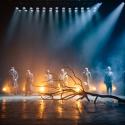
For the first part of Punch it feels as if you’re riding a roller coaster, watching the world speed and loop past as you see it from the perspective of a young man high on hormones and cocaine. He’s 19 years old and in perpetual motion as he zips in and out of the pubs of Nottingham in search of the next girl, the next dance beat, the next drugs hit.
It looks as if he’s having the time of his life, but as everyone in the audience is aware, this is the night that will send shockwaves both through his life and through the lives of a family he’s never met. After a call from a mate saying that there’s trouble kicking off, Jacob Dunne hurtles over to meet him, and throws a single punch at a stranger, James. Nine days later, James dies from the resulting head injuries.
With more than 30 plays under his belt, James Graham has proved again and again the extent to which he has his finger on the pulse of modern Britain. In this Nottingham Playhouse Production – which previously played at the Young Vic – he’s back in the county in which he was born, mapping the emotional turmoil, the economic hardship and the botched state initiatives that have formed the backdrop to Jacob’s life.
Due in no small part to the dynamism of this production – sparkily directed by Adam Penfold who commissioned the play after hearing the real-life Dunne talking about his experiences on Radio 4 – the initial impact is of Jacob’s ebullience. As Jacob, David Shields compellingly captures the cockiness and the devil-may-care attitude of a kid left behind by the education system, while Leanne Pinder’s movement direction makes the opening scenes feel almost like modern dance. (At one point when we hear a champagne cork “pop” all the cast members tilt upwards as if they’re about to take off like champagne bubbles.)
 Yet the brilliance of the production – given real oomph by Anna Fleischle’s acrobatics-enhancing set – is the way that this rush of energy contributes to the intensity when the action slows and Jacob is forced to take account of his actions. After the laughter and giddiness, everyone’s let their defences down, which makes the moment when he confronts the stone cold reality of what he's done even more profoundly sobering.
I should say at this point that I’m writing my review as someone who lost my sister to a head injury when she was 20. In her case it was a van that hit her. But like James’s family we had to take the decision to switch off the life support machine, and like James’s family we had to come to terms with the realisation that a cruelly random event had ended her life.
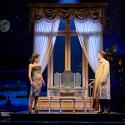
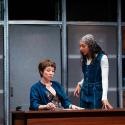
So it’s a credit to both Penfold and Graham that the details of James’s family’s grief felt beautifully observed. There’s not one emotional false note as you watch Joan, James’s mother – played with moving honesty by Julie Hesmondalgh – persuade James’ father, David, that they should get to know their son’s killer through a “restorative justice” scheme.
As Dunne relates in the book on which the play is based, Right From Wrong, the extraordinary relationship that builds between Jacob and James’s parents becomes a powerful example of modern redemption. In the scenes where Jacob is forced to think properly for the first time about James, a paramedic with a love of adrenaline sports, the transfixed silence in the audience was tangible.
At a time when hate is one of our strongest political currencies, this real-life story provides a glimmer of hope about how much better the world might be if more people behaved like Joan. There’s no playing down of the pain that she and David (poignantly played by Tony Hirst) are going through, no minimising of their doubts. Yet in their halting conversations with James, we get a glimpse at what might happen if more people took the time to reach out to boys let down by the system. Political to the core, Graham includes details about the cuts that are endangering even the small number of schemes that already do exist.
This year, as a nation, we have been gripped by the TV series Adolescence, which showed what happened when a fictional teenage boy was drawn into violence through the internet. These stories about toxic masculinity are the stories that are defining our society both in the lower rungs of society and at the highest echelons of power. Punch is one of the few narratives that offers a route out of what feels like a constant downward spiral. If only it could be demonstrated more often that forgiveness demonstrates just as much strength, if not more, than macho posturing, then what else might be possible in these troubled times?