

Those nostalgic for a time when the Haymarket offered big names in well-upholstered plays will have a field day at Grace Pervades, in which David Hare furthers his relationship with Ralph Fiennes. Their partnership includes Straight Line Crazy here and in New York and the solo play Beat the Devil, in which Fiennes actually played the dramatist (15 years his senior) in the tale of Hare's battle with COVID.
This play inhabits notionally less troubled times in its story of two titans of the Victorian era, Henry Irving and Ellen Terry, the latter of whom was the great-aunt of the legendary John Gielgud to whom Fiennes back in the day was often compared. (Both men were notable Hamlets in their day.) In essence, Grace Pervades is a modern-day equivalent of Ben Kingsley at this same address as Edmund Kean, which was playing at the Haymarket when I first moved to London.
And so Jeremy Herrin's production gives us a prismatic view of a bygone age during which actors on occasion had to be encouraged to look at one another and new plays were considered a step too far for many: better to stick where possible to the Bard. The result allows the golden-throated Fiennes to dip into a Shakespeare repertoire which no one of his generation knows as well as he, while allowing a shining-faced Raison to hold her own, and then some. This is true whether the onetime Spooks star is playing "banished queens" or checking in now and again on her two children, both born out of wedlock.
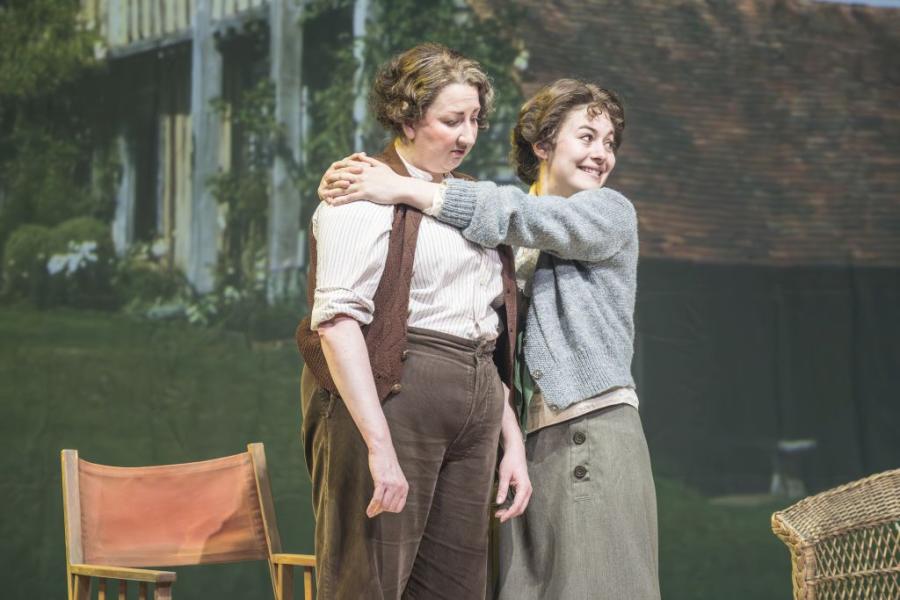
It helps Hare's play retain theatrical focus that Terry's offspring were in fact Edith Craig (Ruby Ashbourne Serkis, pictured above, right with Maggie Service), the gay theatre director and suffragette, and the director and theorist Edward Gordon Craig (a faintly epicene Jordan Metcalfe), who sired at least 13 children and possibly more.
It's not immediately evident from this play that Edward was so priapically inclined, but his story does at least allow the likes of Isadora Duncan and Konstantin Stanislavski to make a fleeting appearance or two. The former - an extended cameo, really - grants Saskia Strallen a nice opportunity to break away from musicals, whilst the latter prompts the appreciative greeting, "Ah, Stanislavski!", which is the sort of thing you don't hear every day.
A large cast bustles about Bob Crowley's handsomely appointed stage in service of their stars, each of whom gets a deathbed scene of competitive corniness alongside numerous chances to strut their rhetorical stuff. Terry yearns to play Rosalind in As You Like It - which Fiennes in fact directed as part of the same season last year in Bath at which Grace Pervades premiered - while a ceaselessly dour Irving appears at one point as Cardinal Wolsey from Henry VIII, which instantly brings to mind fond memories of Fiennes onscreen in Conclave.
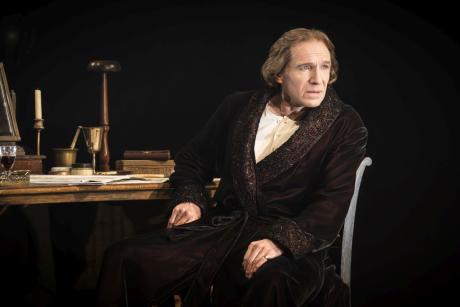
The purpose and essence of theatre get a workout. Terry lets slip that she'd like most of all to be "a successful human being", while Irving confesses that he's more comfortable onstage than off, a sentiment I heard the great Maggie Smith make more than once: art can be more accommodating than life. Fiennes plays up the script's view of Irving as an anxious talent plagued by personal and professional inadequacy, notwithstanding his longtime success in The Bells, duly referenced here. "He doesn't lighten the room," Terry comments of Irving, though Raison herself illuminates the stage with immediate radiance. So, too, does the firm-voiced Ashbourne Serkis, following on very capably here from her Critics Circle prize-winning performance last autumn at the Hampstead in Indian Ink.
The play's title is not, as some have thought, borrowed from the Spanish (!) but in fact represents an excerpt from a longer assessment of Terry made back in the day that "grace pervades the hussy". (You can see why that remark, in full, might sit awkwardly upon a marquee.)
As it is, there's great fascination in pairing this latest Hare offering with the fine West End revival a few streets away of his play Teeth and Smiles from a half-century ago: the raucous work of an angry young writer set against something fittingly more elegiac, as comes with age. Along the way, Hare has shaped the British theatre no less decisively than the personages in this latest play, and if the mere mention here of Peter Brook elicits an appreciative murmur from the audience, there are few theatre practitioners as guaranteed a comparable reaction in years to come as Hare himself - even if this particular offering makes one pine for the glory days of his past.











