

It's nine years since soprano Lise Davidsen gave a Wigmore Hall audience her first credentials as a recitalist, in true partnership with a pianist to whom she's remained faithful since, James Baillieu. Alexandra Coghlan welcomed her then, and while I'd been bowled over by her role in Pappano's Royal Opera Verdi Requiem and was stunned by her Sibelius Luonnotar, I had some questions about the first half of her Barbican recital. Any here were purely a matter of taste; her Schubert programme with Baillieu was finely shaped in every respect. You couldn't fail to love her by the end.
Suffering women gave the recital its backbone, and even here there was infinite variety. My "matter of taste" moment came only with "Gretchen am Spinnrade": frighteningly operatic, where other singers have found a more inward sense of restlessness, and Baillieu's urgency, which could occasionally seem too much, must have been Davidsen-approved. Another dramatic scene in "Der Zwerg" ("The Dwarf") made us visualise and suffer with the dying queen on a fatal boat journey.
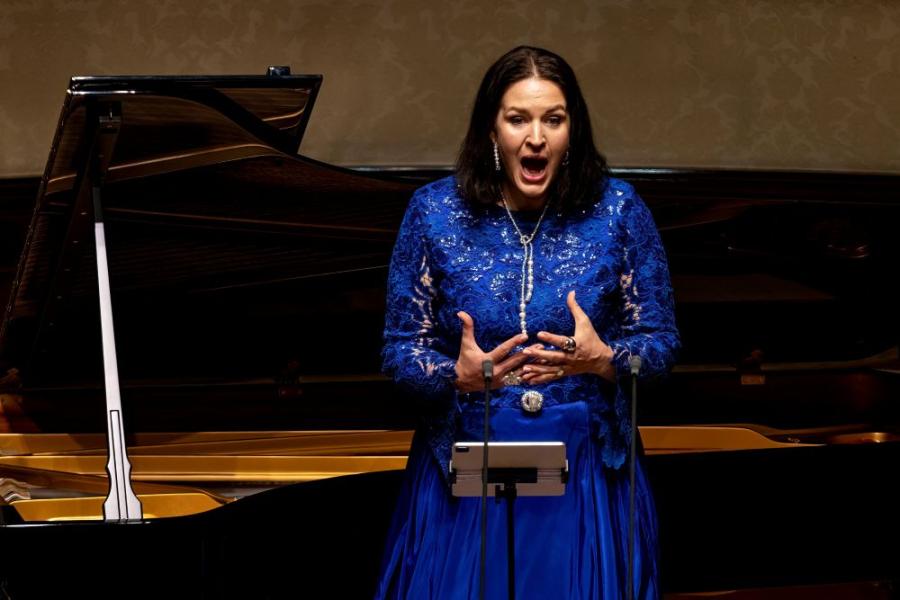
The sequence that followed, the songs of Goethe's plaintive Mignon, began with the full range: when Mignon asks if her friend knows "the land where the lemon trees bloom", it was all smiles, but the third verse's "mountain and its cloudy path" brought forth the Wagnerian universe with which Davidsen has made us so familiar. Three of the later "songs from Wilhelm Meister" found Davidsen at her most poised and inward. You can't imagine her great forbear, Kirsten Flagstad, inscaping and colouring Lieder quite as well as this. "Death and the Maiden" made the perfect sequel, and conclusion to a rich first half.
The soaring joy of "Ganymed" and more perfect poise in "Du bist der Ruh" combined with voluptuousness in "Suleika I", leading us magically onwards from nature-worship to the woman's expected passionate meeting with her lover. In one of her many very likeable introductions - at one point she gave Baillieu the microphone - Davidsen told us that "Der Allmacht" gave aria-like rein to her full Wagnerian apparatus, an opportunity she took against Baillieu's pounding piano chords to the delight of the audience. It's not a lovable song, though, unlike three second-half gems, "Lachen und Weinen", "Auf dem See" and "Der blinde Knabe", where the blind boy's contentment with his lot was so movingly and fastidiously conveyed.
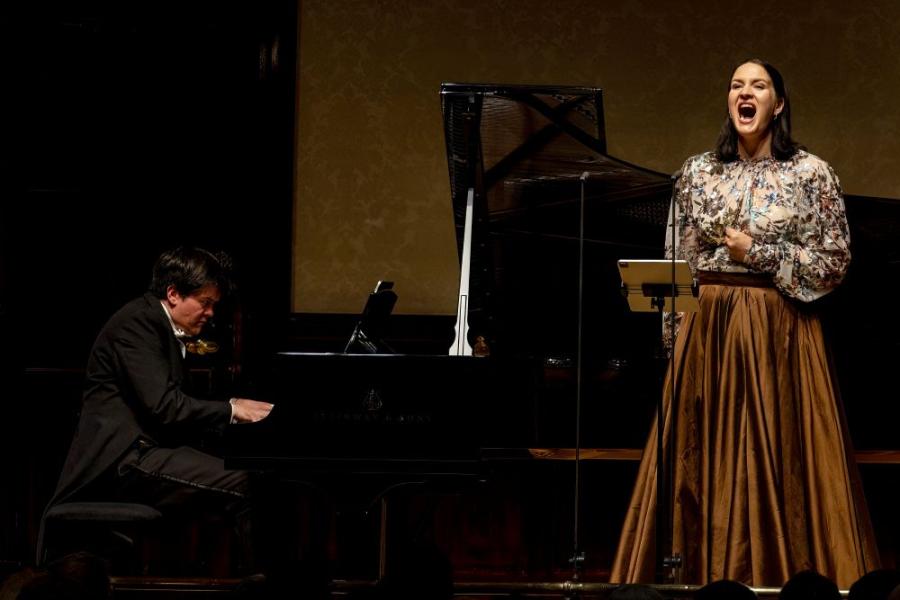
A final official pair gave us extreme contrast again, an ideal double-bill. In "Erlkönig", the most terrifying voice was that of the most terrified, the child; to lay this awful death to rest, we had "Am Tage aller Seelen", "On All Souls' Day", one of the few strophic songs - two more followed as encores - where the repeats are welcome, Davidsen becoming ever quieter in the final verse.
Full marks for presentation in this Wigmore Hall 125th Anniversary Festival concert, too: not just the costume and appearance change for the second half, but also the projection of translations on the back wall, which didn't stop multiple page turns from the audience (why not, I wonder?). Each artist praised us all for making it against the odds (Davidsen gave thanks for that, "for the good things in my life" and for Schubert). Missing the old days when a tube strike would mean I simply got on my bike, I was happy to have walked from South Kensington to the Wigmore Hall, and didn't even resent the more tortuous two-hour journey home.











