In his fascinating but overlong and sometimes unfocussed ‘political life’ of James Joyce – the biographer himself died in 2021 so was perhaps unable to make the necessary cuts to a 909-page text – Frank Callanan gives us a portrait of the artist as a young socialist who became disillusioned with socialism once he left Ireland in 1904 for exile.
It’s an interesting revisionist view because scholarship has often tended to promote a depoliticised reading of Joyce’s work in order to burnish the novelist’s credentials as a god of 20th-century literary modernism, transcending politics in much the same way that he transcended Ireland.
Yet Callanan isn’t the first biographer to see Joyce as a politically engaged writer who somehow became invisible in his handiwork, “refined out of existence” by the scale of what he’d created, rather like Stephen Dedalus’s god in A Portrait of the Artist as a Young Man. The same argument can be found in Colin MacCabe’s James Joyce and the Revolution of the Word (1979) and Dominic Manganiello’s Joyce’s Politics (1980) and even surfaces as far back as Richard Ellmann’s magisterial James Joyce (1959).
Nor did Joyce really transcend Ireland anyway. He chose Dublin as the setting for all of his work — Dubliners (1914), Portrait (1916), Ulysses (1922), Finnegans Wake (1939) — and suffused each of them with the minutiae of the city’s life and language and legend. In Trieste or Zurich or Paris or wherever, Joyce endlessly craved the latest information and cultural detritus from Dublin. In November 1906, for instance, he wrote to his brother Stanislaus from Rome that he’d asked an aunt to provide him with Irish newsprint and books “and to send me a Xmas present made up of tram-tickets, advts, handbills, posters, papers, programmes & c. I would like to have a map of Dublin on my wall. I suppose I am becoming something of a maniac.”
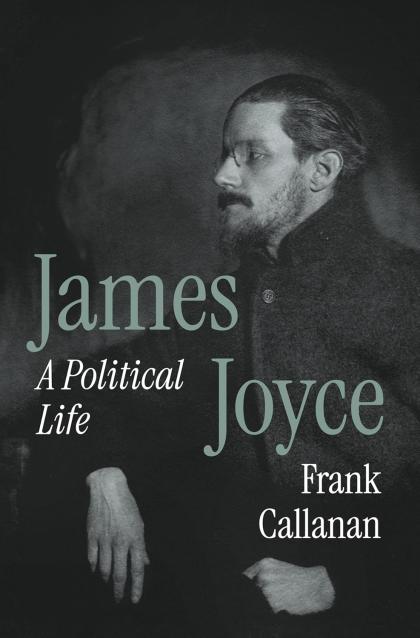
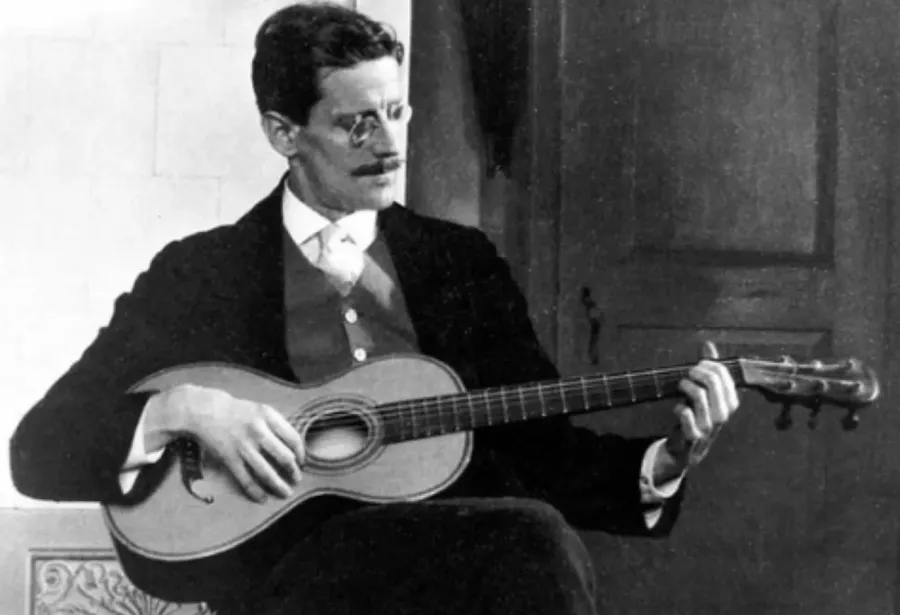
In Rome, Joyce’s short-lived employment as a bank clerk coincided with a meeting of the international socialist congress, and his correspondence with Stanislaus at the time reveals a definite interest in Italian revolutionary syndicalism, echoing calls for a general strike and for “the overthrow of the entire present social organisation” in order to spur “the automatic emergence of the proletariat in trade unions and guilds and the like”. Yet, in reality, as Callanan argues, Joyce’s political outlook was almost entirely homegrown, a pessimistic response to the failure of Irish nationalism during the years of his adolescence. (Pictured below, James Joyce in 1915, by Ottocaro Weiss, Cornell Joyce Collection)
Any reader of Dubliners or Portrait will know that Joyce grew up in the shadow of Charles Stewart Parnell, the nationalist politician whose affair with a married woman led to a split in the Irish Parliamentary Party and thereby delayed Irish independence for a generation. One of Joyce’s best stories, “Ivy Day in the Committee Room”, and the famous Christmas dinner scene in Portrait vivisect the bitterness and stagnation of Irish politics following the downfall of Parnell.
An historian of modern Ireland as well as a barrister by profession, Callanan is very good on Joyce’s rendering of the Parnell myth in almost everything he wrote from Dubliners through “L’ombra di Parnell”, a 1912 article for the Triestine newspaper Il Piccolo della Sera, to Finnegans Wake, published only two years before he died.
Joyce was anti-Catholic, and Parnell was brought down by the Catholic Church. Like Parnell, Joyce was condemned for immoral behaviour – in his case, because he fled Dublin with the unmarried Nora Barnacle. So it’s quite plausible to argue, as Callanan does, that Parnell’s fate influenced Joyce’s treatment of Ireland in his writing, its themes of doubt and betrayal.
The trouble is that Callanan had already published several books including The Parnell Split and a biography of Parnell’s main adversary Timothy Michael Healy, before he spent a quarter of a century researching this project. As a result, too much of James Joyce: A Political Life reads like a rehash of that earlier work, with Joyce himself often confined to the margins or, in the case of some early chapters, hardly even mentioned at all.
Nevertheless there is much here that will interest admirers of Joyce’s fiction, particularly in the chapters about the politically active Joyce of Dublin and early exile, including details of the relationship with his father John Stanislaus Joyce and his friendships with four contemporaries at University College Dublin (Francis Skeffington, Thomas Kettle, George Clancy and John Francis Byrne, the model for Cranly in Portrait).
Callanan is less assured when it comes to the second half of Joyce’s vagabond life, that of the politically distanced author of Ulysses and Finnegans Wake. By this time Parnell is long dead, if not quite forgotten, and Healy has become the first Governor-General of the Irish Free State. Yet, like a hunted stag, the one is still pursued by the other, not only in the pages of Callanan’s exhaustive biography but also in the “politico-ecomedy” of Finnegans Wake: “… but hunt me the journeyon, iteritinerant, the kal his course, amid the semitary of Somnionia. Even unto Heliotropolis, the castellated, the enchanting.”
- James Joyce: A Political Life (Princeton University Press, £38)
- More book reviews on theartsdesk