

Despite Proms appearances, I'm still not sure that Tom Fetherstonhaugh, mover and shaker of the young Fantasia Orchestra, has yet had quite the limelight he deserves for original programming that reaches out, not to mention for the sleek and romantic sound he got from a relatively small body of strings in this lovely sequence (portamentos as apt for Gershwin as for Mahler). Harry Baker also deserves full credit for a chain of wondrous arrangements. But the star, of course, without upstaging her colleagues, was young Irish mezzo Niamh O'Sullivan, fresh from her triumph as the classiest of Octavians in the Garsington Opera production of Strauss's Der Rosenkavalier.
Fetherstonhaugh had heard the wonder of her Jerome Kern approach in a mixed recital, and so she became the last in a fine list of "special guests" across this Smith Square season. The versatility - let's not call it crossover, because everything was treated stylishly, if not classically - ranged from Mahler (Alma as well as Gustav), Strauss and Elgar to Cole Porter and Sondheim. You felt that the conductor might like to have threaded more without applause, in the way he set up for the second half when we moved from the night of Elgar's Chanson de Nuit and Strauss's "Die Nacht" to the day of Chanson de Matin and "Morgen".
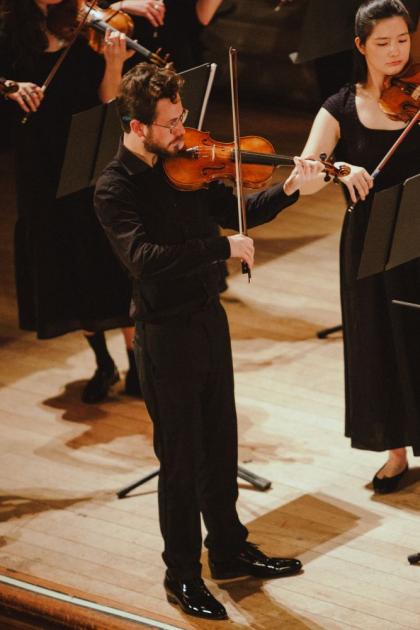
At a stretch, "Send in the Clowns" could have followed immediately too, an introspective treatment by O'Sullivan with the scene set by Toby White's cello solo which pulled us in rather than reached out; bittersweet-exquisite. But lovelier still was "Morgen". If I had to pick a highlight, it would be this. Samuel Staples (pictured left by Pablo Strong with Hana Mizuta-Spencer), whom I last met as a young aspiring professional, played the violin solo more exquisitely than I've ever heard, and the novelty of a mezzo weaving her line at first underneath made this very special indeed.
The bread of a rich two-layer sandwich was Americana both purely orchestral as well as voice plus. Ellington's "Take the 'A' Train" established strings swinging with perfect splashes of harp (drumkit discreet); the opener of part two, Kern's "The Way You Look Tonight", simply one of the greatest songs ever, represented Fetherstonhaugh's diligence. He loved the Morton Gould arrangement, found the only set of parts were lodged in Washington's Library of Congress, contacted Gould's daughter, and open Sesame!
Baker's adaptations were always apt for the ensemble, and he helped to cast the string magic of Schoenberg's Verklärte Nacht over an Alma Mahler summer double bill, "Laue Sommernacht" and "Erntelied" ("Harvest Song"), O'Sullivan colouring carefully to be part of the textures. Before them came Gustav's famous love song to Alma, the Adagietto from the Fifth Symphony. Fetherstonhaugh preferring the supple but not rushed movement of the Mengelberg end of the scale rather than stretched-out Bernstein, and to end the first half a real rarity, Erwin Stein's change of Strauss's early Serenade from wind to strings. it works, and Stein's care to give the lower strings the recap at first provided extra sophistication.
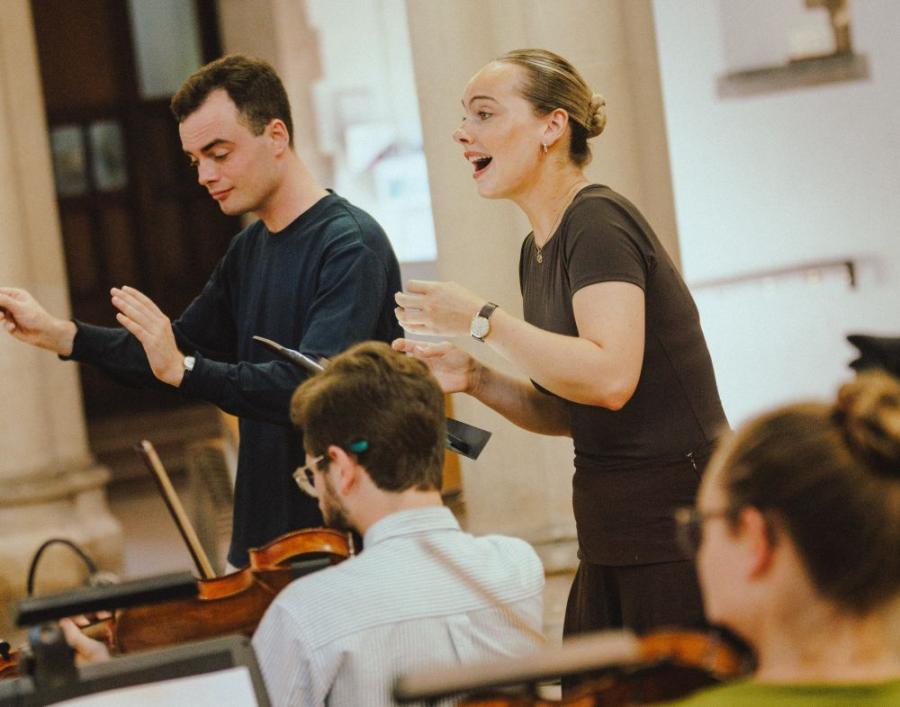
Of O'Sullivan's show songs in the first half (the mezzo and Fetherstonhaugh in rehearsal pictured above by Pablo Strong), "Someone to watch over me" worked better than "Can't help lovin' dat man" (partly a problem, for once, of the string accompaniment), but when in Part Two we moved from the dark moonshine of the Sondheim to broad daylight, "I get a kick out of you" and "Let's call the whole thing off" truly swung, chest voice in splendid use for the ineffable Cole Porter winner. "Summertime" was the spellbinding encore, albeit in brief form. I don't know if Fetherstonhaugh has planned the whole of next season, but a visitor to two of my Ariadne auf Naxos Zoom classes, the dynamic Jennifer France, told me that musicals are her first love, so there's a thought.
- A chance to hear the same programme in the summer setting of Snape Maltings on 2 August
- The Fantasia Orchestra appears again at the BBC Proms on 9 and 11 August
- More classical music reviews on theartsdesk











