Alfie’s back. The eponymous scallywag from the late Bill Naughton’s picaresque yarn set in London’s so-called Swinging Sixties is at it again, canoodling the women and cuckolding their husbands. “Keep them all happy,” he says in cavalier style, “Happiness is transitory, of the moment.” He takes no responsibility other than helping to arrange the odd back-street abortion. Never get attached and never get dependent - these are his watchwords. Life’s a giggle. His attitude to women is expressed by his dated vocabulary – “bint”, “bird” or just “it”. And he’s always on the fiddle.
Half a century after he first came into the world in a radio play for the BBC Third Programme, Alfie Elkins is now brought back to the stage in Bolton, where the author was brought up, originally working as a coal-bagger and truck-driver. It’s all a very long way from the period and the place. (The co-production moves on to the New Vic Theatre in Newcastle-under-Lyme, Stephen Joseph Theatre in Scarborough and the Oldham Coliseum.)
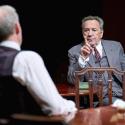
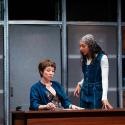
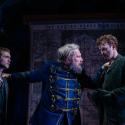
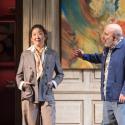
 In David Thacker’s low-key, rather restrained production, David Ricardo-Pearce (pictured right, with Francesca Ryan as Doctor) in the stamina-testing title role, centre stage for nearly three hours, is no charismatic cheeky Cockney. His Alfie seems more plaintive than punchy, although he does catch some of the complexities of the character, the callousness, the tenderness and the humour. “I look on an evening with just one bird as only half the menu, sausage-and-mash without the treacle pud,” he famously says.
Ricardo-Pearce, constantly working the audience, even helps to do a lot of scene-shifting, as the in-the-round production is played out on a bare set, with furniture being moved in and out to keep the piece moving episodically along - although it still lacks pace and drive.
Eight actors play 18 roles, which reduces the play's impact. For example, Isabel Ford takes the parts of sexy Siddie, Alfie’s first conquest in the Ford Zodiac, as well as plain put-upon Lily, who ends up having an abortion. The contrast is diminished because she looks more or less the same in both roles, although the abortion scene, with John Branwell as the businesslike inducer, remains the strongest episode in the play.
 There is some classic humour in the sanatorium, where Alfie tries to wise up Lily’s better half, wheezing bed-fellow Harry (Ken Sabberton), to the meaning of life while being suggestively attended to behind the screens by the nurse.
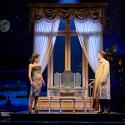
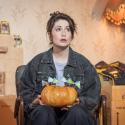
We meet half a dozen of Alfie’s conquests, including maternal Gilda (Barbara Hockaday), home-loving Annie (Vicky Binns, pictured left) and mature blousy Ruby (Francesca Ryan), the only one who gets the better of him and sees to it that he gets his comeuppance. Even Siddie, in this version, stands him up in the end. Leaving him one step behind where he began – a neat bit of circularity.
Bolton is rightly proud of Bill Naughton - this theatre’s studio space is named after him. It is just 20 years since he died and this production is a testament to his achievement. He was in his fifties when Alfie Elkins and His Little Life took to the airwaves. It was quickly taken up for the stage by Bernard Miles at the Mermaid Theatre. In turn, Lewis Gilbert turned it into that iconic X-certificate film, with Michael Caine memorably in the title role, in 1966.
I suspect that Alfie, an amoral creation out of character for Naughton, can now be laid to rest. In today's wicked world, for all his lack of responsibility and constant exploitation of women, Alfie appears as unreal as he is flippant. The novel, essentially a stream-of-consciousness monologue, is still a good read. Alfie has a restless mind. “I sometimes think,” he says, "If only thoughts would leave me alone my life could be happy.” But it never was, beyond transitory pleasure.
- Alfie at the Bolton Octagon until 18 February, then touring