An excellent director makes a rare misstep with Amsterdam, in which a compelling if tricksy play is given an arch and mannered production that only distances the audience further. Not to be confused with either Rotterdam or Europe, two similarly titled plays that in name alone form a de facto triptych, Israeli writer Maya Arad Yasur's short, jagged play doesn't so much challenge playgoers as wilfully try their patience: the 80 minutes (no interval) pass very slowly indeed. (The translation is by Eran Edry.)
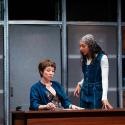
The irony is that Yasur has an important story to tell about the weight of the past on the present – that is, once you get past such ceaselessly coy devices as a bell that is rung every time a foreign word needs translation. Or a narrative style that prefers to report events rather than dramatise them. Style and structure jointly place a great weight on the tireless (if uneven) cast of four who have to enter into the language on cue, like so many members of a chamber quartet. Daniel Abelson amongst them seems most at home with the furious task at hand, though Michal Horowicz (pictured below) adroitly fields her share of the heavy lifting, as well.  What eventually comes into focus is a wounding tale that takes the form of a mystery, at once historical and sociological. How did a pregnant, Amsterdam-based Israeli violinist get landed with a gas bill for 1,700 euros dating back to 1944? The answer involves a labyrinthine rolling back of the clock that folds into an ever-thickening mix Auschwitz, ultrasound sticks, and the Dutch word for slippers. As directed by Matthew Xia, here marking his debut at the helm of Actors Touring Theatre in a co-production with the Orange Tree and Theatre Royal, Plymouth, the play provokes but doesn't especially engage. There are too few of the pleasures that come with the sorts of teasing theatrical puzzles on which Caryl Churchill, to cite one name out of many, has built her brilliant career; one espies nods to Martin Crimp, too, whereas a dash of the urgency that informed Xia's terrific revival at this same theatre of Athol Fugard's Blood Knot wouldn't go amiss here.
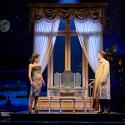
The published text indicates a minimum of three performers but Xia has gone for four, who between them toss back and forth a volley of facts and observations that range from the flippant to the grievous as we learn more about the specifics of where this violinist lives, and those who have come before. Given the circumstances, one expects passing references to Anne Frank, and the potted history of Amsterdam – canals one minute, mottos the next – provides a sense of place amidst designer Naomi Kuyck-Cohen's deliberately faceless set with its mustard-coloured floor. (An old typewriter visible in the corner as one arrives provides a clue of sorts to the ensuing narrative.)
But it's probably not a great idea to freight an already-burdensome evening with a long set change, however much the curtain of chain that gets painstakingly pieced together allows for a cunning and faintly ominous visualisation of canal-side habitation. And the device whereby the actors silence themselves at the mere mention of genocide seems highly dubious: a faux-profound affectation too far for a play that has enough on its sobering mind as it is. Civility and peace seem fictive constructs by the time Amsterdam comes to its revelation-packed end. Wars continue into peacetime, as does prejudice, the play rightly suggests, even as its delivery leaves audiences awaiting the one, albeit metaphorical bell that matters most and allows us to escape the collective artifice and go home.