The Anatomy of Melancholy (or to give it its full title - The Anatomy of Melancholy, What it is: With all the Kinds, Causes, Symptomes, Prognostickes, and Several Cures of it. In Three Maine Partitions with their several Sections, Members, and Subsections. Philosophically, Medicinally, Historically, Opened and Cut Up) is not a succinct sort of work. Running at over 1,500 pages in some editions, this 17th-century answer to self-help is as long-winded as some of the medical sufferers it depicts. Fortunately it’s also slyly witty and wonderfully wide-ranging (covering kissing, crocodiles and cramps, among other things). But is this reason enough to adapt it for the stage?
I think it might be. The book is just that kind of against-the-grain eccentric that could lend itself to radical, slash-and-burn theatrical reinvention. Unfortunately what theatre-company Stan’s Café (who have previous form with such bold concept-productions) offer us instead is a too faithful treatment that doesn’t so much adapt as narrate. And there are flip-charts.
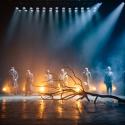
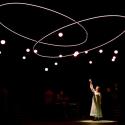
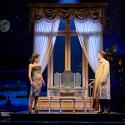
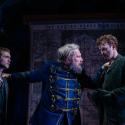
Visually it’s a riot of deliberate anachronisms, and there’s a particularly good episode involving a bag of crisps
For a start it’s much too long. That may seem a cruel criticism given the length of the original, but like all those theatrical or cinematic jokes about tedium and repetition, Robert Burton’s endless curiosities and diversions lose their charm well before the two-hour mark. This needs a Reduced Shakespeare Company-style deftness if it’s to carry off the plotless, discursive, digressive musings of its author.
Burton himself is quite the character, pronouncing on topics wildly removed from his own quiet, academic existence in Oxford. There’s a glee to his magpie hoarding of other people’s facts and quotations and a witty eye in combining them, but the sheer volume of material here weighs in down. It’s not helped by an over-reliance on flip-charts (presumably to give us some sense of the architecture of the whole – something we could quite easily do without) and a rather self-conscious work-in-progress concept that sees the four cast members rewriting as they go, tearing out pages and rethinking things as though Burton himself – playwright manqué - were adapting his material for the stage.
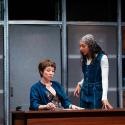
 Visually it’s a riot of deliberate anachronisms, combining ruffs and breeches with high-top trainers, and there’s a particularly good episode involving a bag of crisps. It’s laid back and effective up to a point, but too fussy for sustained effect. The four actors – Gerard Bell, Rochi Rampal, Graeme Rose and Craig Stephens – are animated and amusing, but it’s hard not to feel like they’ve been given an impossible task and no real dramatic ammunition to tackle it.
In an age where depression is ever more ubiquitous, Burton’s musings on “melancholia” feel shockingly modern. Little has changed, it seems, either in medicine or life. Diets, parenting, bad neighbours and bad marriages all come in for discussion, though discussions of astrology and witchcraft do remind us that we are in another time. Eventually Burton reaches the inescapable conclusion that everything causes melancholy, and all attempts to ward it off are futile. Burton himself may have triumphed (“I write of melancholy, by being busy to avoid melancholy”) but trapped in his company for so long, the same can’t sadly be said of the audience.
- The Anatomy of Melancholy is at Ovalhouse until 30 November, 2013