

Musicals don't get madder than Anyone Can Whistle, the 1964 Broadway flop from onetime West Side Story and Gypsy collaborators Stephen Sondheim and Arthur Laurents which makes history of sorts at Southwark Playhouse as the first Sondheim show to be revived since his death last year, age 91. What this trailblazing talent never short of an opinion might make of Georgie Rankcom's production is anyone's guess, though I suspect he would admire a sizeably non-binary set of artists gathered on a show about otherness and non-conformity.
I for one began proceedings with a grin on my face, prompted largely by some thrilling vocals from Alex Young as Cora Hoover Hooper, the mayoress of a town badly in need of a miracle (main picture: Alex Young and Danny Lane). But as Laurents's book burrows its echt-1960s way into territory that throws questions of sanity up for grabs and seems pitched somewhere between Marat/Sade and Rowan and Martin's Laugh-In, I began to thirst for a curative dollop of quiet or nuance or something of that sort.
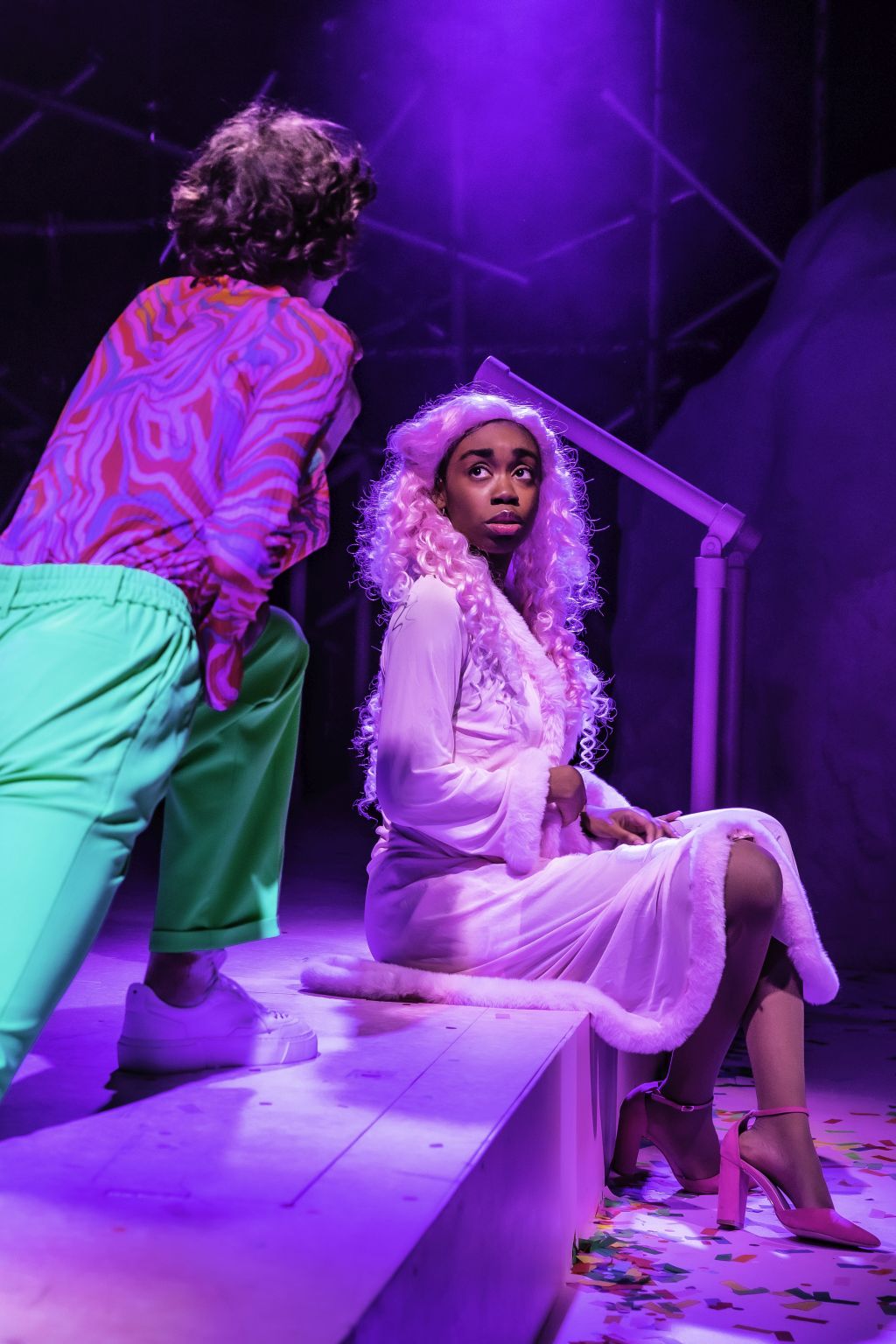 Instead, Rankcom's approach seems to be to come out all guns firing – or should that be all trumpets blaring given an often-thrilling score (known to Sondheim devotees from many starry concert performances over time and even the odd fringe revival here) that includes the military-sounding "There Won't Be Trumpets", cut during previews but now inextricably linked to this show. Someone somewhere is sure to write a PhD thesis about the lyrical emphasis on brass instruments in 1960s musicals ("Cornet Man" from Funny Girl, "I'm A Brass Band", from Sweet Charity), not to mention a collective interest in parades: Funny Girl, premiered on Broadway the same year, again features in this category ("Don't Rain on my Parade"), whilst Whistle includes the Mayoress's anthemic "There's A Parade In Town". Not to be outdone is "Before the Parade Passes By", again first heard in 1964, on that occasion in Hello, Dolly!
Rankcom's approach to a story that pits the gleaming-eyed Mayoress against the reason-loving Fay Apple, a psychiatric nurse with an evident penchant for French, is to put everything on overdrive, amplified (very literally so) by striking new orchestrations from Charlie Ingles for musical director Natalie Pound's hard-working five-piece band. The cast, by contrast, might deliver more likably as the evening goes on if they weren't trying quite so forcefully, and the efforts to bring the audience into the mix seem a misguided attempt to roll over into this show the question asked of us at the end of Sweeney Todd: "Isn't that Sweeney there beside you?"
Indeed, a photo in the programme finds company member Nathan Taylor ("happy with any pronoun", he indicates next to his bio) striking a Sweeney-esque pose, even if the response of that 1979 Sondheim anti-hero to the shenanigans on view here would be to make them into so many meat pies. Or, perhaps, cookies, to co-opt the name given the denizens of the local mental asylum known as "the cookie jar". I'd love to know what psychedelics were at metaphoric (or even actual) play at the time to deliver "Come Play Wiz Me", a lunatic duet for a wigged Nurse Apple (Chrystine Symone, pictured above with Broatch) and her putative amour, Hapgood, who is given a Pippin-esque vibe (another show about that delights in the zany) by Jordan Broatch, who on this evidence would be perfect casting if and when Timothee Chalamet's life story itself becomes a stage musical. (Well, Anyone Can Whistle is here to remind us that shows can spring from anywhere, right?) The bright, brash designs suggest a comic book come to life, which may not be a helpful comparison to bring to mind.
A musical that crowns a "king and queen of madmen" needs someone akin to Ionesco to lend a proper surrealist throughline, though Ibsen gets referenced via Peer Gynt not once but twice. And Sondheim completists will note a beaming comment voiced by Broatch to "being alive" even if Company, the show containing the song of that very title, seems galaxies away from this belligerently counter-culture confection that leaves you humming many a notable tune and tapping your feet in impatience at the same time.











