What is truth? Is it fixed or fluid, personal or universal? Does it require hard evidence or merely faith? These are the areas of interest poked and prodded in this co-production between the Traverse and Peepolykus, the company which previously brought The Hound of the Baskervilles to the stage. The result is an eccentric romp through the life of Arthur Conan Doyle, a famously ridiculed figurehead for the spirit world in his later years, which ponders – none too deeply, but with immense good humour – the conflict between fideism and rationalism.
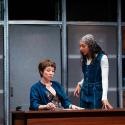
Doyle’s story is presented here as an illustrated lecture by PhD student Jennifer McGreary (Gabriel Quigley), aided by two hapless hired actors, Javier (Javier Marzan) and John (John Nicholson). It’s a slightly stodgy device, but wittily realised, enabling the play to leap back and forth between the past and present, the real and imagined, and allowing Jennifer to converse with Conan Doyle, as well as some choice Sherlock Holmes cases to be brought hammily to life. Woven in between is a farcical, fictionalised account of the inner workings and internal tensions of the theatre company itself, fresh from a 52-date Highland tour which has clearly taken its toll. Often, one scenario elides into the other, as when a table-top tussle between Moriarty and Holmes on Reichenbach Falls rapidly descends into a battle between John and Javier for the heart – and a few other bits – of Jennifer.
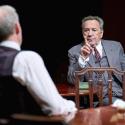
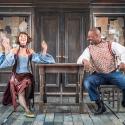
 A comedy moustache is passed around as each of the three actors take turns playing Doyle, tracking him through the creation, demise and resurrection of Sherlock Holmes, the death of his first wife and child, and his role as willing dupe to the two schoolgirls – played with delightful silliness by Marzan and Nicholson (pictured right) - who present him with the Cottingley Fairies.
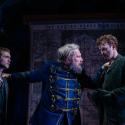
The irony of a spiritualist being trumped by the vice-like rationality of his most famous character is neatly teased out, particularly in a vividly presented scene from The Hound of the Baskervilles. This ideological stand-off between the author and his detective is mirrored in the views of staunchly pragmatic John and mystical Javier (“I 'ave powers”), with Jennifer hovering somewhere in the middle seeking answers. It transpires that she has her own connection to the spirit world via her beloved and recently deceased granny Mooney.
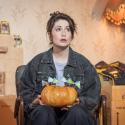
The three terrific actors carry the play through the script's occasional moments of indulgence and the odd rather aimless excursion. Gabriel Quigley not only anchors the proceedings with flashes of real emotion but is also very funny. John Nicholson, who wrote the play with Steven Canny, is a boyishly likeable straight (ish) man, while Javier Marzan – part deranged circus barker, part Fawlty Towers’ Manuel – steals the show with his wonderfully expressive face and ability to wring every last drop of comedic juice from each scene. In their affectionate tussles he and Nicholson evoke both Morecambe and Wise and Crosby and Hope.
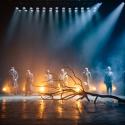
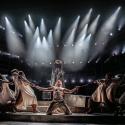
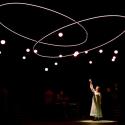
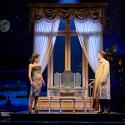
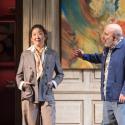
 Orla O'Loughlin directs with joyous verve, while there is considerable invention in the set design, sound and lighting. While the first act is spare and deliberately shambolic, the broad physical comedy enhanced by malfunctioning mikes, stray flexes, dodgy plugs and random explosions, the second half is more expansive and theatrical. A vast back projection screen evokes London, Dartmoor and Edinburgh at night, creating a suitably magical and somewhat more reflective atmosphere over which the events unfold. The scene in which Doyle meets Harry Houdini and his wife (pictured above) provides an opportunity for Nicholson to pull off some nifty illusions, while Quigley gets a well deserved chance to be huskily sexy.
In the end all but the most rudimentary philosophical points are sacrificed in the name of fun, farce, gags about Brian Cox DVDs and the chance to play the theme tune from The X Files. But even if there is little real substance behind it all other than the concluding plea for mutual tolerance and understanding, this is a consistently inventive and wonderfully funny two hours. Full of warmth and laughter, as a love letter to the power of imagination it is itself suitably imaginative. And who wouldn’t want to believe that after tumbling over the Reichenbach Falls Holmes spent the next seven years “running a tapas bar in Ibiza”?