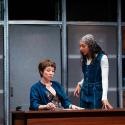
Lila had breast implants at the age of eight. Karen, her mother, is required to take psychotherapy sessions on account of the fact that she arranged for the operation. Tessa (played by Monica Dolan, pictured top and below) is a psychotherapist who is treating Karen.
In the course of The B*easts, a tight hour-long monologue written and performed by Dolan, Tessa lounges in an easy chair and drinks and puffs, occasionally fielding calls from her mobile. She is frustrated and wired (possibly through fatigue) as she relates Lila and Karen’s case history, which emerges as a prism through which to comment on the nature of the gap between who we are and who we could be in relation to the societal structures that tell us who we should want to be (specifically if “we” are women).
 Dolan’s performance as Tessa is almost flawless. Her expostulations, self-interruptions and tangents are uncannily true to life: “And is it healthy? I mean, it’s debatable. Women’s magazines. Well, it’s not debatable really. They’re pretty unhealthy for women, they’re pretty shit.” At these moments it is not Dolan on stage, but all Tessa. Tessa is middle-class and caring. Tessa wears clothes in different shades of wheat and is prone to bouts of liberal outrage. She occasionally draws on unintentionally extreme analogies, and is surrounded by friends and family to whom she probably can’t quite adequately express the variety of moral grey areas she encounters in her day-to-day work.
Time and again she unpacks Lila’s desires and Karen’s reactions to her demands, asking the audience to look carefully at who should be the focus of the moral outrage, or rather, who should take moral responsibility: a four-year-old child who imitates sexy MTV dances, or the “hundred businessmen” who decide that should be the norm to which she's exposed. She also highlights distinctions in class and taste: Karen, who like all mothers wants the best for her daughter, is “Essex-y, but not from Essex”, formed in the image of the magazines she reads – magazines that bay for her blood once her role in her daughter’s breast implants comes to light. She is by far the easier subject of opprobrium than the mother not in thrall to high-heels and blow-dried hair.
The only slightly stale notes are attributable to the writing. An odd tick whereby someone is mentioned in the third person and named directly after (ie: “she, Karen”) is overly artificial. It may be included to remind us that Tessa is breaching patient confidentiality by talking to us, or because there are so many women involved the “shes” can become confused, but it’s a construction seldom used in speech and clearly awkward to perform.
Another more fundamental problem is that Lila is neither quite surreal enough to provoke extreme reactions, nor quite realistic enough to excite sympathy. She hovers as a chimera symbolic of society’s ills, its unbalanced power dynamics and hypocrisies. In this sense she is the ultimate victim, her entire identity predicted upon the extremes of capitalism and patriarchy, but it also makes it hard to sympathise with the terrible things she goes through, and while sympathy is not a prerequisite of drama, given Tessa’s naturalistic portrayal, it appears quite likely desired.
Finally, one question remains: the telephone calls that intersperse Tessa’s monologue mean we, the audience, are watching things unfold in real time, but who are "we"? Are we Tessa’s conscience? Her dictaphone? Monologues need to be addressed to someone, else the point gets lost.