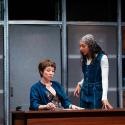
There’s a vivid moment in this Joe Penhall revival when Christopher, a psychiatric patient suspected of suffering from paranoid schizophrenia, finds himself caught in the linguistic crossfire between his two rival care-givers. Oblivious to everything but their argument, the doctors continue to shout across their subject as he sinks to the floor, the tormented vertex in a taut dramatic triangle. Never mind the ones inside – it’s the voices outside Christopher’s head that seem to be doing the most damage.
When Blue/Orange was first staged, winning the Olivier Award for Best New Play at the National Theatre in 2000, New Labour’s age of silver-tongued spin was at its height. This isn’t just a play about how we approach mental illnesses and how we treat ethnic minorities. It’s a play about the language we use to talk about them – and around them, and over them. Come the end of Christopher Luscombe’s new staging for Theatre Royal Brighton Productions, the air is murky with "signifiers" and "perjorative epithets" and "cultural antecedents" and "ethnocentricity". Apparently every successful psychiatrist, like every successful politician, must be a player of semantics first. Linguistic slip-knots tighten around Christopher the more he pulls against definition.
 Bruce (Gerard McCarthy), a junior doctor in a mental hospital, has asked his supervisor, Robert (Robert Bathurst, pictured right) to sit in on a final assessment. Christopher (Oliver Wilson), a 24-year-old black man from Shepherds Bush who has been sectioned under the Mental Health Act, is nearing the end of his statutory 28 days' care. But he appears to be suffering from paranoid delusions – he claims he is the illegitimate son of Ugandan dictator Idi Amin; he says that the oranges in the fruit bowl are blue. Bruce, who seems to have Christopher’s best wishes at heart, thinks he needs to be detained. Robert, who admits he needs to free up beds, is insistent on releasing him into care in the community.
Just how corrupt is Robert? Just how righteous is Bruce? Just how mad is Christopher? The play launches powerfully with – but frustratingly never gets beyond – these three interlocking questions. Satisfyingly vicious as this fleet-footed cast make it, the heavy comic irony of Robert’s egomaniacal insensitivity and Christopher’s comparative reasonableness also becomes rather repetitive. But Bathurst is disturbingly impervious as the RD Laing-quoting consultant whose air of patronising paternalism and suave disinterest masks sharp cynical ambition – he soon sees that Christopher could prove useful to his paper on "a cure for black psychosis". Only when Bruce insults Robert’s precious rugby game with trademark Penhall flair ("It’s just a bunch of hairy twats biting each other’s ears off") does his complacency seem remotely shaken.
 McCarthy (pictured left with Wilson) has still fewer places to go with Bruce, and spends much of the play loudly disbelieving Robert with his hands on his hips. But it’s Oliver who gets the toughest role in a play partially inspired by the fact African-descended Londoners are far more likely to be diagnosed with a mental illness (Penhall keeps the "why" open, while suggesting a very recognisable urban aspect to many of Christopher’s fears). Repeatedly sent from the room and summoned back again, Christopher agitatedly packs and unpacks his pyjamas and toothbrush offstage, changing his mind about whether he wants to be discharged almost as frequently as his doctors. It must be tricky not to make this character’s every line seem either a tick or a cross in the "mad" box, and Oliver is best when communicating simple, universal, pitiable fear.
Colin Falconer’s chicly clinical set does rather stick a spanner in Blue/Orange’s political premise – furnished in gleaming metal, polished glass and spotless white leather, it’s hardly suggestive of a cash-strapped NHS consulting room. Then again, neither is Penhall’s fruit bowl.