

Although overwhelmingly remembered now as a novelist, Somerset Maugham was best known during his lifetime as a playwright. “England’s Dramatist”, as the newspapers christened him, produced more than 20 plays spanning the length of his career, outdoing contemporaries Shaw and Rattigan for popular and critical success. But his was not an enduring fame, and with his work now strikingly absent from the theatrical repertoire, any revival must inevitably face the suspicious question: why?
Romping its way through questions of “love, beauty and the economic situation” (with a few theatrical detours to discuss war, parents and children and the nature of youth), The Breadwinner answers critics with a stiff upper-cut to the stiff upper lip stereotypes of British postwar drama. Tortured vowels and tennis whites are (inevitably) the order of the day, but some more palatable Maugham soul-searching does grope its way out through dense social comedy, leaving its audience morally improved but also guiltily entertained.
Tortured vowels and tennis whites are the order of the day
It’s far too long however, even played straight through as Maugham intended, and with the addition of two intervals it does try the patience. It’s nothing that a few judicious cuts from director Auriol Smith couldn’t fix, and indeed a brisker edit of the repetitious opening section would pace the unfolding story rather better. But a fine cast, led by Ian Targett as stockbrocker-turned-flaneur Charles Battle, have a great time with Maugham’s acid dialogue, and it certainly plays well to the Orange Tree’s Richmond demographic.
 A long opening setup feels overdone as Nathalie Buscombe (Judy), Joseph Radcliffe (as her brother Patrick), Sarah Schoenbeck (Diana) and Jeremy Lloyd (Timothy) all graft their way through the thematic exposition. Aren’t the young callow; aren’t they just too pompous for words, Maugham exhorts, striving rather too hard with the comedy. Accents vary across several decades of RP, and period-poise slips in and out of artificiality and affectation. But as the writing improves so do the performances.
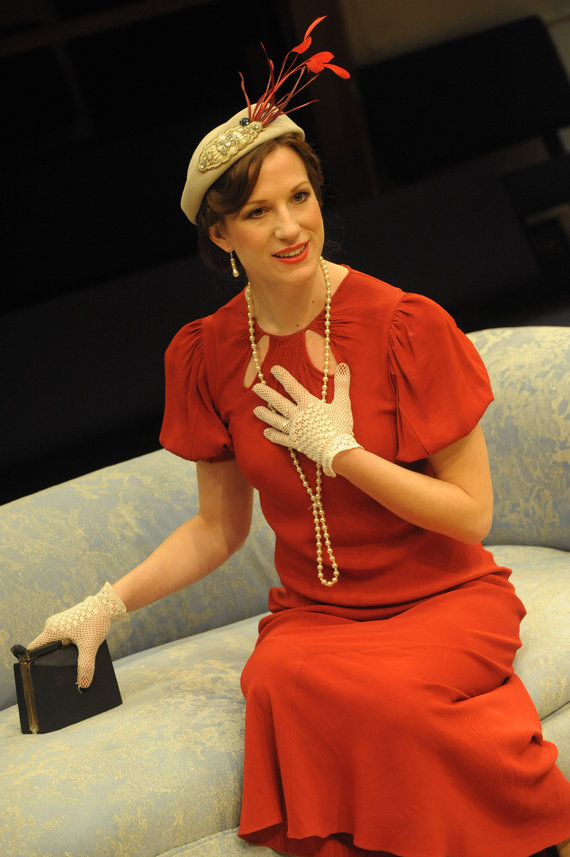
Cate Debenham-Taylor’s Margery, misty-eyed over a top-hat that reminds her of the babies of sad Armenian folk-songs, is a delight, but if anything outdone by Isla Carter’s vampish Dorothy (pictured above right). Taking a brief swerve into farce, Fisher amps up the comedy deliciously just as things are getting slow, setting up a further lurch into the unexpectedly tender sincerity of a father-daughter moment between Targett and Buscombe.
The conflicts of a generation blighted by the mistakes of their elders, a shock economic collapse and the resulting questioning of authority – The Breadwinner is almost awkwardly topical. Some of Maugham’s political observations could have been written this week for a television satire, and the Golders Green microcosm feels no less revealing to a 2013 Richmond audience than it would have done at the premiere in 1930. With very few tweaks this is a play that could bear a lot of updating, and it might have been nice to see a more radical approach to this revival. What it would have lost in cucumber-sandwiches-and-kitsch it could have gained in social and political heft.
Maugham is most celebrated as a storyteller, preserved most often in film and stage adaptations of his fiction (as with Before The Party at the Almeida). But here he proves himself a skilful writer of dialogue too, every bit the equal of Shaw for bladed wit and Rattigan for emotion without sentimentality. The theatre has let others speak on Maugham’s behalf for too long. His is a witty and prescient voice, and one well worth taking the time to hear.











