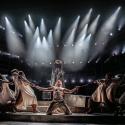
Better than the 2001 film but likely to disappoint devotees of the book, Captain Corelli's Mandolin onstage works best as a reminder of the identifiable stagecraft of its director, Melly Still. Playful, non-literal, and often endearingly physical (the human goat all but steals the show), Still's approach to this tale of love during wartime overrides a reductive and sometimes comically cliché script from Rona Munro full of lusty Italians singing Verdi and the like. As summer filler at a playhouse devoted for most of the last year to Harold Pinter, one could do a lot worse, and the two leading performances suggest that Madison Clare and Alex Mugnaioni are more than ready for the big time.
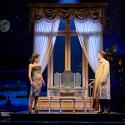
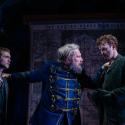
The pair play Pelagia and Corelli, she a Greek islander with dreams of being a doctor, he the musically-minded Italian who has been posted to Cephalonia during the Second World War only to upend a previous romance that Pelagia had with the illiterate if well-meaning Mandras (Ashley Gayle, inheriting Christian Bale's screen role). For much of the first act, you wonder whether Corelli will actually amount to more than the glowering presence with a halting gait whom we see hovering around the periphery of events. But once Mugnaioni's charismatic, notably English-seeming Corelli enters into the action for keeps, the story lifts off in its depiction of an enemy-occupier who comes to embody artistry and love. For all the Journey's End-style reminders of the depredations of war, the spirit of the piece tilts in the direction of Brief Encounter.
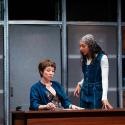
 Their burgeoning love story is inevitably compressed – arguably too much so in relation to the Louis de Bernières novel – and then oddly attenuated for an epilogue of sorts that seems to go on forever. But it's set neatly against the clamped-down anguish of the secretly gay Carlo (Ryan Donaldson), the Italian soldier who leaves his own lasting impression on the ruminative leading light of the musical world that Antonio Corelli becomes. Worthy of a name-check all its own is "Antonia", to cite the name afforded the mandolin that Mugnaioni plays live with entirely winning ease: a Sunday evening cabaret ("Mugnaioni at the mandolin?") surely beckons at some point during the run. (Antonio and "Antonia" are pictured above)
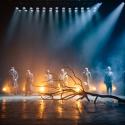
Lacking the roving camera from which any movie situated on a Greek island is likely to benefit, Still, as director, and her adroit designer, Mayou Trikerioti, instead forsake postcard-pretty visuals in favour of an angled metal sheet whose visual ripples suggest the shifting fortunes, and topography, of this unexpectedly wartorn community; Malcolm Rippeth's shimmering lighting conjoins with Dom Baker's projections to communicate a locale in flux, as first Italians and then Germans upend a populace who, it's suggested late on, will simply replace one war with one another once the partisan movement takes hold. Britain, incidentally, doesn't come out of the narrative at all well and is more than once derided for implementing a blockade; the islanders take to scavenging for snails so as to have something to eat.
The theatrical knowhow on abundant display amplifies one's disappointment in a gatheringly soapy text given either to bald-faced pronouncements ("hope is danger, love is treachery," Carlo at one point opines) or to melodramatic musings worthy of a Movietone newsreel: "a terrible darkness has fallen across the world".
One feels, too, for those cast members relied upon mostly to be colourful, chief amongst them Eve Polycarpou as Drosoula who has a thing or two (or three) to say about the difference between love and marriage. Still, the two leads chart a winning courtship whereby the familiar feels entirely fresh, and their subsequent reunion in later life tackles the corresponding thicket of emotions head on. And in the interval, I surely wasn't alone in searching in the programme, alas in vain, for special holiday packages to Cephalonia. Until that happens, at least playgoers wanting a welcome taste of Greece onstage now have something else to consider besides Mamma Mia!