

In Dublin, a city that has changed more than most in the last 30 years, a young woman, with an English accent that is expensive to acquire, is cycling through sexual partners. We eavesdrop on their conversations, witness the physical intimacy fade as the psychological intimacy hesitantly grows, in that strange vacuum in which you realise that you know everything and nothing about the person in front of you.
There’s an awkwardness, both thinking “Sure that was fun, though I’m not sure this is and… what’s next?” Mark O’Halloran’s two-hander won Best New Play at the Irish Times Awards in 2022 and makes its London debut in a space not much bigger than a family home’s master bedroom. Director, Jess Edwards, pushes that proximity vibe further by dominating the playing area with a king-size bed, making us voyeurs peeping, not from outside, but from inside that private domain. Early on, a key content warning is vindicated, but that also pulls us further into the relationships that play out between the woman and her lovers. It’s not quite discomfiting, but it’s not quite ease-inducing either.
It’s a good start, but it’s rather downhill from there as the play becomes too static. Wild dancing and a little half-hearted simulated sex provide some movement, but the bed, now somewhat redundant, squats in our eyeline. The post-coital conversations descend into familiar accounts of ennui, alienation and debilitating mental illness. There’s humour in some of the early conversations, but the tone becomes steadily darker, relationships limping along or failing (some catastrophically) and a miserabilism flattens the joy of sex the lovers found at the start.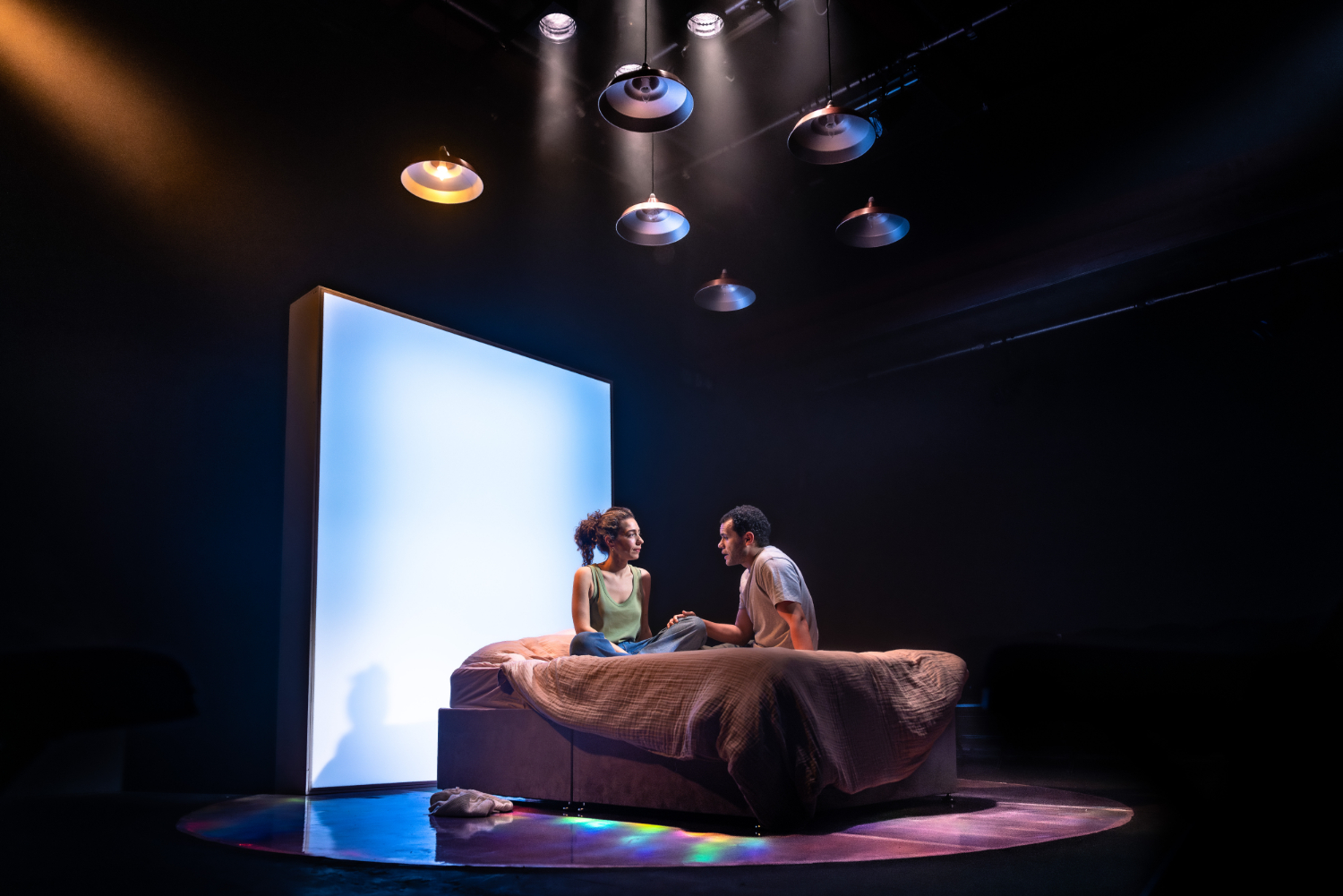 Julian Moore-Cook (pictured above with Olivia Lindsay) plays the succession of men that drift into the unnamed woman’s life. They’re largely emotionally adrift too, but would probably agree with Woody Allen – “Sex without love is a meaningless experience, but as far as meaningless experiences go it's pretty damn good.” Moore-Cook does some good accent work, but it’s tricky at times to catch whether he’s a new lover or a returning friend with benefits, which both irritates and distracts from the narrative thrust of the play.
He can at least extend his range, which is more than can be said for Olivia Lindsay, who has to spend a lot of time wearing a look that says, “Are you for real?” and a lot of time lamenting the fact that enjoying sex is not the same as enjoying the company of men. She isn’t just running away from commitment though, she’s also running towards the exorcising of a guilt she can never lose, which has frozen her emotional development, PTSD crowding in. Lindsay is rather stuck with a male writer’s idea of what a female character would say and do and it doesn’t quite ring true.
Jo Herbert arrives three times playing the role of a partially estranged sister, but the character seemed superfluous at the time and seems even more so in this write-up.
Perhaps there’s always been a market for watching relatively wealthy people lament that their lives are an empty emotional wasteland blighted by the spectre and subsequent reality of mental illness, but one feels that there have been so many plays that address these issues since the pandemic that they have to be sophisticated and subtle to stand out. This 90 minutes all-through production has potential, but rather fades into a well-worn narrative that squanders our initial investment in its lost girl and lost boys long before time is up.











