Nowadays, playwrights do their apprenticeships at university, studying drama. But, once upon a time, they had proper jobs before they started making theatre. Such is the case of the late Michael Hastings, who died in 2011 and whose most famous piece is Tom & Viv (about TS Eliot and his wife). Before becoming a playwright, he worked for three years as a tailor's apprentice. The Cutting of the Cloth, written in 1973 and accumulating dust in a bottom drawer ever since, is based on those early work experiences. But is it worth staging?
This is a wintry play
for a cold night
The story is set in Savile Row and takes place during just over a year between 1953 and 1955. In the cellar of a gentleman’s tailor is a chilly workshop where two craftsmen work long hours for little money. They are vividly contrasted: the Polish-born Jewish Spijak, a widower given to shouting, believes that hand-sewn suits are the mark of true craftsmanship; Eric, a Londoner and bachelor, uses a sewing machine to improve his productivity and his income.
Both master craftsmen have female helpers — tailoresses called kippers (because they looked for work in pairs to avoid sexual harassment): the older Iris, who helps Eric, and the younger Sydie, who is Spijak’s daughter. Into this isolated world, with its own vocabulary and traditional work practices, comes Maurice, Spijak’s 16-year-old apprentice, who at first has aspirations to become a playwright. In one sense, this is a traditional 1970s work play; in another it is a family drama and a coming of age story; in yet another it is about the passing of an old way of life.
 At the tragic heart of the play is the figure of Spijak, a master craftsman and lone drinker, who sees a hand-sewn and perfectly tailored suit as man’s closest brush with heaven. If work demands a 14-hour day, then work will get 14 hours from him — even if it kills his wife (who was also Eric’s sister). In one moment of meditation, we learn that their love life was arid, for Spijak’s main desire is to excel at work. By the time Maurice arrives, he is known as “a bleeding tyrant”. For the teenager, the play begins in fear and trembling.
The Cutting of the Cloth is a real drama of feeling. Not much happens over the duration of the evening, but a deep sense of real life being lived is evident and all of the characters are deftly drawn. As time passes, a sense of tragic inevitability grows, which, despite the humour of the writing, shades into an exquisite feeling of deep sadness. This is a wintry play for a cold night. If you can, sit under the air con.
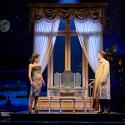
It is also a real find. Discovered by Two’s Company, it is sensitively directed by Tricia Thorns on Alex Marker’s set, which is so realistic you can almost feel the loose threads tickle your nose. The cast is superb, with utterly convincing performances by Andy de la Tour (Spijak), Paul Rider (Eric), James El-Sharawy (Maurice), Alexis Caley (Sydie, pictured above with Rider) and Abigail Thaw (Iris). Although I wasn’t entirely comfortable with the fact that one tearful moment was played for laughs, the show did convey a wonderful sense of a world and a sensibility we have lost. Yes, this feels like Zen and the art of tailoring — real craft, real quality, no rubbish.