

You don’t have to be Scandinavian to act out Strindberg’s fantastical extremes at the highest level, but I’ve not seen any British performers come close to what Norwegians are giving us right now at the Coronet Theatre. Expectations ran high following Pia Tjelta’s lacerating performance in Ibsen’s Little Eyolf in 2018 and her Ellida in The Lady from the Sea the following year, and here, as then, she and her colleagues are simply stunning.
The claustrophobia of the house on a tiny Swedish island where a disappointed military man and his former actor wife ritualise the love-hate of a 25-year-old marriage – way more hate than love – and corrupt an old friend works so well in the close quarters of the decayed Coronet Theatre. On Saturday night technical hitches twice brought the action to a halt. An impressive member of the dedicated audience asked director Marit Moum Aune to fill us in on how she’d worked on the production while we were waiting. In the absence of a printed programme (bring them back, please, Coronet), that simply enriched the experience as far as learning what had been cut, and why, as well as the difference between the larger venue of the Norwegian National Theatre, where this was first staged, and the intimacy at the Coronet, a place these Norwegians love, whatever the immediate drawbacks.
We even had a plus when the second failure meant proceeding with the bare bones: not only one set of lights but also the removal of the quite unnecessary atmospheric muzak; this trio of performers need a background of silence to complement the black behind them. And it is entirely their interaction and delivery which rivet our attention right from the telling physical postures at the very beginning of the drama, especially the angular discomfort of Tjelta’s Alice as a nightmarish marital routine begins.Her vocal range, too, is rare among actors. 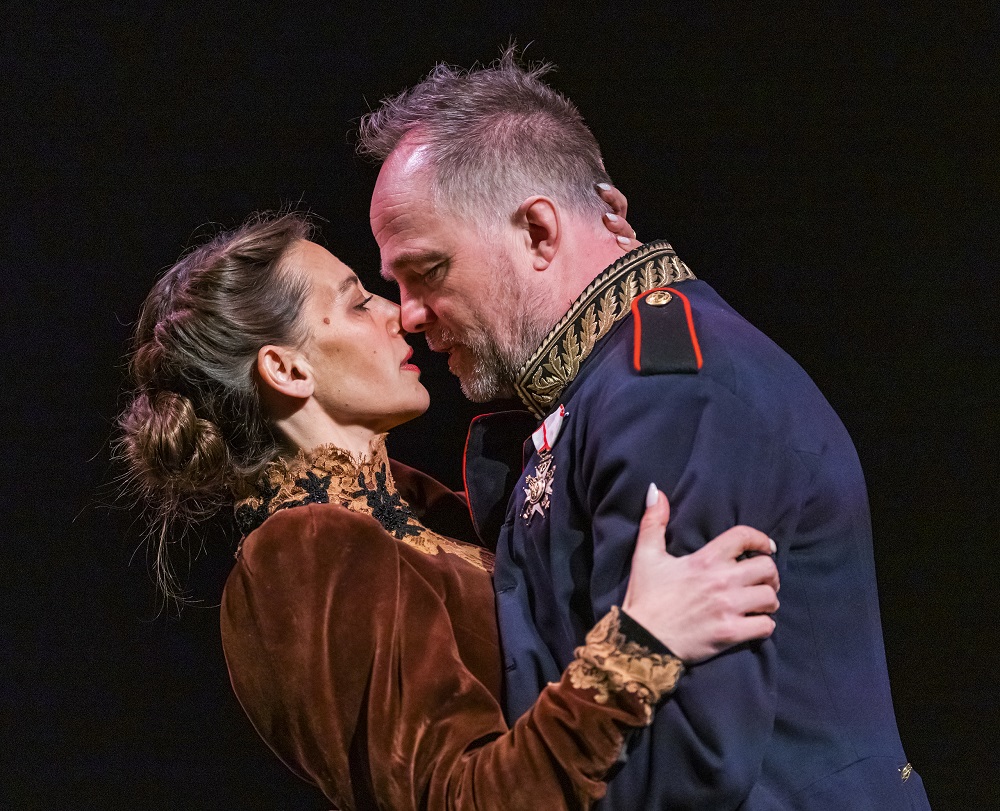 Should the audience laugh? Definitely – this is not the knowing mirth of the home counties responding to, say, Stoppard at the National Theatre, but one of many responses magisterially won by our trio of actors (the version sheds minor roles, leaving a concentration on the occupants and their visitor which makes me realise that the putative masterpieces of Enda Walsh, in equally superb performances which were my previous two revelations in the theatre, could well have taken their cue from Strindberg).
Jon Øigarden’s possibly dying, definitely half-deranged Edgar (pictured above with Tjelta) may not get the crazy dance he executes in the original to Alice’s piano rendition of Halvorsen’s Entry March of the Boyars, but his physicality and sudden violent gestures rivet throughout. Are the occasional switches into English, apparently done for the first time on Saturday night and partly improvised, successful? Mostly, yes, though not entirely; definitely so when a character addresses the audience (the main language is Norwegian, with English translation on screens at each side of the stage). There’s sexual tension and release, too, between Tjelta and Thorbjørn Harr as the cousin who comes back into the poisonous little world and suffers his own vampiric transformation when caught up in the games of the couple. Part of Aune’s licence is to have her Alice and Edgar do a groundhog day on the opening sequence at the end, as brilliant and riveting as anything in this extraordinary evening. You leave not drained but strangely energised. Fresh rickets to another performance were generously offered at the end, but we'd had our vision; it's one that definitely benefits from no music and total focus on the three remarkable actors.
- Read about the Norwegian production of Ibsen's Little Eyolf at the Coronet on David Nice's blog
- At the Coronet Theatre until 31 March. Tomorrow's performane (20 March) is followed by a post-show discussion
- More theatre reviews on theartsdesk











