

There are two dances to unheard music in Howard Brenton’s pithy Strindberg reduction. One spells trouble for the interloper between the vampire couple who suck the blood of others to sustain their 30-year hell of a marriage; the other, in the rarely-performed Second Part, is a prelude to both liberation and death. The symmetries and the differences are cleanly underlined in Tom Littler’s production and the degrees of light admitted in to Jerwood Young Designer James Perkins’s sets. And in a performing space even smaller than Strindberg’s Intimate Theatre of the early 1900s, Michael Pennington’s monstrous-fallible Edgar can scare the life out of us.
Strindberg, acting out the part for actor-manager August Falck, might have been describing Pennington’s compromised military man to the life: "A refined demon! Evil shines out of his eyes, which sometimes flash with a glint of sardonic humour…he so relishes saying evil things that he almost sucks them, tastes them, rolls them round his tongue before spitting them out." In the Gate, this Captain’s rages are terrifying. They come from nowhere, not so much as hinted at in the Stalinesque waxy mask which is Pennington’s mode of repose. In deadly irony and poised humour, Linda Marlowe’s Alice is very much his match, and she excels in the feline running commentary on her husband's stratagems. Less convincing are her own furies, expressed more in the nature of thespy squeaks. The relationship as portrayed works better in the heaven of its bleak comic moments than the recriminatory plunges into the abyss which are only sketched.
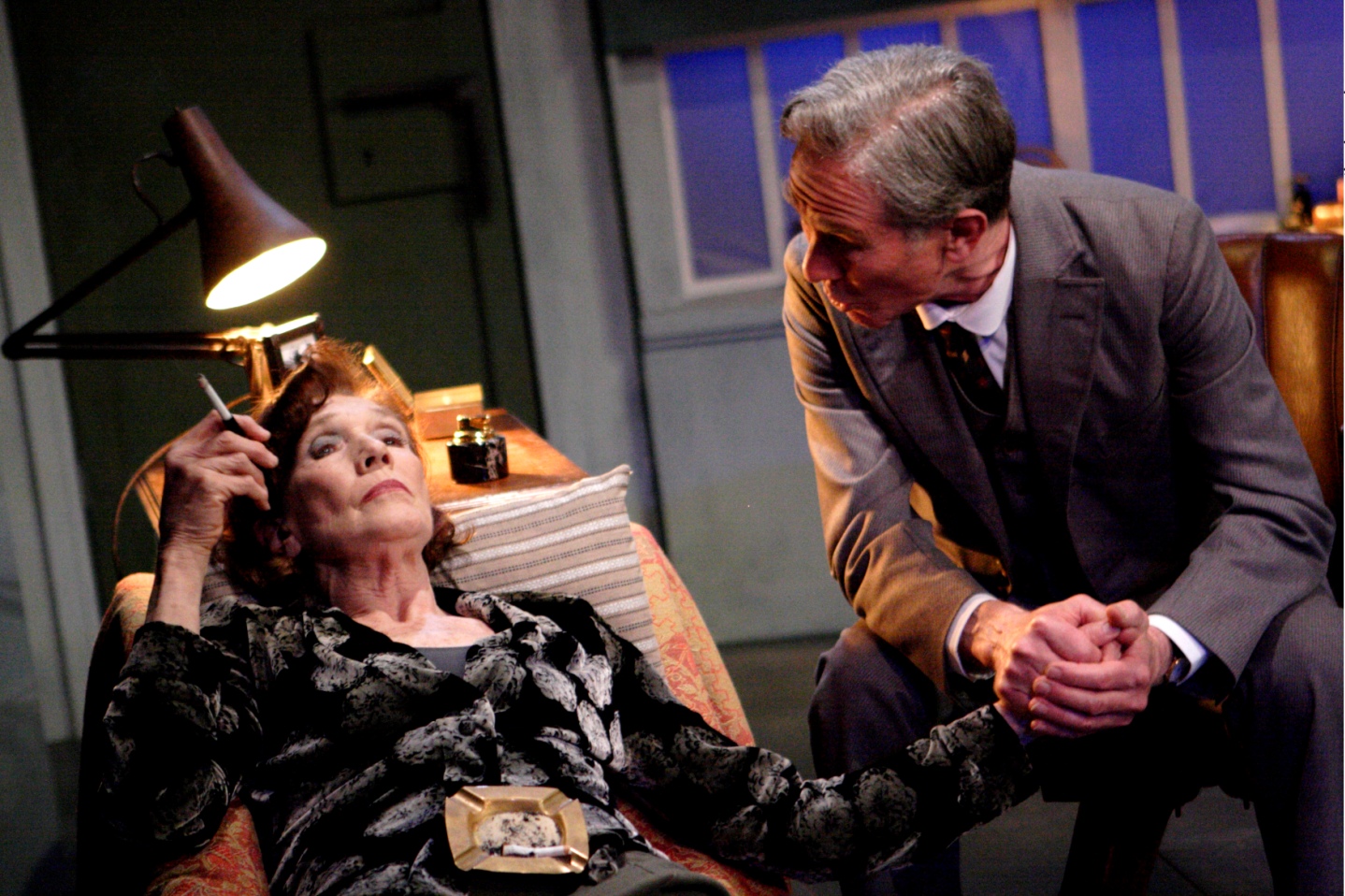 It’s not a drama that can develop or take us into murky depths, as Ibsen’s far less self-centred Public Enemy does in Richard Jones’s more layered production at the Young Vic. You know these two old marrieds relish their satanic game-playing; the fun and the occasional shock are to be had from what’s truth and what’s manipulative lying. You want them to toy with Alice’s spineless Cousin Kurt, though I couldn’t quite work out if Christopher Ravenscroft, with his crumpled, care-worn face, was annoying by chance or by design. He certainly holds the stage with a weird presence comparable to Marlowe's (pictured with him above) and Pennington's.
Part Two completes Kurt’s humiliation; but it also tries to redress the balance by suggesting that the horrid pair’s daughter Judith (Eleanor Wyld), already well versed in the art of cat-and-mouse, might break free. In the first half, the only light from the outside world of Strindberg’s nightmare island comes through the lower panels of the round-tower windows. Now, in the home of Quarantine Master Kurt’s home, we get vistas of painted summer skies, light or stormy, which deliberately evoke Strindberg’s own powerful oil paintings (though it’s a pity that Munch’s The Sun only becomes noticeable when the actors take their bows).
None of the newcomers to the drama, least of all Edward Franklin as Kurt’s son and Judith’s plaything, induces much sympathy. The neurasthenic soundscapes which interrupt the dialogues become more frequent and over-insistent, to what end I'm not quite sure. We take pleasure, though, in the satanic high noon from which the Captain can only tumble. It’s Pennington’s show, and for that alone you should hasten to the Gate for first-rate acting at the closest possible quarters: chamber theatre just as Strindberg wanted.











