Confused people, some of whom may have made the wrong choices in life and love, find themselves in an enchanted wood at Midsummer. Dear Brutus has long been seen to echo Shakespeare’s comedy of metamorphosis, A Midsummer Night’s Dream. A huge success in 1917, it is rarely performed now, and Barrie’s fantasy for grown-ups is probably more of a challenge to the modern director than its Elizabethan precursor. The language is frequently arch, there is a tendency to whimsy, and many of the characters are so spoilt and self-regarding that, on paper, it is difficult to care about their redemption or lack of it.
Jonathan O’Boyle’s centenary production manages, however, to find a tone which invites laughter without making outright fun of proceedings while allowing the inherent sadness its proper place, too. Instead of being distanced by the period trimmings, the audience is swept along at close quarters by the lessons offered, if not always learned, by the guests at Lob’s house.
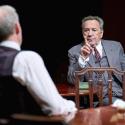
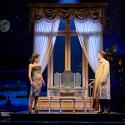
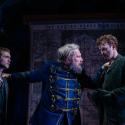
 When we meet them, Lady Caroline is a snob, John Purdie a philanderer, Joanna takes pleasure in superficial affairs – she is having one with Purdie (Charlotte Brimble and Edward Sayer pictured right) – and Will Dearth is an alcoholic artist who is wasting his talent and a potentially good marriage because he mourns his childlessness. Mabel Purdie puts up with her husband’s amorous wanderings while Alice Dearth is spirited and outspoken. A devoted older couple, Mr and Mrs Coade, convey both disappointment at what life has brought and “niceness”. Matey is a pilfering butler employed by the mysterious Lob, an elderly Puck figure (Robin Hooper, pictured below), devoted to his flowers and to stage-managing his guests.
The centre of the play, most of Act II, which takes place in the enchanted wood, is an encounter between Dearth and Margaret, the child he never had. As so often with Barrie (certainly in Peter Pan), his own tragic experience – as the child of a mother forever in mourning for his dead elder brother, and as a childless adult whose failed marriage was probably unconsummated – is closely woven into the fabric here. It could nevertheless go terribly wrong: if Margaret is played simperingly, whimsy will take over. But Venice van Someren and Miles Richardson successfully find a way of expressing this intense parent-child relationship – tender, sometimes joshing, always natural. The sense of loss is palpable, not only because the girl is a fantasy or that she intuits that she is a “might have been” but, even if she had existed, her growing up (exemplified by the putting up of her hair) would entail their parting.
 Richardson’s Dearth, hangdog and defeated in the first Act, comes touchingly to life with his child. This is his second chance. His wife temporarily becomes a vagrant, having married another, grander, husband. The philanderer, in an amusingly self-aggrandising performance by Edward Sayer, falls for his own wife and, later, in a moment of sharp perception, acknowledges his shallowness. The snob finds herself “married” to the butler. Matey, in the world of second chances, could have been a success in the city, but he would still have been a thief.
The title, of course, comes from a line spoken by Cassius in Julius Caesar: “The fault, dear Brutus, is not in our stars, but in ourselves…”. While this suggests that character is immutable and there is an inevitability to our actions, Barrie allows that change is possible for those with “thin, bright faces” who persist. And perhaps some of Lob’s victims will ultimately succeed in finding a better way.
The traverse staging in this intimate theatre has an advantage in that the audience is visible across the action. At the moment of realisation when returning from the wood, Joanna says that they must substitute “dear audience” for “dear Brutus”; Barrie’s fantasy world is unashamedly theatrical and we are all included. His stage directions describe a distinct contrast between Dark and Light, metaphorically no doubt, but also between the drawing-room and the moonlit wood. That is not possible here as the “wood” comes into the room in Anna Reid’s design with the cascading of pink, crimson and green petals on to the Turkish carpets, but an overlap is implied in any case: the guests bring their otherworldly experience with them, and Lob, a silent presence in the last Act, is the mastermind behind both worlds.