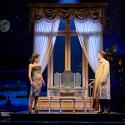
Design For Living is one of Noël Coward’s less performed plays but it fair crackles with bons mots - you know you’re in good hands when delightfully old-fashioned words like “horrid”, “bloody”, “cheap” and “vulgar” are tossed around with, well, gay abandon. What a shame, then, that Anthony Page’s production, while wonderfully easy on the eye and despite some spirited performances from its three leads, doesn’t quite catch fire.
Even though it’s about three bohemians - Otto, a painter, playwright Leo and designer Gilda - nearly 80 years ago Design For Living was considered a very daring sex comedy. Few of its audience would have known, however, that Coward based it on his co-stars in the original Broadway production, the married couple Alfred Lunt and Lynn Fontanne, who were partial to occasional triangular bed-hopping themselves; Leo (Andrew Scott) sums up the play’s plot convolutions nicely when he says to Gilda: "I love you. You love me. You love Otto. I love Otto. Otto loves you. Otto loves me.”
We are in the early 1930s and the three-act play opens in the tiny Paris studio of Otto (Tom Burke), who lives with interior designer Gilda (Lisa Dillon). His old friend Leo arrives from New York where his new play is a smash hit and, in Otto’s absence, they end up in bed together. Guilt-ridden, they tell Otto on his return, he flounces off, only to turn up again 18 months later when Leo and Gilda are living together in London. By now Otto has achieved success as a portrait painter to the stars and he in turn cuckolds Leo, who is away for the weekend. They confess and this time Gilda leaves them both and the men console each other, while in the mix is yet another chap who is besotted with Gilda, the art dealer Ernest (Angus Wright, stealing the show) whom she has married by the time the third act opens in their stunning Manhattan loft apartment.
But however Ayckbourn-esque the off-stage bedroom antics and despite the play’s abundance of very funny lines, this production doesn’t serve up the laughfest it should be; I often found myself appreciating Coward’s words rather than their delivery. At nearly three hours it’s way too long, with an overly talky first act and a bloated middle one whose drunk scene between Otto and Leo overstays its welcome by quite some distance. Page is caught between presenting the play as a period piece - Scott even slips in a quick Coward impression with the line “Fat plays for fat people”, delivered in that famously clipped style - and setting it in a very modern, knowing context. It lands frustratingly between the two.
And while Otto, Leo and Gilda may be vapid fools, we must believe that an almost animalistic attraction exists between them, but I was unconvinced they exchanged anything other than witty aperçus in the bedroom rather than - to be abominably vulgar for a moment - bodily fluids. Granted, the sexual fluidity hinted at by Coward is made much less ambiguous here, but even so one does feel like shouting at the three of them to stop skirting around the subject and get a bloody move on.
Then in Act Three Lez Brotherston’s utterly sumptuous New York set is revealed, three more characters (John Hollingworth, Nancy Crane and Maya Wasowicz all making the most of their roles) are unveiled to act as welcome comic foils to the self-obsessed threesome, Edgar’s outburst when he realises Gilda is setting up a ménage-à-trois with Otto and Leo is a triumph, and one almost forgives Page the longueurs.
- Design For Living at the Old Vic, London SE1 until 27 November
- Find Noel Coward on Amazon