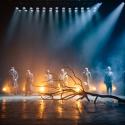
"Some monsters are real," notes a retribution-minded wife (Matilda Ziegler) early in Downstate, Bruce Norris's beautiful and wounding play that has arrived at the National Theatre in the production of a writer's dreams. But by the time this restless, ceaselessly provocative evening has come to its reflective close, you may find yourself reconsidering the efficacy of the word "monster" to describe any human being. Telling of four paedophiles sharing a group home in "downstate" Illinois, 280 miles south of Chicago, Norris all but demands that an audience see humanity in the round. So successful is he in this task that the climactic mood can even be viewed against the odds as hopeful.
A co-commission and co-production with Chicago's invaluable Steppenwolf Theatre company, where the play premiered last autumn with an Anglo-American cast amidst worries that some might find its content to be too much, Downstate couples Norris's ongoing interest in pushing the topical envelope with a compassion one might not necessarily expect from a dramatist best known for his much-prized Clybourne Park.
 At first, one is presumably on the side of the (unseen) community surrounding this gathering of putative undesirables, a quartet regularly subjected to multiple forms of abuse – so much so that they keep a baseball bat by the door just in case. (As the play opens, they are being isolated still further, which will make shopping and transport that much more difficult.) But without for a moment soft-pedalling the brutality or lasting scars left by their actions, the playwright insists on these men as worthy at the very least of a hearing, at least for as long as we can be said to be part of the collective known as humankind (which, admittedly, in Trump's America looks less easy by the day).
Carefully and across two acts whose determined naturalism marks something of a contrast with Norris's style to date, we glean the specifics that have brought these men to this place. The Bible-spouting Gio (Glenn Davis) proffers abundant good cheer to all who are ready to receive it and is counting the months until he can exist back in the world, away from the older housemates whose past actions, in his view, are beyond the pale.
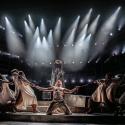
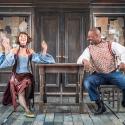
While Gio's is a statutory offense with an adolescent who he thought was of age at the time, the tearful Felix (Eddie Torres) has mistaken love for his young daughter with sexual attraction. The senior generation is represented – thrillingly so in these Steppenwolf actors' indelible performances – by the wheelchair-bound, Chopin-loving Fred (Francis Guinan), who speaks a sort of babyish patois like "shooty shoot shoot", and Dee (K Todd Freeman, pictured above), a onetime dancer who had an affair with an underage cast member in a touring production of Peter Pan. The 14-year-old's role at the time was a Lost Boy (indeed) by the name of Toodles.
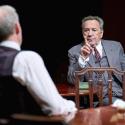
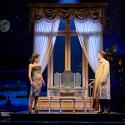
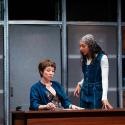
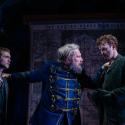
The outside world, so to speak, comes to offer recrimination, judgment, or sometimes not. We first glimpse Fred in combative conversation with one of his victims, the now-grown Andy (Tim Hopper), whose wife Em (Ziegler, pictured below with Hopper) feels emboldened on her husband's behalf by the #MeToo movement. Deflecting a degree of vitriol that he seems unable to absorb, Fred is confronted anew after the interval with Andy, who arrives solo ostensibly to retrieve a forgotten phone. That exchange enfolds within it the reason for Fred's immobility in a speech for the ages which also turns Downstate on its axis. Further complicating matters of right and wrong is Dee's de facto presence as his friend Fred's best advocate, Dee quick to argue to anyone who will listen that there is no such thing as "death by blow job". (Other lines from the play are less readily quoted.)  Returning to the auditorium where she arched a comically roof-raising eyebrow or two in Nine Night, the English actress Cecilia Noble is even better here as a parole officer called Ivy possessed of a keen morality who nonetheless can't help but see the men in her charge in the round. Funny when necessary (her line about the family labrador is a darkly comic classic), Ivy exists as a bridge between the men's widening physical isolation and the psychic self-isolation that they will clearly carry with them to the end.
Small wonder, in context, that the altogether rending final passage puts one in mind of Chekhov in its suggestion of sleep and rest as possibly the only final salvation. Downstate isn't perfect: a few moments betray the author's hand, as if Norris is carefully parcelling out his own arguments amongst his characters. And while I remain grateful for the bursts of levity, one or two feel unearned, as if the playwright doesn't quite trust his own expert conversational ebb and flow to vary the mood. Yet as so often with this writer, he is gifted with a director in Pam MacKinnon who shares his clear-eyed embrace and who ensures that the beats land, large and small, whether that means Dee memorialising Diana Ross's screen turn in Lady Sings the Blues or Fred nursing a Chopin disc with the tender embrace he might in another life have extended to a child. You exit Downstate bruised, yes, but oddly blessed as well to be in such achingly empathic company: there are no monsters here, just fallible, flawed, simultaneously fearsome and fearful men.
- Downstate at the National Theatre/Dorfman to 27 April
- Read more theatre reviews on theartsdesk