

We live in tragic times given over to cataclysmic events that require outsized emotions in return. That may be one reason to account for the uptick, therefore, in Greek drama, which includes not one but two Oedipi, various adaptations of Antigone, and the arrival on the commercial West End of the obvious companion piece to Oedipus, namely Elektra – the K in the title perhaps nodding to a landscape in which people exist to kill.
The star attraction is Oscar winner Brie Larson, who certainly deserves credit for taking on this part in the harsh glare of the commercial theatre, not least in a production from the American director Daniel Fish that owes its provenance to the alternative theatrics posited some years ago of New York's Wooster Group (and more contemporary avant-garde entities like Target Margin).
 A dirigible is visible high atop the action, an arrow pointing down to a playing space that mixes the vaguely classical drapery of the chorus with modern footwear and a punky, shaven-headed Larson herself outfitted in a Bikini Kill t-shirt and jeans. Her Elektra, keen to avenge the murder of her father Agamemnon by her mother Clytemnestra, could as well be on furlough from the sort of dystopian movie (V for Vendetta comes to mind) that has kept her contemporaries busy, and Larson is given not one but two mics so as to vary her decibel levels. No dice: an underlying affectlessness remains throughout.
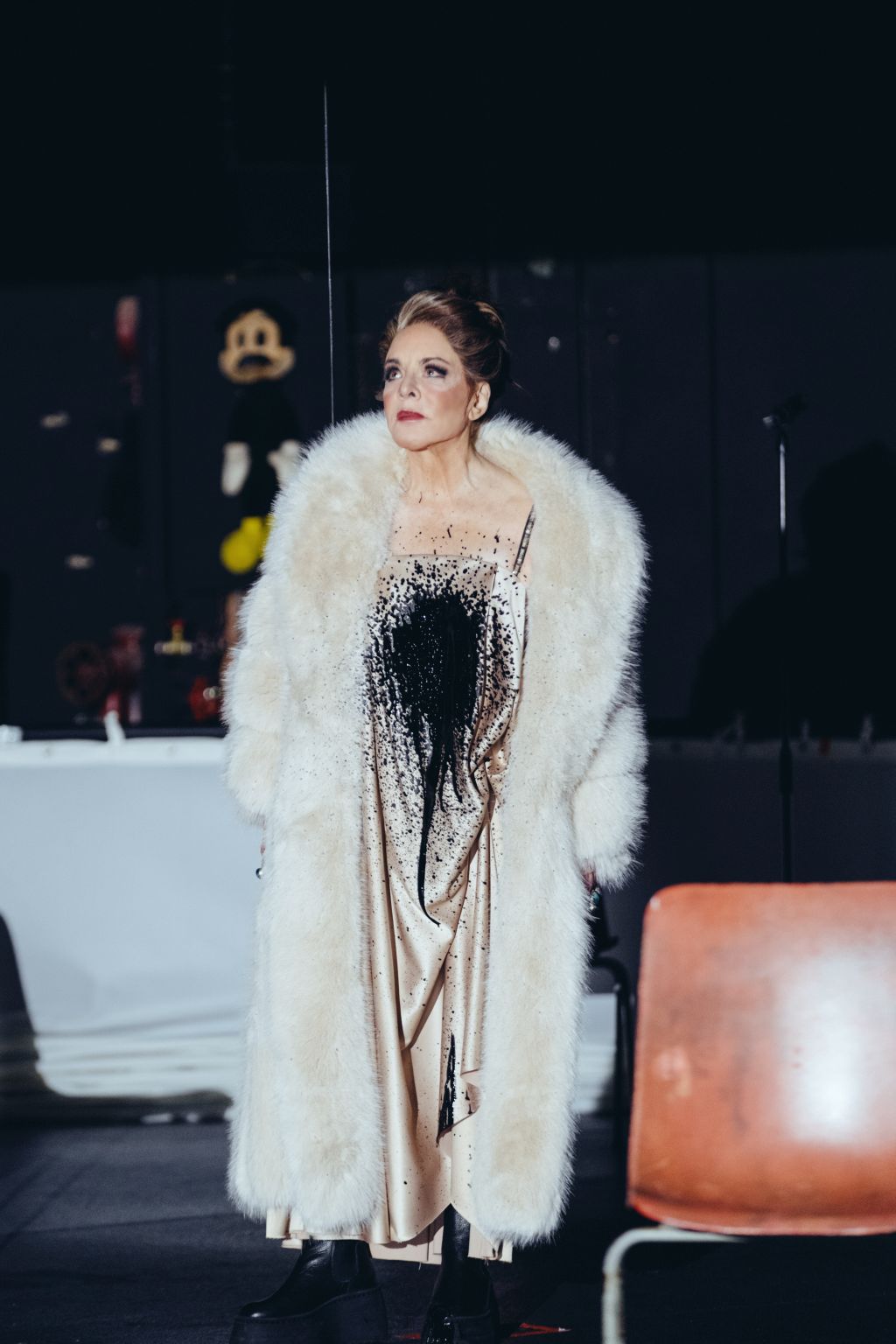
On the one hand, you have to salute the audacity on view. At a time when it's easy to knock together stage knockoffs of familiar TV and film titles (look pretty much anywhere else on the West End), this Elektra at least aims high, pushing into the commercial sphere the sort of venture one might expect consigned to a warehouse theatre somewhere. Nor is there any questioning the weight of a company that includes the redoubtable Stockard Channing – a Broadway legend now based in London – as a Clytemnestra swathed in fur and two alums, Patrick Vaill and Greg Hicks, of Fish's pioneering Oklahoma!: Vaill, another American expat, has been a constant on Fish's adventuresome career for nigh on two decades now.
Oklahoma! found a murderous spine to a Rodgers and Hammerstein musical thought so buoyant that it carries an exclamation in its title. So you'd have thought a play defined by murder – by the sort of retribution currently besieging American politics in an altogether different context – would make a logical follow-up for Fish, except that this show lands with next to no impact at all. Anne Carson's furious version of the text may push the rage to its natural limits and beyond, but you tune out after a while to Larson's monotone, however amplified.
The effect is of a formal exercise that hasn't tapped a reservoir of feeling. The modish trappings are there to be enumerated: the dry ice that swirls into view at a climactic meeting involving Vaill's is-he-dead-or-isn't-he Orestes, or the splattering of black ink against Clytemnestra's lushly appointed pale regalia: Channing, soon (astonishingly) to be 81 (pictured above), makes all she can of a smallish role and prompts thoughts of what she might have been like in the title role back in the day. But direct connection is crucial to Greek drama, which tends to report events rather than necessarily dramatising them: people occupy extreme emotional states that they then cling to, as devotees of Strauss's astounding opera version of this very story know full well. Larson is given to spitting and shouting, as needed, and to varying her vocal register on the word "no", all on the way to a sustained howl of that very negation as if summoning the furies from deep within. Annie-J Parson and Ted Hearne, further notable American talents, are there to lend movement and music, respectively, to a skilfully deployed chorus (pictured above), who are part of an arsenal of talent that is formidable on paper.
But the net result forsakes the wished-for immediacy and pushes the audience away. The hipster vibe might seem to invite us all to this pathological party only to leave us on the threshold awaiting some way in.











