How do you adapt a book like The Waves? A terrifying idea, and one I could not get out of my brain, from the moment the director Jùlia Levai asked if I had ever considered doing it.
For those who haven’t had the joy of reading it yet (and I would highly recommend doing so!), Virginia Woolf's experimental 1931 novel follows six friends from childhood to middle age, in as many stream of consciousness monologues covering the events of their lives, and also their musings on the cosmos, on past lives, on making art, trying to find purpose, surviving grief. These are all combined with huge, Woolfian images, and cut through with lavish, vivid descriptions of the journey from sunrise to sunset on a beach. So - a lot to get through.
First, we spent several evenings in the pub together raving about how much we loved the book, the profound effect it had on us as teenagers, how fresh it felt to return to it as adults, and wondering how on earth to stage it.

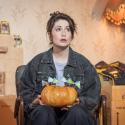
That last challenge seemed impossible - which also made it exciting. We arrived at the concept of spinning the whole show out from the dinner scene in the middle, an idea which has grown and moulded with the pressures of writing an actual play, but remains at the core of our version. It’s the most naturalistic moment, where we get to see the characters interact with each other without any insight into their inner lives, just as they see each other, just as we all see our own friends. It’s my favourite part of the show to watch: like a new episode of a sitcom that you’ve been watching for years. (Flora Wilson Brown and the play's director, Júlia Levai, pictured above photo c. Greta Zabulyte)
Whilst that scene was easy, the rest of it was joyously, impossibly hard. I wrote several different versions of the opening two scenes, starting with what was effectively an edit of the book - my favourite lines divvied out between the characters. It was beautiful (because it was all Woolf) and it was absolutely impossible to stage, as well as being 30 pages too long.
Feeling slightly stuck, I got an incredible piece of advice from another playwright, who told me to kick Woolf out of the room, lock the door, and see what happened then. After all, she was a modernist and would want us to do something new.
So that’s what I did, and after a few drafts I figured out what from the book is impossible to lose, the lines that make it The Waves, and I let them back in. What we’re left with hopefully is something that is a play - its own thing in its own form - but remains The Waves. I wanted to replicate the feeling of reading a book that is at once difficult and dense and also incredibly rewarding. When you’re in the swing of it, the experience is like a wave: it washes over you, and you can’t always make sense of it, but you can feel it all very clearly. That’s what is so brilliant about the material: it genuinely replicates the feeling of being alive, of feeling alone with your very favourite people, of feeling huge and unknowable and very, very small. Hopefully I’ve captured some of that experience.
One thing I was really struck by is how incredibly well Woolf writes about grief. It is such a deadening force, and so isolating and infuriating and boring to live through, as well as agonising and sad and all the rest, that I think it can be hard to write about in a way that feels present and true: she really nails it.
By coincidence, whilst we were working on this show, I lost someone very important to me, and I found her words really comforting in that time. Reading something that speaks so clearly to the horrible moment you are in, from almost a hundred years ago, makes you feel so much less alone. It reminds you that people have been surviving awful things for as long as we’ve been around. And that’s what we kept coming back to in making the show, it’s a story about how life is full of things that feel unsurvivable - and yet we survive them anyway. We survive them because of our friends, and because of art, and because of ordinary, wonderful things. Hopefully we’ve made something that will remind us all of that.