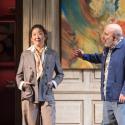
Just weeks after the theatrical version of the cult film Paranormal Activity successfully recreated the original’s nail-shredding fear, A Ghost in Your Ear offers its own distinctive route to transcendental terror. Where Paranormal Activity – directed by Punchdrunk’s Felix Barrett – leans heavily on superb stage illusions, A Ghost in Your Ear, as the title suggests, largely channels its chill factor through soundwaves.
It was only going to be a matter of time till a theatre maker brought together a ghost story and binaural sound effects. Both have enjoyed increasing popularity in recent years. Whether in Simon McBurney’s 2016 production of The Encounter or Max Webster’s Macbeth starring David Tennant and Cush Jumbo, binaural headphones for each audience member have proved to add a disturbing intimacy to action on stage. The eery three-dimensional soundscape that they conjure up – in which every whisper has resonance – lends itself perfectly to a state of mind in which you’re ambushed by your fears and uncertainties.
Writer and director Jamie Armitage – whose 2023 play An Interrogation impressed critics with its psychological and technological acuity – here collaborates with brothers Ben and Max Ringham, giants of theatrical sound design. Anisha Fields’ set is starkly simple – a recording studio, in which the sound engineer’s booth sits behind an anechoic chamber in which the dominant microphone is a binaural dummy head.
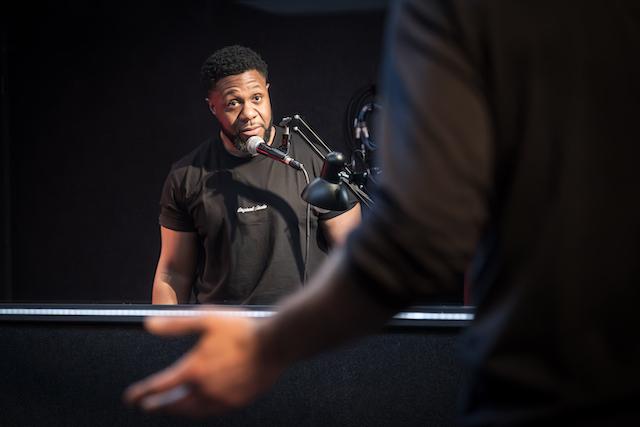
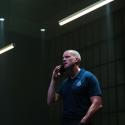
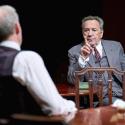
George Blagden plays a blokey thirty-something actor who’s happy to do a bit of last-minute voice work to make some extra money and help out his sound-engineering mate Sid. At first it’s strictly bantz, as he and Jonathan Livingstone’s Sid (pictured above) joke about the fact that while Sid’s about to become a father, George doesn’t want children to distract from his career or his personal freedom.
Then the recording starts. It’s clear that Armitage, like fellow ghost-story obsessive Mark Gatiss, is fascinated by how the mechanics of an apparently traditional narrative lead you from the rational to the irrational. Like George himself, the narrator has just broken up with a serious girlfriend and is steeping in self-pity when the phone rings, and he discovers that his father has died.
The trick, of course, with horror story telling is to allow us to recognise its mechanisms and clichés while still ensuring that it seeps beneath the skin. Those clichés are there in abundance as we discover that the narrator’s father lived as a hermit in a house in the middle of nowhere, and that whatever his son does, he should not go to that house to help clear it.
Of course he does, and the next thing we know, he’s being driven there by his father’s somewhat reptilian lawyer. Only one road approaches the house, and the moment he’s warned that he might be cut off if it snows, we know that’s going to happen.
But rather than induce eye-rolling, we are already gripped, as the soundscape designed by the Ringham Brothers combined with Blagden’s performance starts to take effect. Though verbally he repeatedly refutes any idea that this might be a strange situation, his increasingly jagged intakes of breath – delivered direct to the eardrum – belie his words and increasingly put us all on edge.
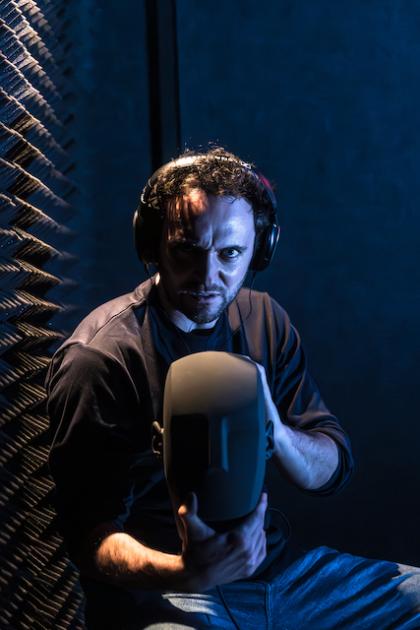
While there are no illusion specialists, as there are in Paranormal Activity, the visual effects become increasingly spine-chilling. Though words are still king here – as George describes his father’s house in detail, we become alive, like him, to the terrifying potential lurking in every darkened room and corner. The result of this solidly constructed narrative is that it takes no more than some very swift and simple apparitions to send gasps through the auditorium. The subliminal wail and rumble of the sound effects heighten the sense of growing physical and psychological claustrophobia.
Ben Jacobs’ simple but highly effective lighting design also stokes the hysterical atmosphere. At first, the prime difference appears to be between the bright lights when Sid and George are chatting and joking and the muted lights when George is narrating. Yet as the voices and bumps in the night become more threatening, Jacobs makes the white light round the window of the recording booth pulsate while the red recording light intensifies. The binaural microphone’s resemblance to a blind, featureless head, is also manipulated to both comic and sinister effect throughout the evening.
It’s not a perfect ghost story – for instance, a couple of details connected to the narrator’s recognition of the figures in a photograph don’t entirely add up – but there’s plenty to compensate for minor flaws. Like any effective supernatural tale, it’s ultimately anchored in the characters’ psychology, looking in particular at fears surrounding fatherhood. Plaudits to both Blagden and Livingstone for an enjoyably compelling management of the journey from the rational to the irrational. Whether or not you believe in ghosts, this should prove at the very least a decent work out for your adrenal gland.