Playwrights return to classical myths for two main reasons – to shine a light on how we live today and because they're bloody good yarns.
Marina Carr's re-telling of Clytemnestra's story is boldly innovative in its conception and execution, but it never loses sight of its source material's power – and we wonder how, if "Enough is Enough" didn't work thousands of years ago, how is it going to work now?
King Agamemnon needs to do something as his men are mustered for war and the blood is up, but the winds will not come to fill their sails for the passage to Troy. Worse still, a potential usurper, Achilles, has emerged to charm the tribes and challenge his leadership. The Gods demand blood sacrifice and his daughter, Iphigenia, is the price they exact for their favour. Her mother and his Queen, Clytemnestra, will not forgive him and, after 10 years away in the Trojan Wars, she resists, rebels and, ultimately, revenges her dreadful loss.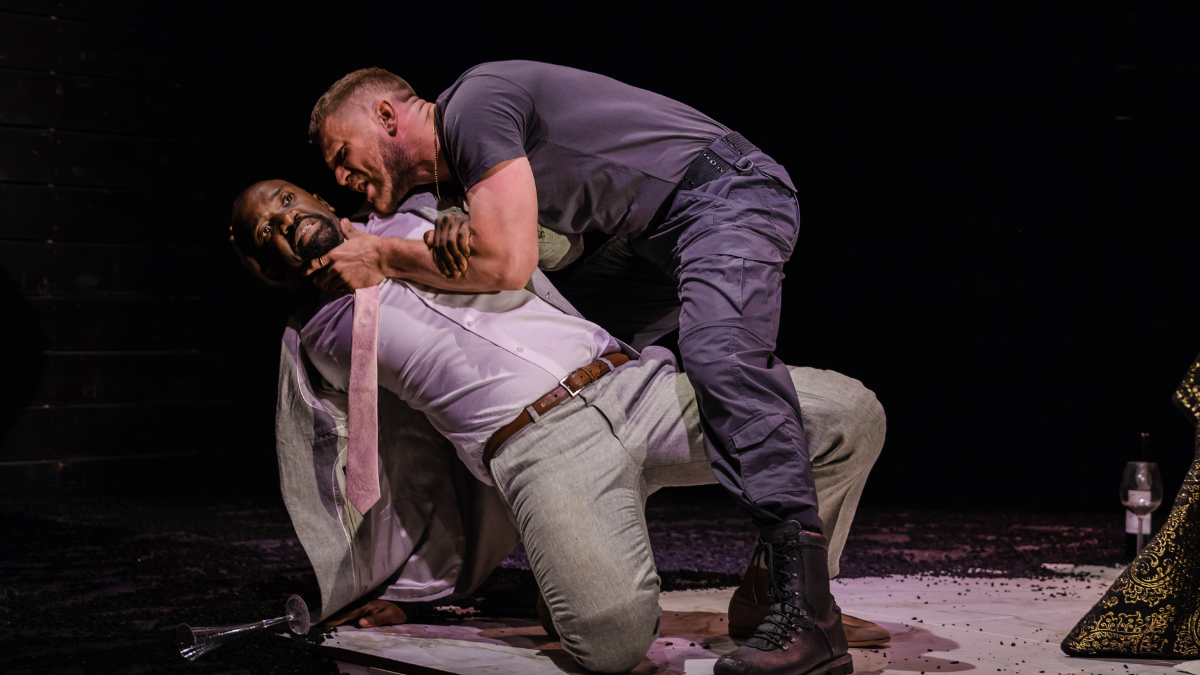 Eileen Walsh and David Walmsley (pictured above, with Daon Broni) circle each other like two TikTok cats unwilling to strike a blow but unable to leave the scene. They are locked in a kind of hideous stasis that some longtime lovers fall into almost without realising – even the aspects of their characters that repel them psychologically attract them physically. She cannot resist looking at his wounds, a plunder of battle as much as her jewels, and he cannot resist her talking back at him, the one person in the kingdom who can do it and retain her head, "Zeus Agamemnon" given permission to be a mere mortal for once.
Walmsley, with the build and strut of a super-middleweight boxer and that go-to Liverpool accent that connotes aggression covering insecurity (blame Stephen Graham), is compelling, building enough credit in the first act to ensure that the monstrous Agamemnon that emerges later is no mere caricature of evil. Walsh wades through the testosterone sloshing about the stage with imperious confidence never forgetting that she is the daughter of a king herself and that her children, one gone forever, must be continuously protected from the male violence that swirls around them.
There's excellent support, too, from a cast whose accents remind us that these wars were imperial adventures, one people subjugating another for land and treasure. Kate Stanley Brennan's Cilissa, handmaiden to Clytemnestra, shows the flashes of anger before Agamemnon that few would dare, but a telling aside reveals that she, of Amazon heritage, would wrestle the King as a boy and win – the only currency he understands.
Each of the six strong cast speak their lines with such clarity that they assume a verse-like quality, the piercing daggers cast in their words all the sharper for it. Though it should not be a matter for comment, too often the most professional of productions is let down by the actors diminishing the power of the text by failing to find the right rhythms for their speeches – emphatically not so in this case.
It's critical, too, because much of the action is reported in, characters directly addressing the house, telling us what has happened in extended accounts. It's an approach that can be irritating, conjuring thoughts of journalists' sign-offs with the real action going on behind them, but a combination of Annabelle Comyn's pacy direction and the actors sympathy for the language sees us through. There's also a little too much directing of the audience towards the suffering of women at the hands of the patriarchy which, in a play with these levels of physical and psychological violence, we can probably be trusted to "get" without the prompting.
The flaws are far outweighed by the strengths in Carr's vision of the story of a tragic heroine, the beautiful prose placed in service of a tremendous, horrific, transfixing tale. And, as one filters out into the North London night, one thinks of the successors of Agamemnon, demanding control of women's bodies in Afghanistan and America and elsewhere. A myth from millenia in the past it may be, but men haven't changed much – for shame.