

Hollywood has never met a cliché it didn’t love; unfortunately, neither has Dylan Costello. His peek behind the curtain of Tinseltown’s Golden Age employs every stock type imaginable, from the boorish, chain-smoking manager to a pill-popping Marilyn-lite. It’s a play with admirable aims, but desperately in need of a good script doctor.
Playing the part of fresh-off-the-bus ingénue is British thesp Patrick Glass (David R. Butler), getting his big break in 1949 when – you guessed it – the movie’s lead actor is forced to withdraw. Not the victim of All About Eve scheming or a good shove down the stairs, but of scandal, his hot tub threesome deemed in contravention of the studio contract’s strict morality clause. Might closeted Patrick face the same danger? Enter tall, dark and handsome co-star Jackson Harper (Alexander Hulme), whose tools of seduction are a wildly overblown good ol’ boy Southern persona and Noël Coward-esque silk robe. It’s a juxtaposition worthy of more analysis afforded in a sketchy character study.
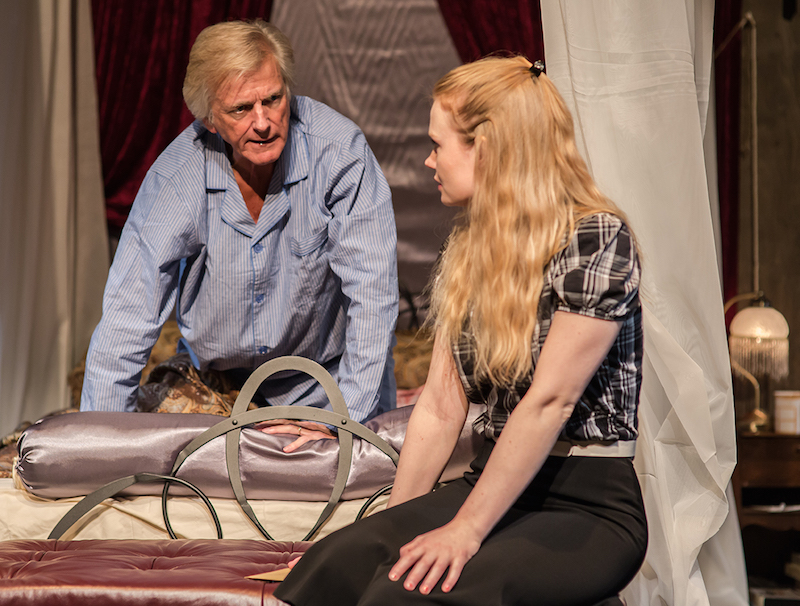 If the plotting were not predictable enough – and signposted with regular doses of eyebrow-waggling prophetic irony – we are also gifted a gloomy glimpse of Patrick’s future. In 1989, he’s a cartoonish curmudgeon (Paul Lavers, pictured right with Sheena May), terrorising his lonely creep of a son (Stephen Connery Brown) and assistant/East German mail order bride Ava (May), a fellow escapee from an oppressive regime. May’s is by far the strongest performance, blending dignity with bruised resignation. Her co-stars, meanwhile, have the unenviable task of imbuing broad stereotypes with something approaching humanity. There is none of City of Angels’ layered wit here, nor Mamet’s searing insider wisdom – the show’s success depends solely on our emotional investment.
The forbidden love story occasionally succeeds in that regard, played earnestly and eagerly by Butler and Hulme, though any mention of their thematic anvil movie – called (ye gods) Secret Heart – is a guaranteed mood-killer, as is the unnecessary verbal paralleling of acting in films and in life. Their conflict is rarely embodied but soundly declaimed in frequent expository speeches, as well as provided in CliffsNotes form by predatory Inquisitor magazine gossip columnist Nella (Mary Stewart). This personification of all evil is too much of a caricature to function effectively as antagonist – she makes Rita Skeeter look like Edward R. Murrow.
The historical lens of Costello’s play is limiting, consigning its issues to the past rather than pointing to present-day Hollywood double standards and alarming continual erosion of the division between professional and personal lives. Patrick, pressured into a conventional marriage, and starlet Candice (Emily Loomes), trapped in her prescribed dumb blonde role, at least have a measure of privacy; how would they fare in the age of social media and the 24-hour news cycle? Matthew Gould’s mannered production has some resonance, but its synthetic quality prevents truly meaningful engagement.











