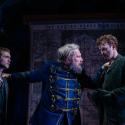
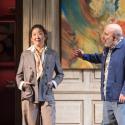
{rtmp width="510" height="310" img="http://www.theartsdesk.com/media/k2/items/cache/dc0900c4858a2f0dce82ed3898356bb3_XL.jpg"}Mysteries{/rtmp}
If you thought Bible stories were just for Sunday school, think again. Shakespeare’s Globe - the open-air reproduction of the original “wooden O” on London’s Bankside where past and present collide and eager groundlings jostle in the Yard for the best view - is bringing them to vibrant life in this summer’s revival of The Mysteries. Based on medieval dramas created by guildsmen in York, Wakefield, Chester and Coventry, poet and playwright Tony Harrison first tackled The Mysteries for the National Theatre in 1977 and has adapted his iconic version to create The Globe Mysteries - featuring no fewer than 60 characters played by an energetic cast of 14, and telling a range of biblical stories from The Creation to Doomsday. But do modern audiences really want to listen to a sermon from the Middle Ages?
 Fortunately director Deborah Bruce insists that’s not at all what we’re in for. “These are stories about people, about what it means to be human, and they ask the big questions that we all ask at some point in our lives,” she declares. “Medieval audiences would have already known them well. They would have formed the foundation stone of their spiritual and cultural beliefs. That’s not so much the case now, but they’re still about exactly the same things we live with every day. We all feel jealousy, we all feel grief and regret and joy. They’re not historical documents, they’re about who we are. And they’re delightful for that.”
William Ash, who has the potentially daunting task of playing Jesus in Bruce’s production, concurs with her vision of The Mysteries as grounded in universally familiar emotions and relationships. “I’m approaching Jesus as a real human being - someone who’s fallible, fragile,” he says. “The Jesus-God relationship in the play is an ordinary father-son relationship. The father has asked his son to do something, and he’s got to carry it out. He’s got to sacrifice everything about himself as a human being, and he goes through an awful lot of pain and anguish to do it. For me that’s what the production is about. It’s almost a rite of passage.”
Harrison’s language, accordingly, is bracingly immediate: “It's really anarchic, wicked and irreverent, yet he’s also more than capable of moving you with an intense intimacy,” says Bruce.
 And even the most divine figures are given an earthy representation: toiling to create the world in seven days, God makes use of a forklift truck.
The original Mystery cycles were performed on religious festivals and remained prevalent until the rise of professional theatre; their influence can be seen in Elizabethan and Jacobean drama, in which Shakespeare was, of course, a towering figure. At the height of their popularity, they were frequently performed on travelling carts. Eager punters would wait at open-air staging points often, according to Bruce, from three in the morning until midnight, and the plays in the cycle would trundle into view one by one.
At the Globe, of course, audiences can expect a much less gruelling experience. But the powerful sense of a communal event will, Bruce maintains, remain paramount. “The medieval Mysteries would have been played outside, often at markets and fairs,” she explains. “People in the audience would have been as much a part of the performance as the actors themselves, and that’s a very nice link with the Globe. You can’t eavesdrop on these stories, you have to witness them, be part of them. They have a presentational, demonstrative quality that demands acknowledgement. There’s no fourth wall. I think that’s going to be fantastic at the Globe.”
It’s key, too, that in the Globe, unlike in a conventional theatre, the stories unfold not beneath an ornate ceiling and a complex lighting rig but under the skies. “That means that as an individual you are constantly reminded of how small you are, and how responsible we are, as individuals, for each other and for the world we live in,” says Bruce. “The sky is a reminder of something outside the theatre, outside our own lives, and of what connects us all.”
And there’s one last, very important aspect of the production that makes it truly accessible: tickets start at just £5. To hear the word of God, albeit the most human of Gods, that’s got to be a bargain.