

Doom and gloom, we are told, may have abounded in the classical underworld, but Hadestown suggests otherwise. Returning to London five years after its run at the National Theatre, this time with a slew of Tony Awards, this bracing musical proves its mettle as a heart-warming and atmospheric feast of deeply soulful tunes.
With music, lyrics, and book by American singer-songwriter Anaïs Mitchell, Hadestown reimagines familiar tales from mythology through exquisite songs and eloquent stagecraft. The story centres on the tragic romance between the bard Orpheus and Eurydice, as king Hades and his captive wife Persephone vie to shape the fate of the young lovers, which culminates in Orpheus’s attempt to rescue Eurydice from the underworld. But don’t expect to encounter any Grecian trappings here. Instead, Mitchell and director Rachel Chavkin transpose this well-trodden terrain into a modern milieu resembling a Depression-era speakeasy, with the titular underworld brought to life as an industrial, smoke-filled inferno ruled by a leather-clad Hades.
Rachel Hauck’s surprisingly expanding set makes exceptional use of a triple revolve – and a hole in the ground – to evoke a range of locations in and out of the titular town, while Bradley King’s richly coloured lighting amps us the otherworldly charge. Michael Krass’s costumes endow the characters with an American feel that still nods at their timeless, and placeless, aura.
Mitchell’s impeccable music is truly the heart and soul of the evening, as the story is told entirely through songs that stir and dazzle with their jazzy undercurrents. Much of this is the stuff of goosebumps. A seven-strong band – including a trombone, an accordion, and a percussive guitar – adds folksy charm to Mitchell’s tracks, arranged and orchestrated by Michael Chorney and Todd Sickafoose. David Neumann’s gently modulating choreography beautifully complements the songs’ inward force and makes much of the Lyric’s relatively small stage.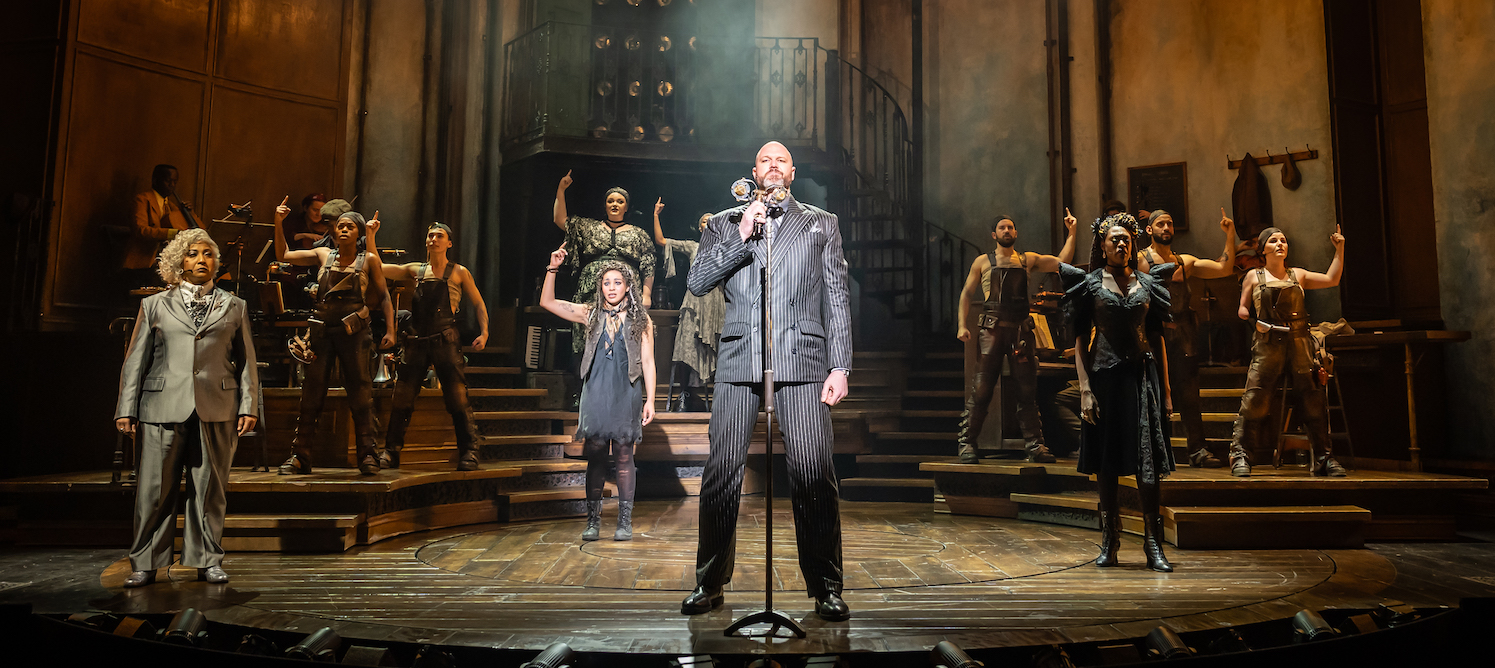 All this, of course, depends for its beguiling effect on a formidable cast. Dónal Finn is excellent as Orpheus: his silken, crystalline voice and boyish looks not only bring irresistible vulnerability to the part, but also turn numbers such as “Epic,” “Wait for Me”, and “If It’s True” into magnificent showstoppers. He is well-matched, too, with Grace Hodgett Young (recently seen in Sunset Boulevard), whose Eurydice impresses with her youthful passion, especially in “All I’ve Ever Known.”
Zachary James plays the villainous Hades with a sternness that alternates between the suave and the gruff. His duet with Eurydice in “Hey, Little Songbird” and his Act One finale “Why We Build the Wall” (pictured above) attest to his strong dramatic zest. An apt counterpoint to this leering figure is found in Gloria Onitiri’s skittish Persephone, whose confident allure in the initial scenes gradually gives way to a poignant sense of entrapment. Throughout, Melanie La Barrie’s Hermes narrates and comments on the events with a knowing authority that comes from a place of fiery compassion. Also swirling around the central action are the three Fates (Bella Brown, Madeline Charlemagne, and Allie Daniel), who provide relief both comic and gothic.
Even as some of the plot points would benefit from greater clarity, and the ensemble of Workers could be better integrated into the story, Hadestown remains a remarkable achievement. It’s fitting that a musical of this calibre, and with such a big heart, should point to the healing, uniting power of music in its very unfolding. Like the red carnation that unexpectedly blooms in the underworld, this is a production that has much to offer in the way of hope, solace, and surprise.











