

Towards the end of the 18th century, Lady Emma Hamilton (like so much in this woman's life, hers was a title achieved as much as bestowed) was the “It Girl” of European society.
They’ve always been around – women who have the combination of looks, intelligence and transgressive confidence fused by a rare alchemy into a concoction that a certain kind of powerful man cannot resist (and plenty of not so powerful men, too). Then, as now, such women were dangerous and the patriarchy exacted a price for the challenge not so much to its norms but to its hypocrisy. Such people burned bright, but not for long.
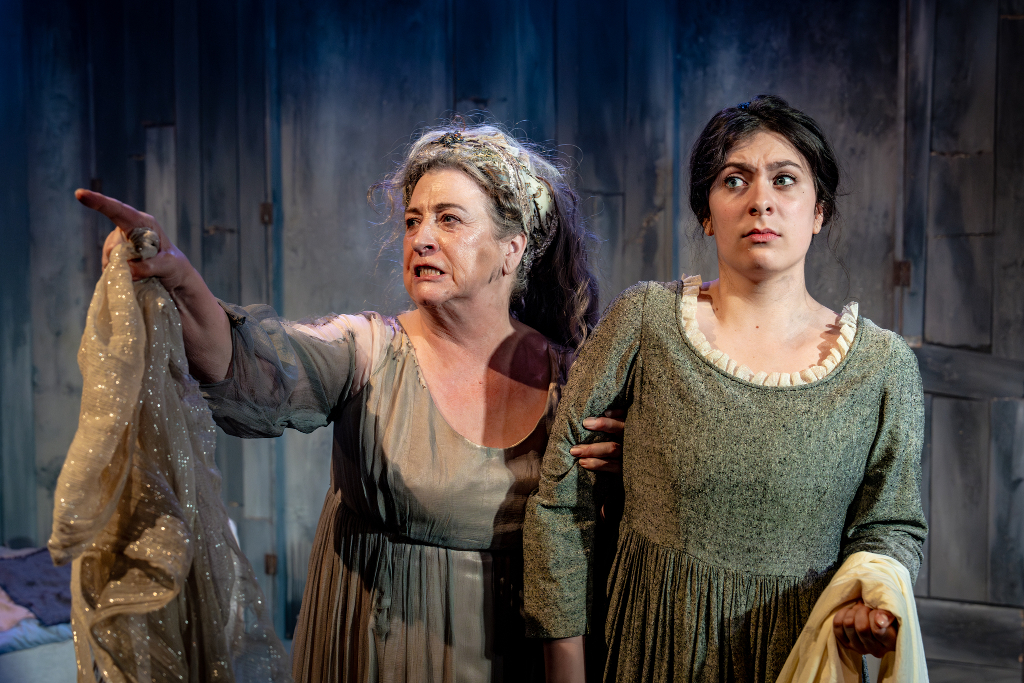 In April De Angelis’s new play, we first meet Emma at the height of her powers. Having successfully buried her humble beginnings on the Wirral of all places and as a teenage actress not shy to do what was needed to get by, she’s the twentysomething wife of the ageing, besotted British ambassador to the Court of Naples: a socialite phenomenon and political operator who just might have it all. But all is never enough for a person with her voracious appetites and low boredom threshold. And so it is that she engineers a meeting with the nation’s saviour, Horatio Nelson, sets her cap in his direction and, well, he may have been missing an eye and an arm, but the rest was flesh and blood – what could he do?
Rose Quentin (pictured above with Caroline Quentin) is our heroine, all witty remarks, tousled hair and heaving bosoms, but she also captures the fragility that clings to a self-made (more accurately, self-imagined) woman in a man’s world. She butts up against her mother (her real life mother too, Caroline Quentin) partly because the charades that work so well in palaces and bedchambers seldom survive the truths that pass between a parent and a child. The pair throw out barbs aplenty, but they love each other, and are very funny about it. Quentin junior has inherited the comic timing gene, and one can only congratulate the director, Michael Oakley, on making good on such an inspired piece of casting.
After the interval, things change. We’re a couple of decades or so on, Quentin senior is now playing Emma, holed up in a barn in Calais with her "adopted" daughter, Horatia (Quentin junior) and hiding from creditors, the late Admiral’s family and wealthy friends having disowned her: the patriarchy has exacted its ruthless revenge. There are still laughs – the wit has withered but not disappeared – but there’s a poignancy in her pathetic recreation of the classical Greek tableaux that once so enchanted the crowned heads of Europe. The girl sees a route out (she casts a little of her mother’s old magic towards the mayor’s son, played by Riad Richie in a sweet cameo) but like the heroine of a Puccini opera, Emma is gone before the age of 50.
It’s an extraordinary tale but one feels that it might better be explored through a musical rather than a talk-heavy play – though, perhaps, one Hamilton show is enough. We would benefit from seeing Emma with her men however much this is a story focused on daughterhood, and there’s an element of the predictable in her descent: the bottle hidden in the sleeve is perhaps a little too on the nose as an indication of her descent into alcoholism.
Most of all, the parallels with today’s celebrity culture, suffused as it is with the seductive lure of fame that so fired Emma’s ambition, is largely unexplored – there’s a lot to say there in a perhaps bigger play that remains tantalisingly out of reach.
Oh, and if this play is ever optioned for adaptation by Netflix, Meghan Markle might just be right for the part.











