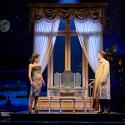
“It’s this ghost they’re talkin’ about. I’m feelin’ an emanation meself. Unless I ‘ad too many pickled eggs last night.” If that’s the sort of crack that tickles your fancy, you’ll find plenty to make you chuckle in Ken Hill’s spoofish take on H G Wells’s novella, first presented at Theatre Royal Stratford East in 1991. Should you also have a taste for rather well-worn magic tricks, you might find Ian Talbot’s new production positively transporting. If, however, like mine, your sides remain stubbornly unsplit and the stage illusions fail to elicit from you the requisite gasps of wonderment, you could very well end up reflecting upon the most striking shortcoming of this good-natured endeavour: that it’s so slight as to be almost as insubstantial as its titular anti-hero.
Wells’s 1897 science-fiction yarn was originally written for a magazine in serial form, and as such it’s full of tingling suspense. Hill, on the other hand, never offers even the most fleeting of chills, choosing instead to send the story up. His version relies, for its appeal, on sight gags, innuendo, caricature and above all special effects (created by Paul Kieve). It’s cheerfully cod, and even broadly charming, as far as it goes. But it’s not long – particularly in Talbot’s stodgy staging – before the joke begins to wear thin.
The action unfolds in an Edwardian music hall, where a dapper MC introduces a troupe of jolly end-of-the-pier Pierrots whose song-and-dance antics frame the tale itself. Their rather superfluous antics out of the way, we are plunged into a wintry night in the West Sussex village of Iping, where a mysterious stranger, wrapped in bandages and wearing a long coat and glasses, arrives at the local inn. Painted flats and cloths, designed by Paul Farnsworth, and handfuls of fake snow flung about by the actors, set the scene; doomy melodramatic music accompanies every appearance of the sinister figure (an unrecognisable John Gordon Sinclair). His peculiar behaviour quickly causes consternation among Iping’s inhabitants, who include the inn’s busty landlady Mrs Hall (Maria Friedman), her dopey servant Millie (Natalie Casey), hearty Squire Burdock (Jo Stone-Fewings) and bluestocking suffragette schoolteacher Miss Statchell (Geraldine Fitzgerald), as well as an oddball assortment of camp clergy, a lecherous physician and a dunderheaded police constable.
 Objects fly unaided through the air; doors open and close; unseen hands rifle through drawers or strike piano keys; and the residents find themselves attacked by an invisible assailant with a menacing, mocking, disembodied voice. This entity even makes free with Mrs Hall’s ample bosom, jiggling her breasts mercilessly and vigorously. At first all imagine that they are victims of a haunting by some restless spectre. But suspicion quickly falls on Mrs Hall’s irascible guest, who is in fact Griffin, a scientist whose condition is the result of a pioneering experiment, and who, in one of the show’s most impressive moments, peels away his bandages to reveal the uncanny nothingness beneath, drawing on a cigarette with his invisible lips as he does so. Griffin will stop at nothing less than world domination. He terrifies a tramp, Marvel (an irksomely chirpy Gary Wilmot), into becoming his unwilling henchman and aiding him in his getaway, while the villagers determine to track down and trap him.
For all this hokum to engage – particularly when its treatment is so relentlessly tongue in cheek – it needs to be slick, and performed at breakneck speed. Talbot’s production never properly gathers momentum, and the slapstick and pratfalls quickly become tedious and repetitive. There are lively turns from Friedman, Stone-Fewings and Christopher Godwin as Squire Burdock’s factotum, who in his varied career has worked as everything from a Bangkok barman to a St Petersburg cryptographer, and the rest of the cast are industrious – but a show this determinedly light surely shouldn’t feel so effortful. There is some wit and ingenuity on display here; but as the evening wears on, you feel you have to look harder and harder to find it.
- The Invisible Man at the Menier Chocolate Factory until 13 February, 2011
- Find H G Wells on Amazon