“Let slip the dogs of war.” Somewhere in the bowels of Kiev’s Olympic Stadium, a football coach will have said something along these lines around the half seven mark. Meanwhile, over on the clever-clever channel, an alternative meeting between England and Italy took place.
Shakespeare set any number of plays in the Italy he encountered in his source material, but with the possible exception of Romeo and Juliet, none feels quite so much of a statement about the Italian state of mind as Julius Caesar. It’s no coincidence that this was the play given to an Italian company for the recent Globe to Globe season. The idea was presumably that Romans would have something interesting to say about it. (They didn’t.) The Royal Shakespeare Company’s artistic director elect Gregory Doran has had the shrewd idea of looking beyond southern Europe for a contemporary setting where assassination and conspiracy might still feel like clear and present dangers. This production intriguingly alights in a black African dictatorship where the ruler has plans to declare himself emperor.
 Doran’s Julius Caesar has already opened in Stratford-upon-Avon, and now hard on its heels comes a filmed version as part of the World Shakespeare Festival and the BBC’s Shakespeare season. The perennial issue with filmed theatre has had to be addressed in a hurry: how to retain something of the live experience when the cameras make the choice for you of what to look at. Great strides have been made in live broadcasts of theatre in recent years, but rather than go down that route, this account occupied the stage only in the public, theatrical scenes – the opening address of the tribunes, Ray Fearon's charismatic Mark Antony yelling over the din of the mob. For the rest, the conspirators squirrelled themselves away in claustrophobic set-dressed interiors.
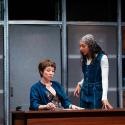
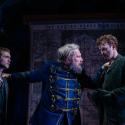
For much of the film it convinced. The plot to decapitate the state takes place in furtive asides and watchful whispers. Brutus, Cassius and Casca discussed bringing down Caesar in the gents. The murder of Jeffrey Kissoon’s Caesar (pictured above right with Paterson Joseph as Brutus) took place on an elevator. The camera stole in on the flicker of a facial muscle, the dart of an eye, the telltale signs of paranoia written in filigree. This approach was partly dictated by budget. Later, as the alliance of conspirators began to fall apart, the action did not shift to an exterior location but stayed indoors and the play’s martial endgame felt suddenly claustrophobic and underpowered. From a cast of talented black British actors, Paterson Joseph’s Brutus profited best from the proximity of the camera to turn the focus away from political dysfunction to a more personal narrative of thwarted ambition. Julius Caesar, thou art mighty yet.
Meanwhile, over on BBC One, it was a case of friends, Romans, countrymen, lend me your midfield generalissimo. Italy’s ruling elite were playing in iambic pentameter while England’s mob stuck to prose. “The gulf in class was absolutely embarrassing,” suggested a compatriot of Macbeth’s in the studio before the climactic shootout. Men against buoys, England just about stayed afloat for the two hours’ traffic of the stage. But there is a tide in the affairs of men and it turned. Eventually.