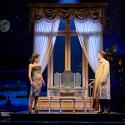
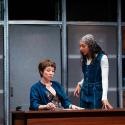
If you've been rolling your eyes at the rash of articles hailing London's ever-increasing number of dry bars, allow writer-director Ché Walker to convince you of their amatory relevance. In his new musical drama, smooth-talker Klook and hard nut Vinette fall for one another over a long tall glass of carrot juice, with just the right kick of ginger. The Park Theatre's 90-seat studio space here gives us two sexy strangers who meet randomly in the grimy health club where Klook works, only to find that the two are craving a metaphorical detox.
Walker, drawn once more into the American noir intensity he explored in his 2011 take, for Southwark Playhouse, on the John Patrick Shanley play Danny and the Deep Blue Sea, gives his (American) characters cleverly heightened speech. They tell us the story of their lives as if reading from their own co-authored novel, lines flowing like melted butter and turning into song as we are taken by the hand through the duo's various arguments, flirtations, and comebacks. Their newly-found trust allows a relationship forged from deep within life's vast darkness to emerge into the light, and actors Ako Mitchell and Sheila Atim are note-perfect. And accent-perfect, too.
 Klook, who grew up a ward of the state, is middle-aged and yet still the lost child. Vinette is young and troubled, convinced she's worthless. Both have heavily built-up defence mechanisms that often go into overdrive, which is what makes their relationship so absorbing. You never know what might set one of them off. With that in mind, it's almost a relief to find not much plot, at least until the final third of the play hits its stride and suddenly too much happens. Into this delicately constructed relationship come some glaringly odd plot developments, shocking violence, and a conclusion that isn't particularly convincing.
The music and lyrics, written by Walker, Anoushka Lucas and Omar Lyefook, become almost their own separate character as embodied by the musician Rio Kai. Sadly, that music only gets cheesier as the play goes on, and directorial choices like the projecting of certain lines onto a wall grow irksome. Utterances on the order of "you can't, you can't" and "like angels singing" (the latter phrase a none-too-helpful simile) distract us from the unforced poetry on offer elsewhere. Their repartee, meanwhile, is characterised as "sex of the mind", which sounds rather self-congratulatory on Walker's part.
Aspects of Walker's writing that start out funny only seem peculiar when repeated in a more serious context, such as the game-changing moment when Vinette finds Klook's gun and her sharp cusses are placed alongside more philosophical thinking. "This is antithetical to how I want to live!" she says, followed quickly by "You droppin' some worrisome shit on my head. I'm so angry I could shit!"
The intensity of the play's 90 minutes (no interval) and the mesmeric lyricism that forms its backbone appeared to blow the audience away on press night. But the gathering emphasis on more cloying lines and narrative potholes – an unnecessary police stand-off included – detract from its jazz-soaked charm. Instead of leaving me reeling from an awareness of life's futility, I was left frustrated by the sorts of plot specifics (the origin of the gun and ski-mask, for starters) that you shouldn't still be pondering come the final curtain.